
s in Montenegro -
A ‘temporary’ landfill in the Montenegrin city of Niksic has been a money-spinner for the owner of the land and the local municipality, but at what cost to the environment and respect for the rules?
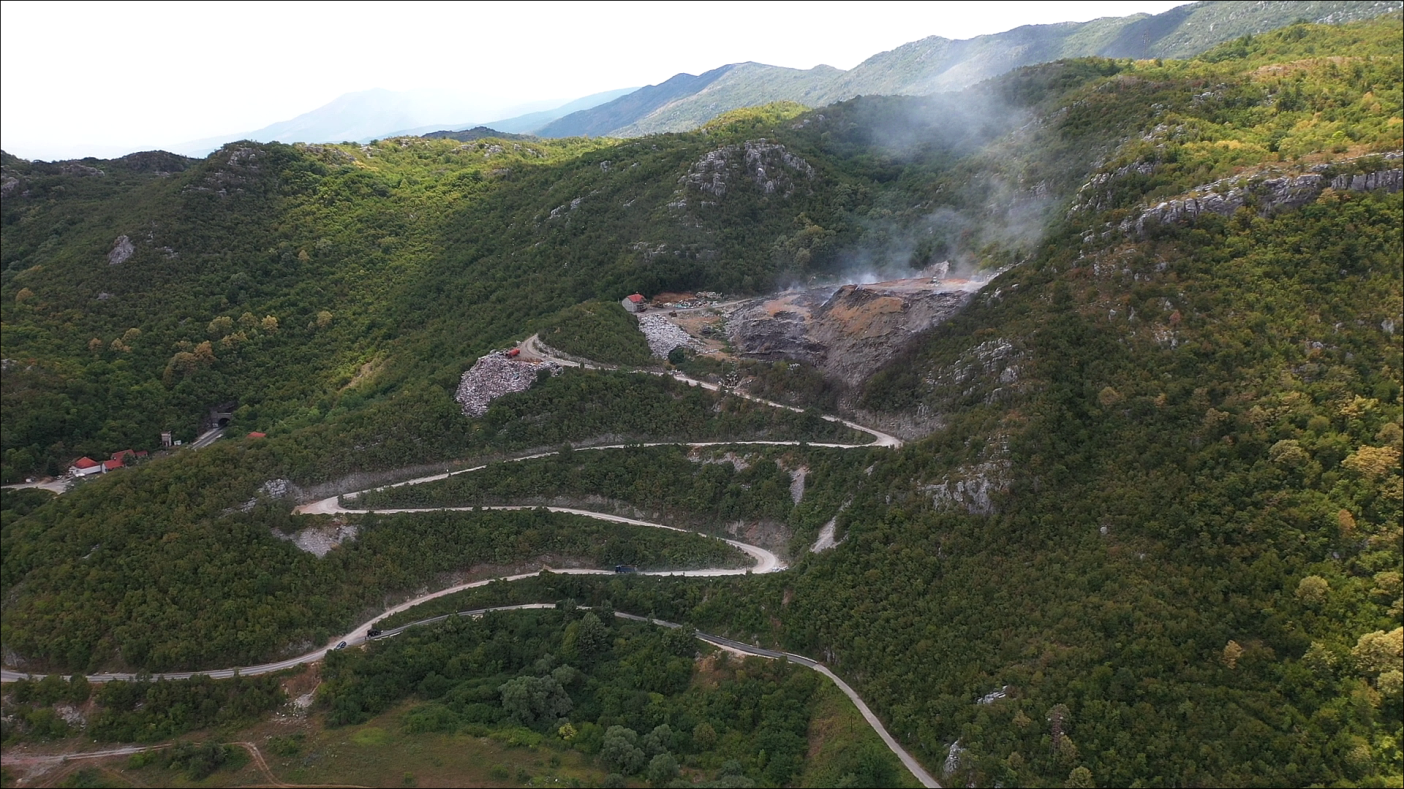
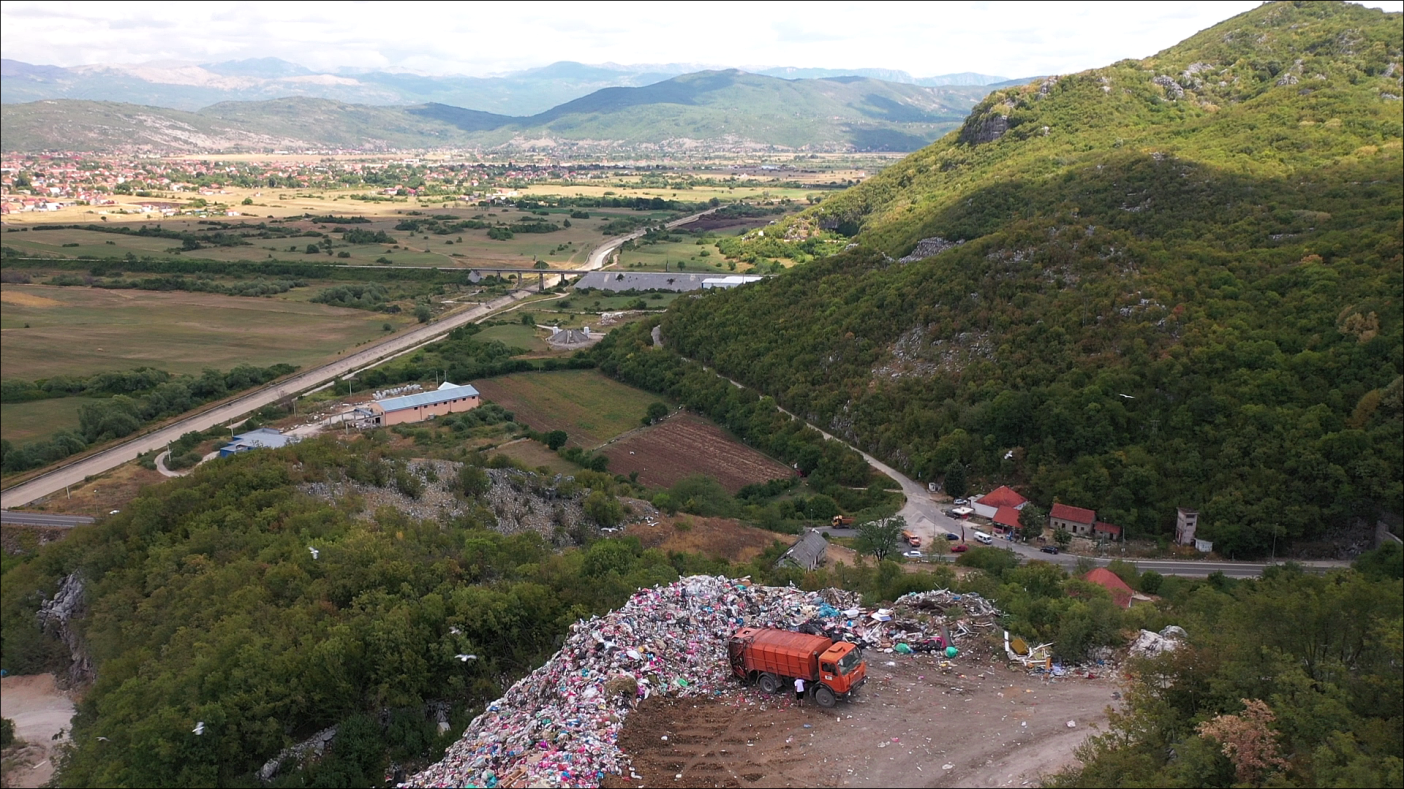
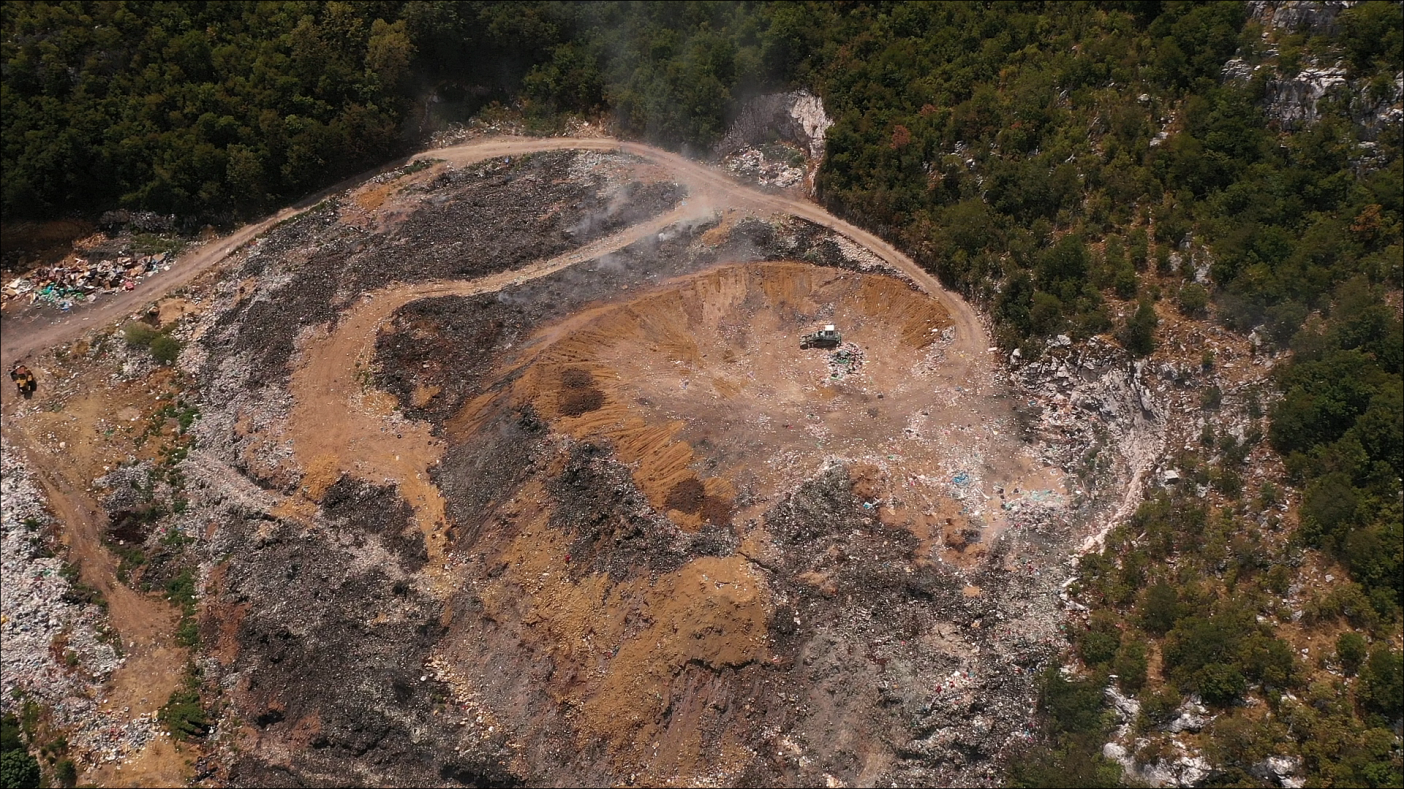
When public authorities in the Montenegrin city of Niksic rented two hectares of land on Budos Hill in 2003 as a garbage dump, it was supposed to be a temporary solution. Almost two decades later, 80-year-old Milka Simunovic says she fears the air from the landfill fires more than COVID-19.
“When a southerly wind blows, we can’t open the doors and windows,” said Simunovic. “I don’t know who can give the fruit here to their children.”
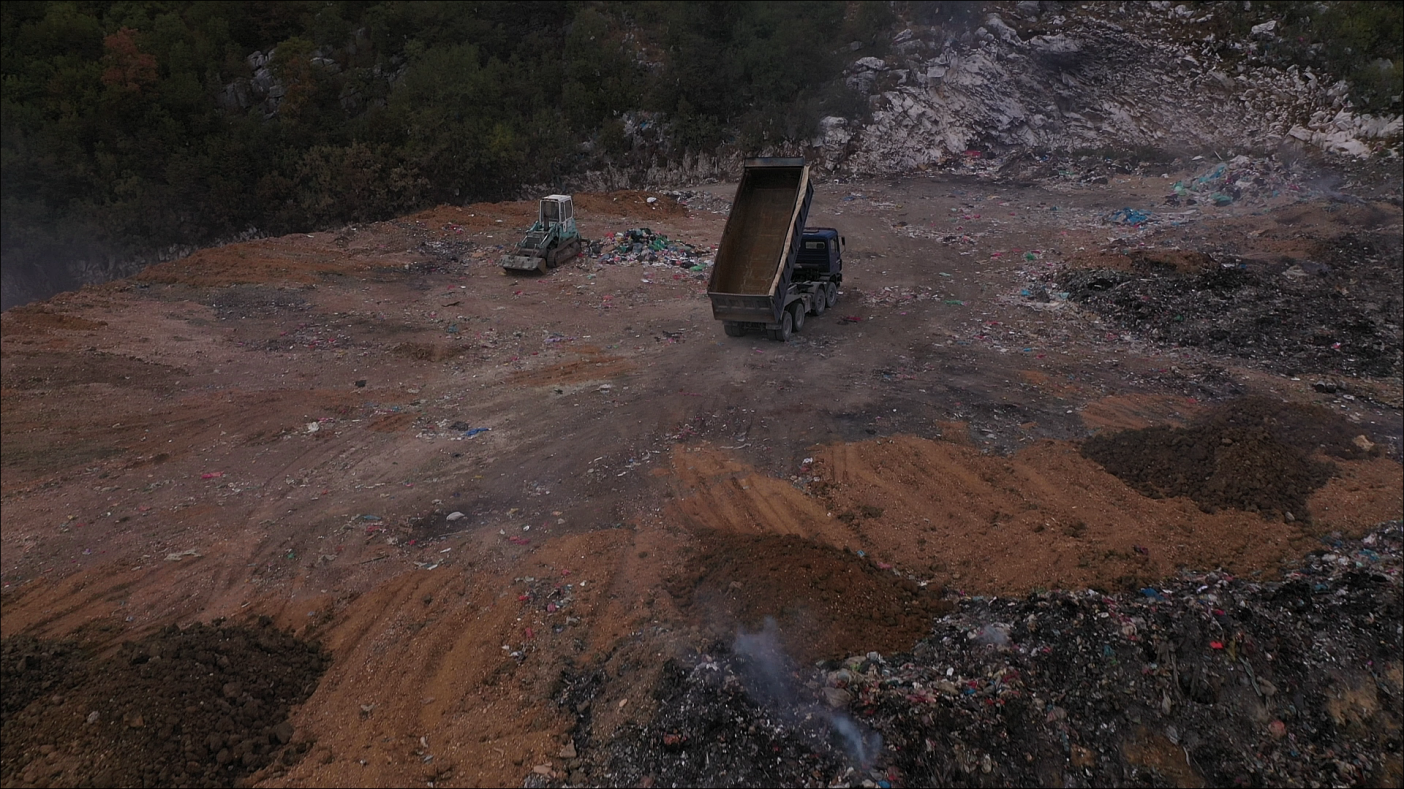
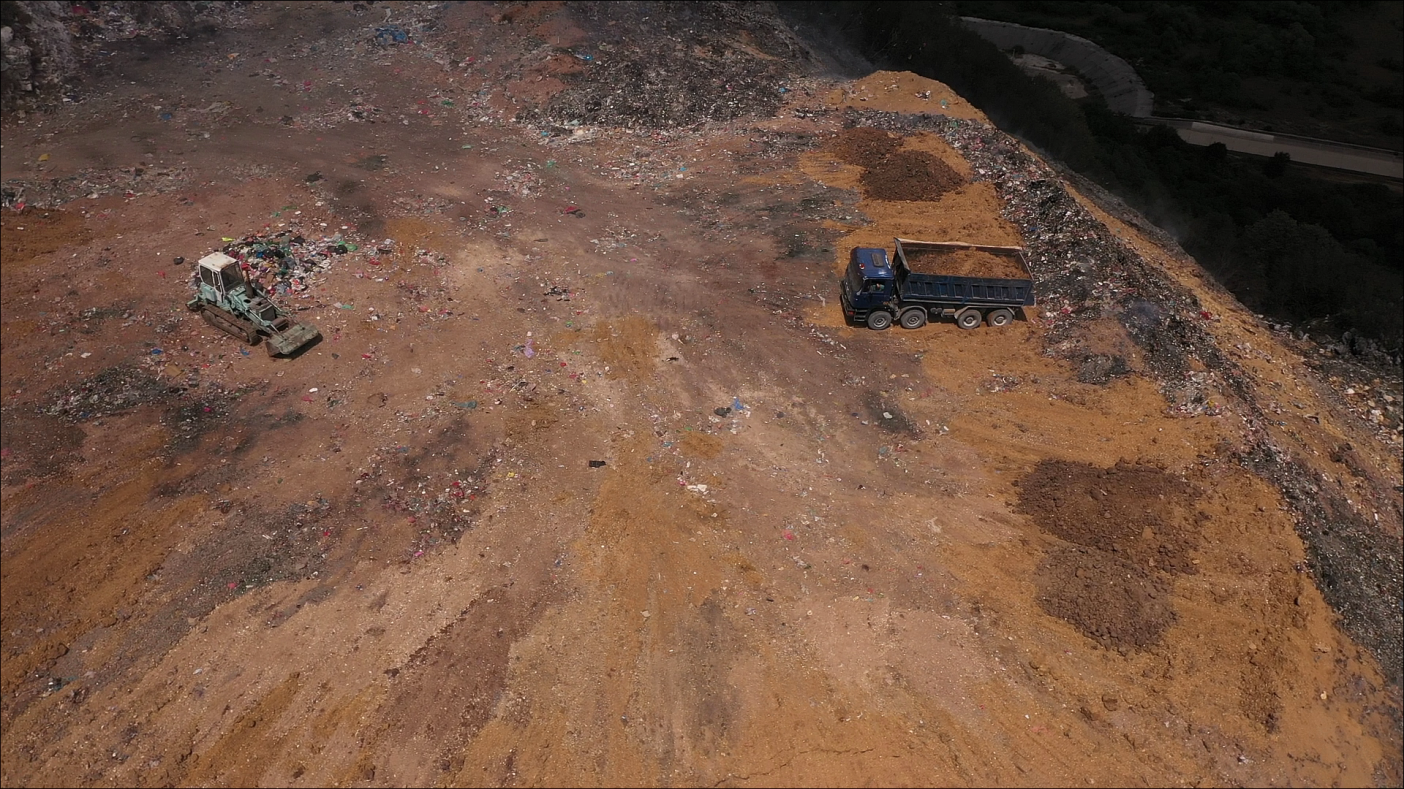
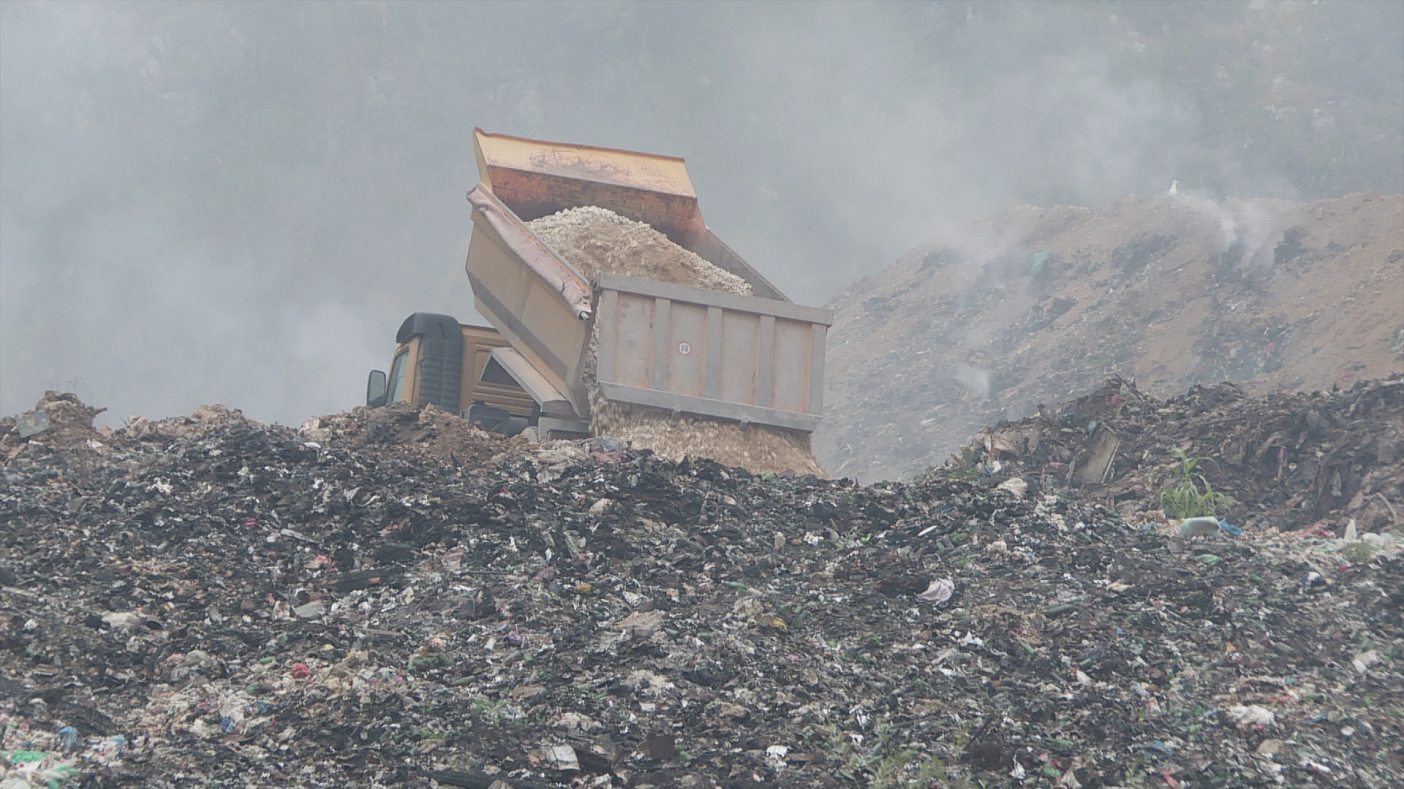
Every day for almost two decades, authorities in Montenegro’s second biggest city dumped 50 tonnes of garbage at the Mislov Do landfill, a few kilometres from the city centre. But it’s not just local waste that ended up there.
According to the findings of an investigation by BIRN and the Centre for Investigative Journalist Montenegro, CIN-CG, waste from other municipalities was disposed of at Mislov Do for years, in violation of the lease agreement, while municipal waste has been mixed with food, animal and chemical waste.
And it’s the people of Niksic who are paying the price, not just in the quality of air. Data obtained by BIRN/CIN-CG from the municipality shows that between 2003 and April 2021 – when the last contract expired – more than 420,000 euros in public money was paid to lease the plot, which, if sold, would not fetch more than 10,000 euros on the current market.
During that period, every month, the municipality paid rent of 2,400 euros to the owner of the land, Miras Djurdjevac, a former local assembly councillor and director of the company ‘Mislov Do’, which the municipality hired to maintain the landfill.
Mislov Do was founded by Djurdjevac’s son, Vukasin, who is engaged in the municipal Public Utility Company in charge of waste disposal and who was convicted alongside four others in 2014 over a brutal attack on journalist Lidija Nikcevic in January of that year.
Critics of the municipality’s waste management practices say the deal raises suspicion.
“It is a matter of private property for which the people of Niksic pay and pay for something that is illegal,” said Aleksandar Perovic, director of the Niksic-based environmental NGO Ozon.
“The law prohibits the mixing of hazardous waste with municipal waste and that is exactly why we say that this location is an environmental time bomb.”
Harm to air, water, soil
Since the contract expired in April last year, waste is no longer dumped at Mislov Do. A new dump will be opened nearby while a recycling centre is built.
According to the original lease agreement signed by Djurdjevac and then Niksic mayor Vera Miljanic in 2003, only communal waste from residential and business premises in Niksic and surrounding areas was to be disposed of at Mislov Do.
Yet municipality records show that waste was brought to the site from the coastal towns of Kotor in 2011 and 2012, Pluzine in 2013 and 2016 and Budva between May 2010 and June 2011, reaping tens of thousands of euros for Niksic municipality.
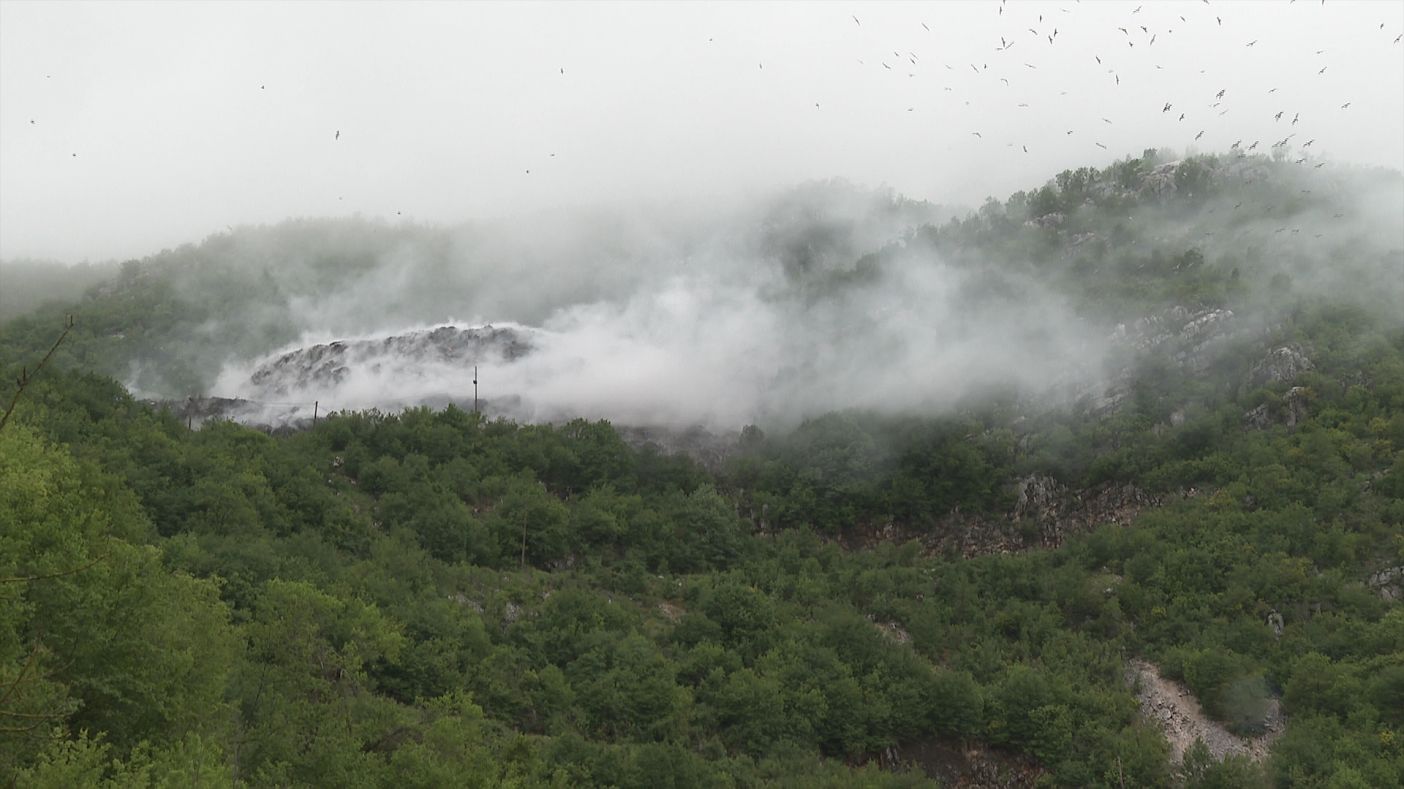
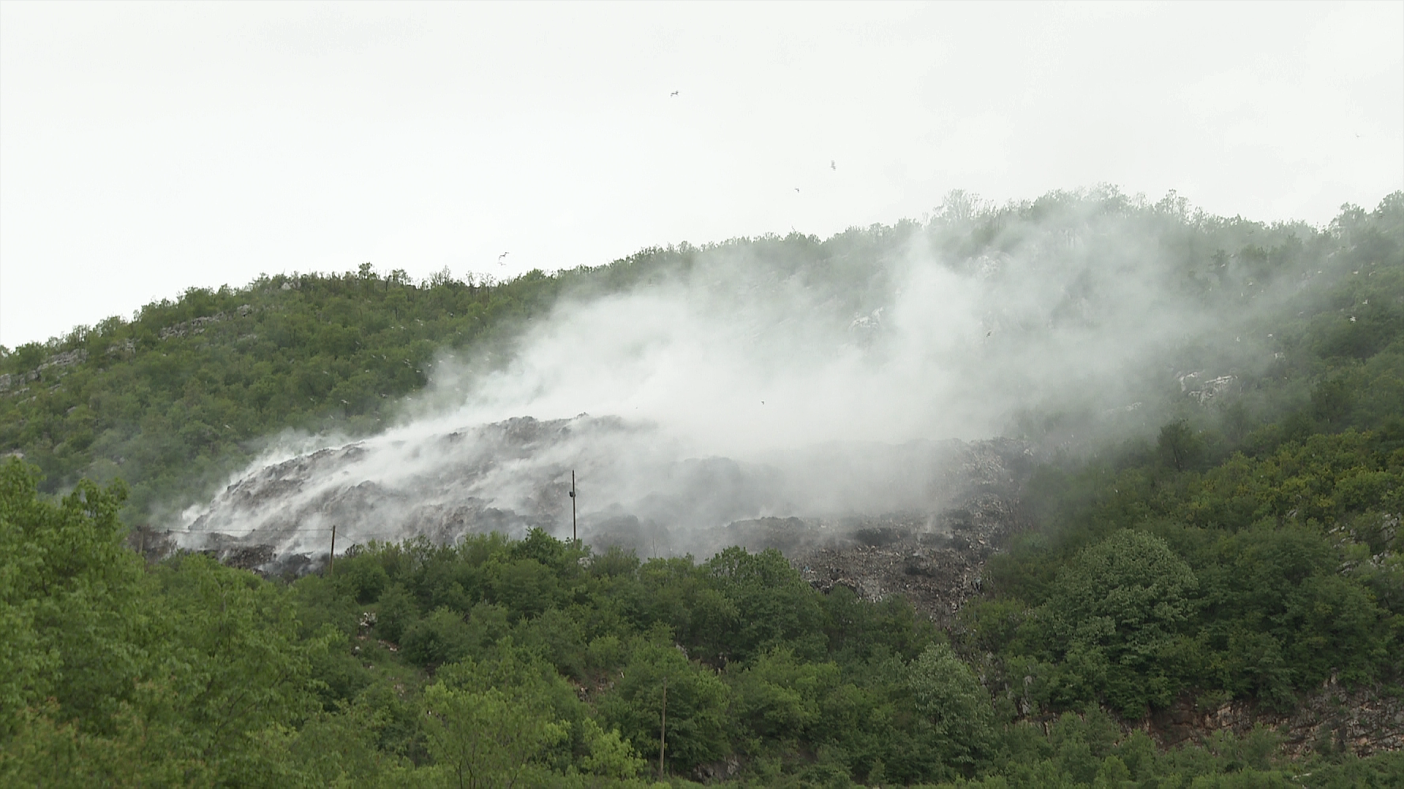
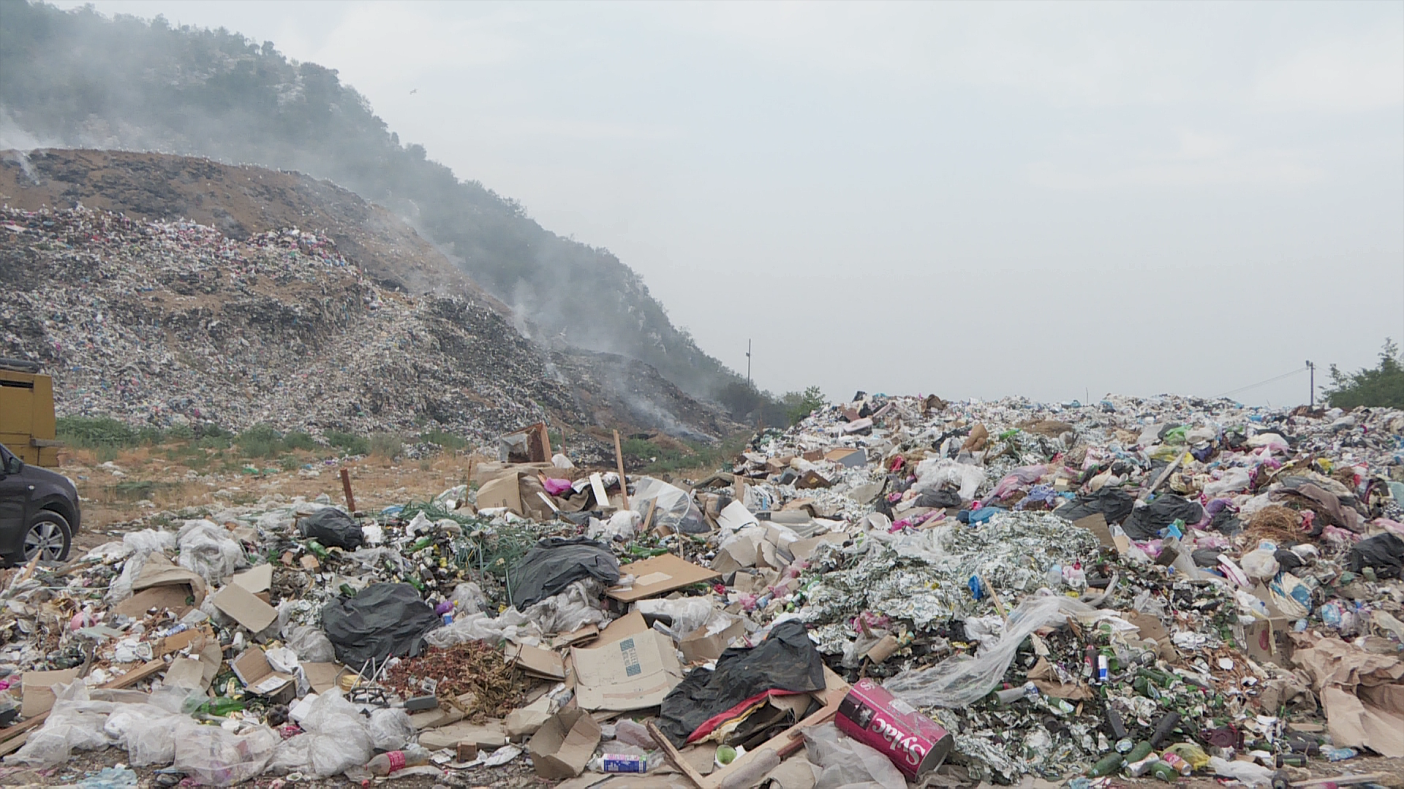
The Public Utility Company, Komunalno, also told BIRN/CIN-CG that waste from most private companies in Niksic is also sent to the site, meaning municipal waste is being mixed with food, animal and chemical waste. Fires burn regularly at the site, sending smoke into the air over Budos Hill.
Public calls for the site to be shut down have gone unheeded.
“How can we know what we are breathing?” asked Simunovic. “Everyone can feel the stench.” Her neighbour, Ranka Simunovic [no relation], said it was not worth mowing the meadow closest to the landfill. “I can’t bring hay from there to give to cows, because I can’t give that milk to my children later.”
Just in 2020, the landfill burned for 45 days consecutively, as long as in 2021.
“We have been warning for ten years that this will happen,” said Perovic, from Ozon. “It is not just about methane gases, but different types of gases that are by-products of plastic combustion, different types of hazardous waste.”
No tests have been conducted on the quality of air, water or soil at the landfill or its surroundings. The Institute of Public Health told BIRN/CIN-CG that it had no data on the impact on public health in Niksic.
Experts, however, say the potential harm is considerable.
Apart from fires that pollute the air, there is concern over uncontrolled runoff of water along the Zeta canal or through the karst base and into springs.
“We are talking about a formation that is like a sponge, full of canals, passages,” said Dusan Jelic, a doctor of biology at the Croatian Institute for Biological Diversity. “And every landfill and every disposal of materials inevitably ends up underground; you cannot prevent leaching.”
No one held to account
Under the Law on Waste Management, the landfill should have been closed down or brought into line with environmental standards in order to secure the necessary permits by 2012, the deadline for regulating temporary landfills.
Judicial authorities have ruled repeatedly that the landfill does not come under the jurisdiction of environmental inspectors, who work at the state level, but under municipal inspectors, who as yet have not sought to deal with it.
“As the Municipality of Niksic did not establish temporary waste storage in accordance with Article 78 of the Law on Waste Management, the Environmental Inspection did not have the authority to control and monitor the storage and temporary storage of municipal waste,” the state Environmental Inspection told BIRN/CIN-CG.
“The day we came to power we encountered Mislov Do as literally a burning issue,” said Niksic mayor Marko Kovacevic, who took office in May 2021.
Authorities are currently exploring the possibility of a regional recycling centre to cater to several municipalities. A feasibility study has been conducted and a location selected. The environmental damage done at the Mislov Do landfill would be repaired.
“It’s not just a problem to stop the work of the landfill; it needs to be rehabilitated, covered in some way, removed,” said Danilo Mrdak, state secretary at the Ministry of Ecology.
“A project should be announced for a conceptual solution for how to technologically repair that wound in space, in the environment, because it will continue to burn again, to emit what it is not allowed to emit and we must figure out a way to repair that area and solve what is, for Niksic, an extremely big black mark.”
Djurdjevac said he expects the municipality to honour the lease agreement and rehabilitate the site.
“My basic motive, when I offered it to the municipality, was to have a livelihood, to raise a family,” he told BIRN/CIN-CG.
Since then, the landfill has had a bad press, but few recall how much it meant to the city, Djurdjevac said.
“This landfill, let me tell you, is condemned at the moment as a villain, as an evil”, he said. “No one wants to remember that this landfill was the salvation of this city for almost 20 years. I didn't force anyone to sign or not to sign.”
Environmental inspectors powerless
Montenegro’s Environmental Inspectorate has initiated proceedings against Niksic utility company over its use of the Mislov Do landfill, without success.
“The regional authorities have taken the position that the motions were submitted by an inspection that is not competent to do so because it concerns municipal waste that is under the jurisdiction of the municipal inspection,” said the Inspectorate.
Under amendments made to the Law on Waste Management in 2012, the job of monitoring the temporary storage of municipal waste was moved to local inspection bodies.
The Ministry of Ecology also cites legal regulations according to which, since 2012, local self-governments must regulate their landfills.
According to the State Waste Management Plan of 2015, Niksic should have become a regional centre for the sorting and partial recycling of waste from the municipalities of Niksic, Savnik and Pluzine, but, like others, the plan never executed.
Irena RAŠOVIĆ

Small fines and a reluctance to pursue criminal prosecution have contributed to a culture of impunity for companies big and small that ignore the orders of environmental inspectors.
By Jelena Jovanovic
On November 7, 2013, environmental inspectors in Montenegro ordered local wine producer 13. jul-Plantaze to resolve the way it treats wastewater.
Two years later, having failed to comply, the company – which produces roughly 22 million kilos of grapes annually – was given a fine of 3,000 euros and a new deadline. When that deadline was missed, it was fined again, this time 4,000 euros. By December 2016, the fine was 5,000 euros, repeated in July 2017 and then again in February 2019.
And still the company, which claims to sell more than 16 million bottled products in over 40 countries around the world, did not comply with the order.
“The company has prepared project documentation for the wastewater treatment system, but large financial resources are needed to carry out the measures that have been ordered,” said chief environmental inspector Veselinka Zarubica.
13.jul-Plantaze said it had worked “intensively” on the issue and was waiting for “a stable financial situation” to resolve it.
“The whole time work is going on to optimise the solution for purifying wastewater, in order to find the most efficient and effective means of dealing with it,” the company said.
It is far from alone, however, in failing to act immediately on the orders of environmental inspectors in Montenegro, who rarely escalate cases beyond misdemeanour proceedings, according to the finding of an analysis by BIRN and the Centre for Investigative Journalism in Montenegro, CIN CG.
And it’s the water, land, air and people of Montenegro that are paying the highest price, say environmentalists.
“We have hundreds of examples that prove that the laws are just words on paper and that the system does not work”, said eco activist Aleksandar Dragicevic.
Fines having little effect
According to data obtained from the Judicial Council, since the beginning of 2016, 534 cases have been opened in Montenegrin courts on the basis of alleged criminal acts against the environment and spatial planning.
But 411 of those concerned illegal wood-cutting; only six were for environmental pollution, none of which ended in convictions.
Instead, the Department for Environmental Inspection relies heavily on fines and misdemeanour proceedings, which carry far less damaging consequences for the guilty party.
In the records of dozens of misdemeanour cases that BIRN obtained via Freedom of Information requests, the biggest violators, besides Plantaze, are Gradir Montenegro, owner of the Suplja stijena lead and zinc mine in Pljevlja, scrapyard WEG kolektor D.O.O. Berane, the steel mill Toscelik Steel and state-owned electricity firm Elektroprivreda.
In many cases, the issues identified by inspectors have not been resolved regardless of the fines imposed.
In 2015 alone, Zarubica filed five requests for misdemeanor proceedings against Turkish-owned Toscelik, based in Montenegro’s second city of Niksic.
In March of that year, Toscelik was ordered to obtain environmental consent from the Agency for Environmental Protection for an environmental impact assessment for part of its operations. When it failed to do so, Zarubica filed for misdemeanour proceedings in June. Then again in October. She filed three more requests in December for other shortcomings, including one concerning the way the factory deals with waste.
Then three years later, in January 2018, Toscelik was reprimanded again for violating the law on integrated pollution prevention and control, according to documents obtained by BIRN and CIN CG. The company ceased operating in 2021.
Likewise, between 2017 and 2019, WEG Kolektor was fined repeatedly over its handling of toxic waste, including failure to measure pollution in the air. In May 2017, inspectors ordered the company to dig a third well for waste, only to find two years later that it had not.
In documentation handed over to state prosecutors on November 6, 2018, the Agency for Environmental Protection complained that “none of the steps taken so far by environmental inspectors concerning the subject under monitoring have had any effect.”
Meanwhile, Gradir Montenegro was ordered in September 2013 to fix pipes at its lead and zinc mine that inspectors discovered were leaking into the Mjednik stream and turning the water cloudy, as well as a faulty pump. The company was ordered to fix the pipes, which it did.
Six years later, the Cehotina river, into which the Mjednik flows, was polluted. Authorities were unable to prove that Gradir caused the pollution because officials from the Institute for Public Health failed to turn up to take water samples on November 15, 2019, according to records made by environmental inspector Irena Popovic and seen by BIRN and CIN CG. Gradir was ordered to remove the pipes altogether.

Dragicevic, the eco activist, said smaller polluters were only following the example set by bigger polluters.
He called for a proper penal policy, law enforcement and reform of the inspection system, warning that “trust in the institutions must be built before it is too late.”
“Because when we reach a point of no return, when anyone can kill what they want with a rifle in the woods, when tons of fish are killed with dynamite every day, when the forest is cut by whoever wants to, wherever they want, without fear of consequences soon we will have nothing to protect and it will be too late.”
‘Nothing but devastation’
Radojica Bulatovic says that the very air he breathes is affected by the failure of authorities to hold polluters to account.
He and other residents near the Cijevna river in Golubovci, southern Montenegro, blame the road contractors Putevi and Tehnoput for the dust in the air and excrement in the river, which both companies scrape for gravel.
“They take the state’s treasures and these people produce asphalt using such outdated technology that they poison us. They are killing us with stone dust,” said Bulatovic.
He accused inspectors of “resolving everything over the phone” and questioned the effectiveness of the “ordinary, small sprinklers” installed to keep down the dust. “If they continue like this, we’ll have to move out,” Bulatovic told BIRN and CIN CG.
Residents say they have appealed to the Directorate for Inspection Affairs on several occasions. Two years ago, the directorate replied that both companies had the necessary permits, had installed water systems to keep down dust and that one of the firms had even planted a “small pine wood” to stop the spread of dust.
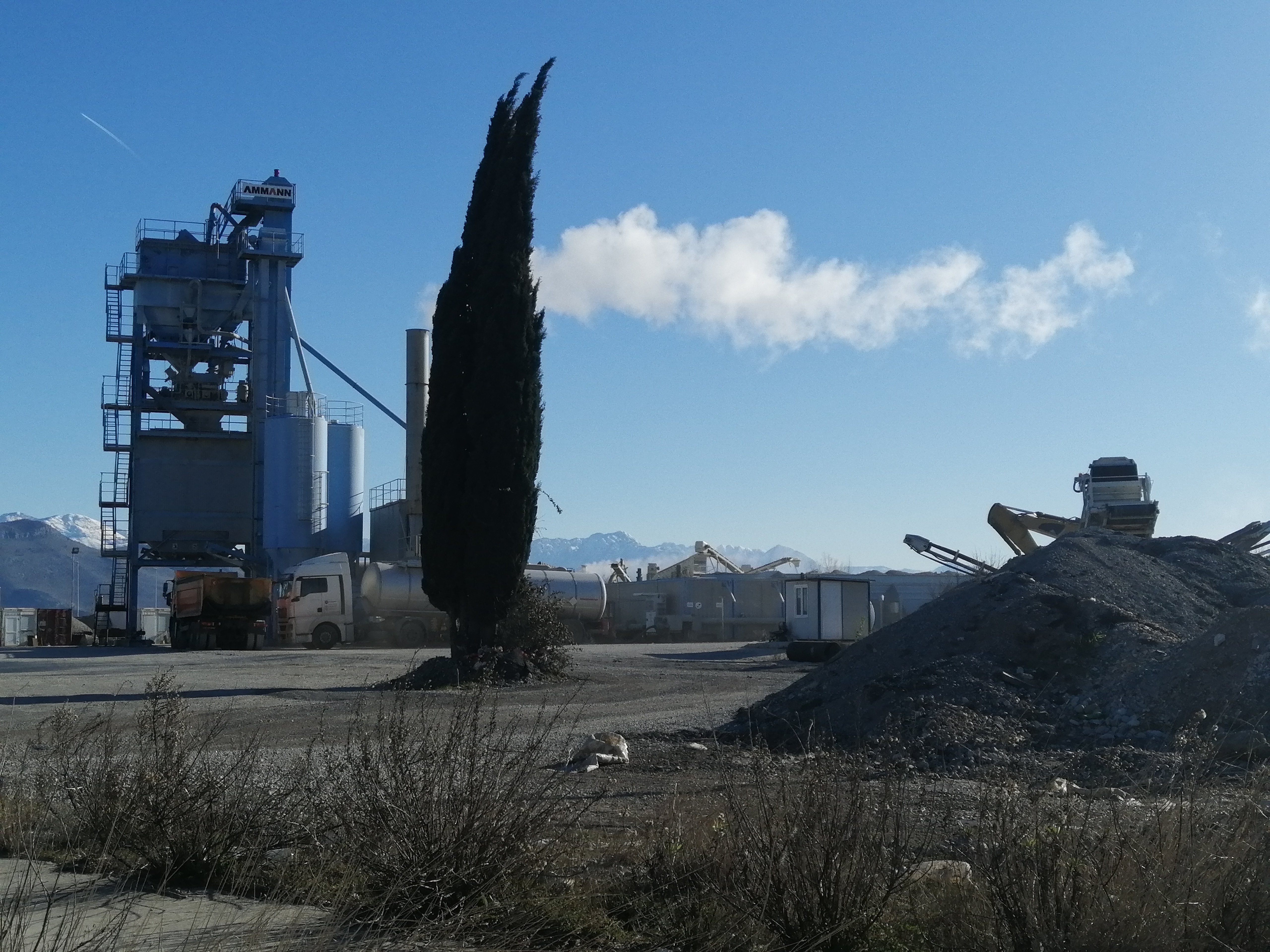
In a response to BIRN and CIN CG, the Directorate said that its inspectors “regularly monitor the companies Putevi and Tehnoput” and that, in response to the concerns of residents, had repeatedly ordered monitoring of air pollution in the air and that Tehnoput would be relocated.
To make matters worse, major polluters in Montenegro have been dodging environmental taxes and contributions for years.
For example, Niksic-based Uniprom, which owns aluminium producer Kombinat Aluminijum Podgorica KAP, was ordered this year to pay just over 800,000 euros in unpaid environmental taxes and fees. On November 25, Uniprom owner Veselin Pejovic was arrested on allegations he threatened the head of the Agency for Environmental Protection. By then, Uniprom had paid some of the money back but still owed just over 670,000 euros.
In total, the Agency ordered firms to pay around 1.3 million euros in taxes and fees this year, a sum that included debts from previous years. Around half that amount had been collected by the time of publication of this story, compared to roughly 300,000 euros annually in previous years.
Milos Lazarevic, executive director of the NGO Coalition for Sustainable Development, KOR, said that a raft of international conventions and agreements that Montenegro had signed up to, not to mention its obligations on the road to European Union accession, had little effect.
“To make matters worse, the previous government concluded a number of agreements that are unconstitutional and passed a series of urban and other plans that would permanently devastate even UNESCO-protected areas, not to mention rivers and lakes,” Lazarevic told BIRN and CIN CG.
“In the absence of a system of rule of law, some citizens pointed out anomalies in society through organised action and thus inspired others to jointly put pressure on the institutions of the system to finally start doing the work for which they are paid from the citizens’ money,” he said.
“There is a critical awareness and desire among the citizens, but as long as the legislative, executive and judicial authorities do not realise that the emperor is naked and do not take responsibility… in ten years there will be nothing but devastation.”
Seven Montenegrin municipalities were offered multi-million-euro grants in 2012 to build essential wastewater treatment plants to prevent sewage polluting rivers and the sea, but no construction work has begun yet, and as years pass, the potential cost keeps rising.
Rozaje was intended to be one of the first municipalities in Montenegro to get a wastewater treatment plant to process domestic sewage in order to ensure that the water that is discharged into rivers, lakes and the Adriatic Sea is relatively clean.
From 2011 to 2014, the municipal authorities in Rozaje managed to conduct a feasibility study for the plant, select a location and include it in the municipality’s urban spatial plan.
The next phase was the construction of the wastewater treatment system. A grant of 200,000 euros was provided from the European Union’s Instrument for Pre-Accession Assistance, IPA, for a feasibility study; the municipality of Rozaje also borrowed around 2.8 million euros from the European Investment Bank for the construction, while a grant of 700,000 euros was provided from the European Fund for the Western Balkans.
But in 2014, the Democratic Party of Socialists, which had run Rozaje for two decades, lost power in the municipality.
The new municipal authorities, led by the Bosniak Party and the Social Democratic Party, then suddenly decided to build the wastewater treatment plant at another location.
As a result, the site study had to be carried out again but the new authorities could not get the money from the EU’s IPA fund. The money was instead diverted to resolving wastewater issues in other municipalities which were more prepared to build plants.
The municipality of Rozaje told BIRN and the Center for Investigative Journalism of Montenegro, CIN CG, that the reason for the change of location was because the facility would have been too expensive at the original site because a pumping station would also need to be built there.
“Although the study predicted that [original] location was the best, it was considered that this solution should be abandoned,” the municipality said.]
This is just one example of how several Montenegrin municipalities have been left without wastewater treatment plants due to poor decisions by the local authorities, which have also failed to take advantage of the money that was granted to them for the projects.
BIRN/CIN CG’s research shows that seven Montenegrin municipalities - Rozaje, Plav, Bijelo Polje, Kolašin, Danilovgrad, Cetinje and Ulcinj - lost the chance to receive more than ten million euros that had been pledged through grant schemes for the construction of the wastewater treatment plants.
The municipalities’ failure to build the plants will also cost Montenegro’s state budget almost 20 million euros, because years of delays have led to increased costs for construction.
The construction of the wastewater treatment plants is one of the obligations to which Montenegro has committed itself while negotiating Chapter 27 of the body of legislation that the country has to harmonise with EU standards in order to move towards membership of the bloc – the chapter covering the environment and climate change.
As Montenegro’s membership negotiations continue, the plants still have to be built, although they will cost the municipalities much more than previously planned.
Delay means more river and sea pollution
Azra Vukovic, executive director of the Montenegrin environmental NGO Green Home, told BIRN/CIN CG that any delay in the implementation of projects to build wastewater treatment plants contributes to the deterioration of the quality of water in the country’s watercourses and increased concentrations of pollutants, and has a negative impact on river and marine life. She also argued that pollution has an indirect impact on public health.
“The lack of spatial planning documentation, the lack of project documentation, the lack of human capacity to lead these processes and the lack of financial resources that needed to be provided in order to use donor or credit funds are just some of the reasons that prevented the implementation of these projects,” Vukovic explained.
She argued that there are several reasons for the problems that have arisen. One of them, she believes, is the lack of capacity at the local level to prepare and lead such large and demanding projects. Local authorities, do not sufficiently recognise the importance of such projects, she said - particularly because their implementation is a long and demanding process.
In some towns, there is also the problem of “illegally constructed buildings at the location intended for the construction of the plant”, Vukovic added. Sometimes extra cost is also incurred because land needed for the plants is privately owned and has to be bought by the municipality.
“Another reason for these projects slowing down lies in the fact that local authorities often do not want to implement projects that will ultimately produce an obligation for citizens to pay additional fees for such services, and therefore they prolong their implementation,” she claimed.
Wastewater flowing into the River Ibar
The municipality of Rozaje, after losing its initial funds from the EU’s IPA, was fortunate enough to get money for the construction of the plant again in 2019.
However, whilet over three million euros were initially allocated to build the plant, the government’s Municipal Wastewater Management Plan for 2020-2035 estimates that it will now cost just over five million. Along with the construction of a new sewerage network for the town, it is estimated that the total cost could go up to 12 million euros.
PROCON, a government-established unit for implementing utilities and environmental protection projects, said that the construction of a system for collecting, draining and treating municipal wastewater is one of the main priorities when it comes to environmental protection.
Wastewater from Rozaje is currently flowing into the River Ibar, about ten kilometres from its source. According to water quality monitoring by the Environmental Protection Agency, in 2018, the Ibar was among the most polluted rivers in Montenegro.
“This [treatment plant] project aims to improve the treatment of wastewater in the area of Rozaje, and thus reduce the negative effects of pollution of the River Ibar,” said PROCON.
The municipality of Rozaje said that the wastewater project now has “a high degree of readiness for financing”, but that the municipality needs more assistance because “this project, in terms of its scope, significance and value, exceeds our current organisational and financial capabilities”.
Unresolved financing issues
A total of 5.2 million euros were allocated by 2012 for the construction of a plant to serve the municipalities of Plav and Gusinje - more almost five million through the EU’s IPA pre-accession programme, and the rest in a loan from the European Investment Bank.
The plant, however, was not built, and the money allocated through the IPA programme was not handed over. Currently, wastewater in the Plav municipality is discharged into the rivers Lim, Vruja and Grncar without being treated beforehand. In 2012, the validity of the study on the impact of the plant on the environment expired. Due to the municipality’s inability to take a loan, it remains uncertain when the project will begin.
The municipality of Plav claims that work on the preparatory documentation for the plant began at a time when it was also responsible for the local community in Gusinje, which later received the status of a municipality.
After Gusinje became a municipality, its representatives expressed reservations about the plan. “They did not agree with the proposed solutions, because all populated areas were not covered by the planned works,” the Plav municipality said.
The Montenegrin government’s Municipal and Wastewater Management Plan states that the plant, which would deal with the wastewater from both Plav and Gusinje, would cost about 4.2 million euros - one million less than in the previous plan. However, it is uncertain how the municipalities will get this money.
“The project is planned to be financed through a credit arrangement with the EIB [European Investment Bank], but as municipalities are not able to borrow, defining the financial structure of the project is an open question at this time,” PROCON said.
Opposition to plant construction in Danilovgrad
The construction of a wastewater treatment plant in Danilovgrad has sparked a dispute between the settlement of Landza, the intended site of the plant, and the municipality. Danilovgrad’s sewage currently flows directly into the River Zeta, although its waters and banks were declared a ‘natural park’ by the government in 2019.
This caused locals in Danilovgrad to launch a campaign to stop the plant being built at the site, which is a few hundred metres from houses, kindergartens, primary schools and the local health centre.
The project was launched about ten years ago but the campaign for the plant to be built elsewhere has stalled the construction. “As a group of citizens opposes the construction of the WWTP at the planned location of Landza, and the contractor has already been contracted, a solution has yet to be found,” PROCON said.
Back in 2010, the state of Montenegro signed a contract with the European Bank for Reconstruction and Development to borrow 5.35 million euros to build the plant in Danilovgrad. According to a 2012 PROCON report, 960,000 euros were set aside for the construction of the plant, while almost three million were set aside for the construction of the wastewater collector and sewerage network. But since then, the costs have increased significantly.
At the project’s presentation on September 9 this year, the municipality of Danilovgrad said that the contract with the contractor had already been signed and that a change of location could lead to international arbitration and cost the state money. The European Bank for Reconstruction and Development announced at the meeting that it had blocked the funds for the plant a few months beforehand.
Municipalities seek more money
By 2012, 1.2 million euros had been earmarked to build a wastewater treatment plant in the municipality of Kolašin. Almost one million euros was a loan with the European Investment Bank, while 200,000 euros were provided from EU pre-accession funds for the development of the project.
The project has been developed, but the municipality of Kolašin has not yet managed to provide funds to take it any further, and it has not yet been built. PROCON said that the municipality was not able to borrow on a larger scale in order to implement the project. Now, with the support of the state and PROCON, it has prepared an application to international financiers.
In the Cetinje municipality, 6.4 million euros was set aside to build a wastewater treatment plant in the village of Dobrsko Selo, most of it in the form of loans from the European Investment Bank, plus more than 1.6 million in grants from the Western Balkans Investment Fund.
So far, it has not been built. PROCON said that there are still several unresolved issues connected to the location for the plant and some of the routes for bringing wastewater from the city. Other sources of financing are also needed.
The project to build the plant and its accompanying infrastructure is directly connected to the project for the drainage of flood and rain waters from the city, through a tunnel to be constructed in Belveder, a location a few kilometres outside the city.
However, the Cetinje municipality said that the municipal Public Works Administration has not yet announced a tender for the construction of the tunnel, which is why the tender for the plant has not been completed yet.
“We must emphasise that we do not have information about when the Public Works Administration plans to announce a tender and realise the works that are a precondition for the realisation of activities on the design and construction of the WWTP,” the municipality said.
The Public Works Administration did not answer BIRN/CIN CG’s questions about when it will announce the tender for the tunnel.
Delays and illegal constructions
The municipality of Bijelo Polje, like the municipalities of Rozaje and Plav, has lost access to money from the EU’s pre-accession IPA fund to build its wastewater treatment plant because of delays. Bijelo Polje was allocated 1.7 million euros but was not able to borrow the additional amount needed to complete the funding and start the project.
In addition to that money, another 2.3 million euros in loans were secured from the European Investment Bank and 700,000 euros from the Western Balkans Investment Fund.
However, of all the municipalities whose projects have seen delays, Bijelo Polje has progressed the furthest and it is expected that by the end of the year, it will announce a tender for the design and construction of its wastewater treatment plant.
“It is realistic to expect that the tender will be announced in the next few months,” the municipality said in mid-September.
Meanwhile in the municipality of Ulcinj, although more than six million euros were provided for the construction of a wastewater treatment plant in 2012, the project was in deadlock until the end of last year.
According to estimates made by the municipality, about 15 million euros will be needed for the construction of the plant. But an even greater problem than the financing is the location for the construction of the plant.
During the ten years of waiting for the construction of the plant, several illegal facilities were built at the site. The municipality of Ulcinj said it is currently working on “an analysis on overcoming this situation”.
Montenegro faces 2035 deadline
As a candidate for EU membership, Montenegro opened negotiating Chapter 27 at the end of 2018. Water quality is one of the criteria that Montenegro has to meet, with the obligation to build systems for the collection and treatment of wastewater in all its municipalities by the end of 2035.
Environmental activist Azra Vukovic said that about 47 per cent of the population of Montenegro is currently served by wastewater collection services. The treatment plants that do exist are also not working to their full capacity to treat wastewater, she warned.
“However, the biggest problem is in those municipalities where plants do not exist and the collected wastewater is discharged directly into the sea or other water recipients,” Vukovic said.
“By discharging untreated wastewater, various substances enter our rivers and seas that have negative impacts on water quality, but also on the aquatic organisms that live in them.”
Ivan ČAĐENOVIĆ
ilustration: Igor VUJIČIĆ

DESPITE THE CLEAR MESSAGE OF THE EUROPEAN UNION THAT FOSSIL FUELS ARE THE PAST, AND THAT THE FUTURE IS RESERVED FOR ENVIRONMENTAL AND RENEWABLE ENERGY AND DESPITE BAD EXPERIENCES FROM THE REGION MONTENEGRO STARTED DRILLING THE ADRIATIC BOTTOM. ENVIRONMENTAL ACTIVISTS ANNOUNCE THAT THE PROTESTS WILL BE CONTINUED AFTER THE TOURIST SEASON
Branko Vujičić, an experienced fisherman, searches in vain for shrimp and prawns on the bottom of the Adriatic. The fish stock is declining, he says, and he attributes that to drilling the seabed in search of oil.
"They live on the bottom of the seafloor so drilling is probably causing some vibration that affects the fish. There are no shrimp anymore, we cannot catch even two kilos, and we used to catch a hundred. Their price has now dropped to three euros. This is not the case only in Ulcinj and Bar, but also in other cities – I have been fishing for them all along the coast, but it seems that shrimp are gone. Shrimp and sardines are food for all other fish ", Vujičić says in an interview for the Center for Investigative Journalism of Montenegro (CIN-CG)/Monitor.
The Topaz Driller giant metal jack-up rig started drilling operations looking for possible oil and gas deposits on March 25 on 20 kilometers from the coast, between Ulcinj and Bar. The investor, the Italian-Russian consortium Eni-Novatek, will search for black gold to a depth of 6,500 meters. Whether there is oil in the Montenegrin submarine will be known, allegedly, at the beginning of September.
The oil and gas exploration continues despite the warnings of environmentalists that this is a risky endeavor and violation of the Paris Agreement and the announcements of the new protests at the end of the tourist season. The fishermen's complaints regarding the decline in fish stock due to the drilling are also in vain. However, the drilling continues with the blessing of the current Government, which in this case continued the work of the previous Government.
Not even enough fish to cover the cost of fuel
In a statement for CIN-CG/Monitor, the Ministry of Capital Investments says that according to the information they have, "ongoing oil and gas research has not in any way affected maritime traffic and the work of the Port Authority. The traffic flow is normal and everything is in the right order."
"They forbid us to approach that platform within a few kilometers. And our sea is small, if I take a boat ride from Ulcinj in the morning, here I am in Croatia in the afternoon ", Vujičić, who is also the president of the Association of Professional Fishermen of Budva St. Nikola, says.
Dragoljub Bajković, president of the Association of Professional Fishermen of Bar, believes that fish from the seabed, including shrimp, began to disappear with the first seismic surveys that preceded the current drilling.
"A couple of years ago, seismic surveys were done, during which the pressure at the bottom was 3,000 bar. Then the fish from the bottom were killed, or migrated to the other side where there were no such surveys - towards Albania and Boka," he says.
Bajković is convinced that the current drilling will seriously affect fishermen.
"It affects the fishermen of Ulcinj, Bar, all the way to Čanj. They go fishing from morning to evening, 10 -12 hours, and bring a minimum of fish, enough only to cover the expenses of fuel. I catch bluefish and I went fishing 29 times from December to July - 10 times I threw nets, and 19 times I came back, because the fish wouldn’t bite. There are some underwater vibrations from drilling. The fish is running away like wild. Something is completely disturbed. And a lot of us make a living from fishing.”
Before the start of drilling, a meeting was organized with the representatives of the fishermen's association at the Ministry of Capital Investments.
"Fishermen told them that they were not looking forward to that research, but if the state decided to carry out these explorations, we must accept it," Milun Anđić, president of the Association of Vessels of Montenegro, says.
At the request of fishermen to form an equalization fund that will help the development of fisheries, the Ministry answered that it will be formed as soon as oil exploration begins.
Government: Everything is fine
"We emphasized the importance of environmental protection and received assurances that they have quadruple systems. They explained to us that the depth at which oil is extracted is 110 meters and that it is accessible to divers, devices, valves so that in case of a leak everything can be closed immediately. They gave guarantees that the ships specialized for oil leaks are ready in Italian ports and that they could be there in 10-15 hours to suck up the oil ", Anđić says.
He assesses that the fishermen had no choice and that they gave tacit consent to the assurances that the fishing industry and the oil industry could work together.
According to Anđić, previous research on fish stock was done arbitrarily and not properly. That is why the fishermen complained to the institutions: "That research was carried out by ships that aren’t specialized. No fishing boats were taken. It was all financed by investors. "
Bajković also says that the investor and the Institute of Marine Biology should have determined the initial state of the fish stock during this year, which, as he says, does not exist.
"The Institute of Marine Biology did not conduct a study of the impact on fisheries. It monitored fishing activities before and after seismic, i.e. analysis of the catch structure of small-scale coastal and large-scale commercial fishing. We are not engaged in current activities related to the platform in terms of fisheries monitoring. We may be involved after the completion of activities related to the platform", Dr. Aleksandar Joksimović, director of the Institute of Marine Biology, says for CIN-CG/Monitor.
The beginning of drilling was marked with environmentalists' protests who pointed out the numerous environmental risks of this exploration, while the new Government convinced them that there was no room for anxiety. Prime Minister Zdravko Krivokapić said that the concession agreement, signed in 2016, was rarely a good decision made by the previous Government. He also assessed that the possible impact on the environment is negligible.
Environmental organizations and activists voiced their opposition to the start of drilling, while the ruling Civic Movement United Reform Action (GP URA) called for a referendum. The Prime Minister suppressed the opposing views by claiming that the termination of the deal with Eni-Novatek would cost the state around one hundred million euros and that the referendum would be technically unfeasible in the conditions of the corona crisis, at a cost of around two million euros.
Minister of Capital Investments Mladen Bojanic also claims that this is a good project. He has said many times that potential oil and gas reserves are measured in billions of euros.
Bojanic: It's all at their expense
"The main characteristics of the contract with the Eni-Novatek consortium are that Montenegro has not invested a single penny in the research and that the concessionaires bear all the costs," Drasko Loncar from the Ministry of Capital Investments told Monitor/CIN-CG. He explains that Montenegro has provided guarantees, "on the mandatory work program", and that the concessionaires have unlimited and joint liability to compensate the damage and lost profits to the state and third parties in case of an incident, and most importantly, that the state provided profits between 62 - 68 percent.
Loncar explains that the obligatory work program that the Eni-Novatek concessionaires have committed to includes: 3D seismic research, geological and geophysical studies, and two exploration wells of 6,500 and 1,500 meters.
In case the concessionaire does not fulfill the obligatory work program, according to Loncar's explanation, Montenegro could activate the guarantee of 84 million euros that it has provided and possibly hire another company to continue with exploration.
The Ministry of Capital Investments points out that, if no commercial hydrocarbon reserves are found, the entire cost of exploration will be borne by the concessionaire, without any obligation on the part of the state to participate in it.
"This is a business that is unprofitable, risky, and harmful to the environment and the economy of Montenegro, primarily tourism and fishing," Mustafa Canka, a journalist dealing with this issue for decades, stated.
He points out that the officials are only talking about financial benefits and percentages, without publicly stating that "in the best case, in their most optimistic scenario, we can earn around 60 million euros a year. And only in a few years."
"To find oil, more wells need to be drilled, more analyzes conducted, so in the best case the exploitation would start in three years. Until then, we will question everything, especially tourism from which in the case of a good season, the state earns a little over a billion euros, while at least a third of the income remains in the gray zone ", Canca says for CIN-CG/Monitor.
A romantic turtle saga
He wonders if it is profitable if we compare 1.3 billion with 60 million. He stated that guests from the West are not thrilled to have a view of the oil platforms. He notes that the damage done to the flora and fauna in the sea will never be calculated, as will the damage suffered by fishermen.
However, the Ministry of Ecology, Spatial Planning and Urbanism is not worried about this project and its impact on the environment. In addition to the obligation to respect domestic regulations that regulate the field of environmental protection, this Ministry also states that the contract envisages two special mechanisms for compensation of possible damage. The first is the Parent Company Guarantee of the concessionaire which covers payments of all obligations under the contract in case of non-performance, as well as all non-contractual obligations to third parties in case of direct damage or losses incurred in connection with these activities (including pollution or incidents). This guarantee, as they explain in the Ministry, means that the concessionaires guarantee the value of the parent company and not the one registered in Montenegro, which is incomparably smaller.
The second mechanism is the Mandatory Comprehensive Insurance Policy for the Oil and Gas Industry, which covers the complete operations performed by the Eni operator, including all their subcontractors.
"Montenegro has ensured that in case of any damage to the environment, it has the possibility of reimbursement of costs, including damage to third parties. In this particular case, that means, for example, that the compensation for possible damage would be paid to the fishermen as well ", they say from the department that also deals with ecology.
The Ministry of Capital Investments also claims that "a large number of ecologists" have a positive opinion on the project, as well as on all the studies done on the protection and preservation of the environment.
"The commitment of the concessionaire towards the environment should be emphasized. For example, during the seismic research, a turtle appeared in front of the ship and the operations were suspended until it moved away to a safe distance. The cost of waiting or stand by installment was about $ 150,000. Therefore, we emphasize that the concessionaires have high standards when it comes to environmental protection ", they say from this Ministry.
The oil spill response exercise
Zenepa Lika, an environmental activist from Ulcinj, is not convinced of these standards, claiming for Monitor/CIN-CG that this venture is risky. She explains that it relies on an environmental impact assessment study conducted by the investor.
"The Environmental Protection Agency (EPA) returned the document for revision several times, which means that Eni did not respect Montenegrin legislation. As far as I know, there is no contingency plan in case of oil spills, techniques and projections for recovery ", Lika claims.
The Environmental Protection Agency confirmed that the Environmental Impact Assessment Study, carried out by Eni Montenegro, and prepared by Italian experts, was not done following the rules. In October 2019, the Agency requested certain amendments from the project holder. The revised Study received the consent of the Agency in December of that year.
The Ministry of Capital Investments claims that in case of emergency, there are plans: "There is a reaction plan of the concessionaire, a reaction plan of Montenegrin institutions responsible for this project, as well as a reaction plan in cooperation with the concessionaire." Also, in June, the oil spill response exercise PLATFORM 21 was held, in which the Administration for Maritime Safety, the police, the army, the Port Authorities, and the Hydrocarbons Administration participated. Of course, in addition to these plans, there are other plans for reaction to all foreseen incidents. "
They also claim that the inspection supervision is constant and that it will remain the same during the entire project.
"The Inspector for Hydrocarbons as well as the Environmental Protection Agency, based on the results of Center for Ecotoxicological Research (CETI) analyzes, are closely monitoring and controlling this project, both at the plant and in the logistics base. For now, the process is completely safe and secure for the environment and staff, as well as for the approved project itself, " the Ministry stated.
In early April, Ulcinj's parliament unanimously adopted conclusions expressing great skepticism about seabed drilling.
"The Municipality calls on the Government to participate transparently and cooperatively in the reviewing of decisions related to offshore oil exploration, taking into account the views of the citizens of coastal municipalities, environmental and economic aspects of demographic data," it was written in the adopted conclusions.
Lika says that from the very beginning of this non-transparent and undesirable project, the former, and unfortunately the current Government, violated the constitutional right of the citizens of coastal and other cities because they were not timely and adequately informed.
"I note that, for example, the citizens of Ulcinj were surprised when they found out that oil would be explored in our sea 'again'. They were also denied participation in a public hearing organized in Bar. On the same day, a public debate was held in Ulcinj on a special purpose plan for the coastal area. So, the first part of research is planned on the coast of Ulcinj, and citizens were prevented from giving their opinion ", Lika says.
The Ministry of Ecology points out that the oil and gas industry is not unknown in the countries with which Montenegro shares the sea borders: "So far, about 1,500 wells have been drilled in the Adriatic for the needs of both exploration and oil and gas production."
Albania's bitter experience
Eni's Environmental Impact Study specifies that there are 1,440 wells in the Adriatic Sea (for exploration, production, and other purposes), of which 1,350 were drilled by Eni S.p.A, and that no eruption was recorded in any of them.
"Neighboring Croatia has declared a moratorium on all new oil and gas exploration, even the 'oilmen' from Croatia themselves oppose drilling in the Adriatic Sea. They think that oil and clean sea simply do not work together,” Lika says.
She points out that Albania does not have a platform at sea, but exploitation is done on land. She warns of pictures and footages from 2015 when a big accident happened in the village of Marinza in the south of Albania when the entire settlement was flooded with oil so the citizens were forced to evacuate, while a strategic investor from Canada, Bankers Petroleum, simply pleaded not guilty to the incident.
Referring to the Albanian experience of oil exploration, Canka also says that "it indicates that Montenegro should not enter this dangerous deal".
"Since 1990, research has been conducted on large global companies in the Albanian part of the Adriatic, and there are no concrete results. "Only in a few cases oil was discovered, but it turned out to be an unprofitable exploitation," Canka points out, noting that sweet dreams of "Albania floating on oil" were also dreamed in that country during the 1990s.
"After three decades, the illusions dissipated in the Adriatic and, unfortunately for us, reached the official Podgorica," Canka says.
Montenegro has started drilling the Adriatic, despite the European Union's clear message that fossil fuels are the past and that the future is reserved for environmental and renewable energy.
In November 2019, the finance ministers of the countries of the European Union agreed that the financing of projects that include oil, gas, and coal should be stopped. On that occasion, they called on the European Investment Bank, the World Bank, and other financial institutions to stop giving loans for those purposes. It was the first time that senior European government officials sought to end funding for all fossil fuels, taking into account sustainable development and energy needs, and the energy security of partner countries.
Environmentalists remind that Montenegro is a signatory to the Paris Agreement, by which 200 countries committed themselves to gradually abandon the use of fossil resources.
"With this project, we are violating the agreement and forcing the exploitation of fossil fuels, even though we know that this type of exploitation affects climate change and certainly the quality of our sea, regardless of the opposite claims," Lika concludes.
Under the Green Agenda for the Western Balkans, the EU has mobilized up to nine billion euros for innovative and green ideas and projects. Environmentalists believe that it would be better to use this opportunity for long-term environmental and financial benefits than to drill the seabed.
The actions of environmentalists against underwater drilling, as announced by the interlocutor of CIN-CG/Monitor, will continue.
The actions of environmentalists against undersea drilling, as Lika announces, will continue.
"We have not given up on our demands and we are asking for the suspension of oil and gas exploration and exploitation. We have stopped the protests during the tourist season because we sympathize with the citizens and we do not want to spread an even more negative image of our country ", Zenepa Lika says.
A small amount of oil sufficient for great damage
Only eight grams of oil is enough to pollute a cubic meter of seawater. One cubic meter of spilled oil depletes oxygen from 400,000 cubic meters of the sea, the report of the State Audit Institution (SAI) states, which published an Audit of the Efficiency of Intervention Management System in Case of Sudden Pollution in the Adriatic Sea in April.
The audit found poor cooperation between national institutions, non-compliance with outdated strategies, and that no coastal municipality has a plan and risk assessment in case of sudden sea pollution, as well as lack of adequate equipment to respond to large-scale pollution…
The SAI's document also states the Hydrocarbons Administration's response regarding the current exploration works: "Measurements of the fish catch in the zone of the proposed activities were performed both before and after the geophysical research by the concessionaire, to compare data on the fish catch before and after the activities. Also, since the fishing activities during the geophysical research were difficult, the concessionaires compensated the fishing associations for the time during which the geophysical research activities took place, following the measures from the study on environmental impact assessment."
Predrag NIKOLIĆ

Montenegro has not performed geological measurements for eight years to precisely determine the water level on the border with B&H and whether the river Tara will be flooded by the artificial lake. The environmental permit was issued based on eight-year-old data
While the Montenegrin authorities have not determined in eight years whether the artificial lake that would be created by building a dam in the Republika Srpska will spill over into the territory of Montenegro, the construction of HPP "Buk Bijela" is being prepared on the river Drina near Foca.
The Montenegrin Commission for the Assessment of the Environmental Impact Assessment Study pointed out in April 2013 that the projected dam elevation, the normal deceleration of 434 meters above sea level (MASL), and the terrain elevation at the border of 432.37 MASL, clearly indicate that the accumulation of HPP “Buk Bijela” would spill over into the course of the Tara and the territory of Montenegro, which is why additional measurements are needed.
According to the findings of the Center for Investigative Journalism of Montenegro (CIN-CG), they have not been done to date.
Preparations for the construction have not even been slowed down by appeals of courts and international institutions, before which environmentalists from both sides of the border, together with the Montenegrin state, are united, claiming that the rules are being violated and that the construction will harm the environment.
The river Drina is formed by Montenegrin rivers Tara and Piva at the border with Bosnia-Herzegovina, which collects the waters of the rivers of the Black Sea basin up to the river Sava.
The construction of the dam for a 93-megawatt (MW) power plant, for which a foundation stone was laid in early May, will cost about 220m euros and is financed by the power companies of Serbia and the Republic of Srpska (RS).
Serbian Deputy Prime Minister and Minister of Mining and Energy Zorana Mihajlovic said that the facility should be completed in four years, while the Minister of Energy and Mining in the RS Government Petar Djokic announced an increase in the installed capacity to 115 - 120 MW.
After "Buk Bijela", the construction of two smaller HPPs, Paunci and Foča, is planned, and the entire project is worth about 520 million euros.
The existing impact assessment from 2013, as they point out, was made based on outdated data, which are not relevant to the current situation. The complaints of the Montenegrin state and non-governmental organizations also emphasize that neither the cross-border consultations from 2012 nor those from 2019 were conducted following the provisions of the Convention and that the renewed environmental permit is invalid.
The Implementation Committee of the Espoo Convention in Geneva should decide whether the Republika Srpska has followed the necessary procedures and whether this process has been done following the European rules as well as to make recommendations. According to the last report of the Committee from May, this issue could be on the agenda at the meeting in February next year, after all the necessary data and clarifications from Montenegro and B&H have been collected.
In May last year, the complaint was filed jointly by the Bosnian NGO Center for the Environment and Resource Aarhus Center and Montenegro's NGOs Green Home and Ozon. Half a year later, at the initiative of Green Home, the Montenegrin Government joined.
According to CIN-CG's findings, non-governmental organizations from Bosnia and Montenegro filed a complaint to the European Energy Community (EnCom) against Bosnia and Herzegovina at the end of June, for non-fulfilling of commitments in the construction of these HPPs.
The complaint, which CIN-CG had access to, emphasizes that B&H has violated numerous directives related to energy and environmental protection.
The Aarhus Resource Center also complained to the RS Supreme Court, requesting that the environmental construction permit be revoked, while the B&H Constitutional Court should decide on the request of 24 members of the Federation Parliament, who are requesting the suspension of the project.
Although the Bosnian entity appears not to be interested in this case, and there is no communication between Podgorica and Banja Luka on the project, B&H central authorities also oppose the construction, arguing that the RS cannot make such decisions on its own.
In 2017, the Government of RS and the China National Aero-technology International Engineering Corporation (AVIC) signed the Memorandum of cooperation on the construction of HPP Buk Bijela. Earlier this month, the President of the United States of America, Joe Biden, added this Chinese company to the blacklist of banned companies in that country for security reasons.
The public relations officer at the RS Ministry of Spatial Planning, Construction and Ecology, Gorjana Rosic stated for CIN-CG that there is no need for new assessments because there were no changes in the conditions under which the previous permit from 2013 was issued and that Montenegro was informed about everything.
The use of Piva's energy began in 1976 with the commissioning of the HPP Piva, with an installed capacity of 342 MW, when it was planned to build two more power plants, "Buk Bijela" and "Komarnica". They were supposed to be about four times stronger than the current projections.
After the adoption of the Declaration on the Protection of the Tara River in 2004 in the Montenegrin Parliament, which permanently prohibits any interventions or works in the canyon protected as a UNESCO world heritage site, the joint construction of "Buk Bijela", which was planned by Montenegro and the Republika Srpska, was abandoned. Now, the construction of smaller HPPs in Gornja Drina in the RS and "Komarnice" and "Kruševa" in Montenegro has been planned.
Suspend construction and conduct a new impact assessment
Nina Kreševljaković, a legal advisor at the Aarhus Resource Center, pointed out that only national authorities and the court have the right to stop the project.
"However, the adoption of complaints by Espoo and EnCom would establish that the Convention and the Treaty were violated by approving the project, and the RS authorities would be obliged to repeat the procedure and prepare a new study, so as not to further violate their international obligations," she explained.
This NGO is also conducting two proceedings before the Supreme Court of the RS to review the judgments of the Basic Court in Banja Luka, which rejected the lawsuits against environmental permits for HPP Buk Bijela and Foča.
"We expect that the Supreme Court will accept our allegations and make a decision that will annul the disputed verdicts. Unfortunately, the proceedings before the Supreme Court are quite lengthy, so we hope that the final decisions will be made by the end of the year ", Kreševljaković stated.
Her colleague from the Montenegrin NGO Green Home, Natasa Kovacevic, expects that the construction of the HPP will be stopped until all the facts related to possible negative impacts on the environment and biodiversity of Tara are established, which, she reminds, apart from the parliamentary declaration, is protected as a national park, a UNESCO natural heritage and potentially a Natura 2000 site.
In the complaints of non-governmental organizations, it is stated that the development of the project for the construction of HPP "Buk Bijela", in a smaller capacity, began in 2012 when the environmental impact assessment procedure was conducted. After concluding at the time that the project would not have a significant negative cross-border impact, Montenegro launched cross-border consultations.
"However, further exchange of information between the two sides has not continued. Competent authorities in Montenegro found out that the construction of the project was stopped, while the competent authorities in the Republika Srpska did not subsequently request the official stance of Montenegro, nor did they inform them about the final decisions on the project ", it is stated in the complaint of the NGO sector.
This document also points out that the period of validity of the environmental permit is set at five years, and that the investor was obliged to submit a request for renewal of the permit three months before its expiration. However, the request for renewal of the license was submitted 20 days later. In May 2018, the RS Ministry still issued a decision on the renewal of the environmental permit. The verdict of the District Court in Banja Luka in May 2019 confirmed that the Ministry violated the regulations, so the renewed environmental permit was annulled. It is one of the proceedings conducted by the Bosnian Aarhus Center.
It Is also stated in the complaints that even though Montenegro has expressed its intention to participate in the new cross-border procedure as a potentially vulnerable party, the RS Ministry has continued the environmental permitting process, without conducting a new environmental impact assessment procedure.
"The obligation to inform and initiate a new environmental impact assessment procedure is inevitable. The period of 7-8 years from the preparation of the Environmental Impact Study of the given plant and the issuance of the environmental permit is unacceptable ", it is pointed out in the complaint of the civil sector to the Board of the Espoo Convention.
It is further explained in the complaint that in the meantime, there have been significant changes - at the location of the project, in the legal framework, but also changes in the basic environmental assumptions.
The complaint concludes that the 2012 impact assessment study, as well as the evidence attached to the 2019 environmental permit application, are based on incomplete and outdated information that does not fully cover the impact on flora and fauna.
The study, published in 2015, also emphasizes the importance of the Drina and its main tributaries, the Lim and the Tara, as the longest habitat for the endangered trout "hucho hucho", where as many as 30 percent of the total population of that species lives.
A study conducted by prof. Dr. Stephen Weiss from the University of Graz and prof. Dr. Predrag Simonović from the University of Belgrade concluded that the project of construction of HPP "Buk Bijela" would most likely negatively affect the ecosystem of the Tara River canyon, within the Durmitor National Park.
Tara is recognized as one of the six main habitats for "hucho hucho" trout in the Balkans, and one of the three most important points on the peninsula for endangered fish species in general.
The findings of this study suggest that the Tara Canyon alone can provide very little habitat for spawning and rearing some of the most important fish species, such as juvenile, grayling, trout, and scorpionfish, and therefore fish must migrate out of the canyon to reach suitable hatchery and end their life cycle.
The study was conducted as part of the "Save the Blue Heart of Europe" campaign, launched by international environmental organizations in 2012, to protect the most valuable rivers in the Balkans from the construction of more than 3,000 planned hydropower plants.
The elevation dilemma at the state border
State Secretary for Ecology in the Government of Montenegro Danilo Mrdak also points out that a precise geodetic measurement must be done to determine the exact elevation of the river surface at the border, ie the level of the shore at the mouth of the Tara and the Piva.
He explains that if the elevation of the river bottom at the state border is 432, where the depth of the river is about two meters, then that elevation 434 means that the water reaches the border and will not sink further.
"If it isn't, then the lake will surely be able to overflow some 100-200 meters," he explains.
That, he adds, can eventually happen if there are heavy rains when the inflow of water on the dam is greater than it can receive.
"Then there would be an overflow. These are extreme cases, but I certainly do not want to ignore that possibility," Mrdak said.
He adds that it should have been done earlier, but he claims that it is not too late now, that it is a simple geodetic survey, which lasts two or three days, and that he will initiate it to be done in agreement with the Government.
"To unequivocally determine the elevation that guarantees us that during the maximum water levels of the dam overflow, the lake will not overflow our territory even a meter," he pointed out.
"If we determine that this is the case, we should try to see by direct communication whether the level of maximum overflow can be lowered by half a meter or a meter. It is best to agree with our neighbors across the border", Mrdak said.
He explains that whether the power will be 93 or 120 MW does not change anything and does not affect Montenegro.
Mrdak, however, unlike his colleagues who did the mentioned study, says that the artificial lake can only have a good effect on the fish on the Montenegrin territory, and that it will provide them with shelter and salvation and that there will be no more poaching, as has been the case hitherto.
"Fish will come out of there upstream to spawn, that will have a positive effect for us. There may be a larger amount of fish. The best example is Plav Lake, where the entire young population has recovered and they are now coming out to the Lim to spawn. The lake will have a good effect on the fish population upstream, it will negatively affect the downstream, but that is already a matter of their assessment ", Mrdak estimates.
Kreševljaković states that, according to the Environmental Impact Study from 2012, the maximum elevation of the reservoir will be 434 meters above sea level, ie. the same as the normal elevation, while Montenegro claims that the altitude at the international border is 432.37 m.
"This means that the accumulation would still include a part of the territory of Montenegro," Kreševljaković emphasized.
Nevertheless, she points out that an impact on the Tara River canyon can certainly be expected, especially on the fish in it, because the area around the planned power plant most likely serves as a hatchery and breeding ground for many fish species living in the Tara River canyon.
Natasa Kovacevic says that the construction of the Buk Bijela hydroelectric power plant brings significant water modification and biodiversity degradation in the length of 30 kilometers in B&H, while it is not clearly defined and presented to what extent this impact will be on the territory of Montenegro.
She says that the impacts on Montenegro have not been assessed in terms of possible accidents (large landslides, rockfalls, induced earthquakes caused by water mass, overflow of other hydropower plants, failures) and other cumulative impacts such as climate change, raging waters, etc.
"HPP Buk Bijela will lead to fragmentation of the habitat of juveniles and other endangered fish species, which proves that the construction project of HPP Buk Bijela would most likely harm the ecosystem of the Tara River canyon, within the Durmitor National Park," Kovacevic said.
Podgorica and Banja Luka play the 'Chinese whispers'
The complaint of the state of Montenegro to the Espoo Board states that the Republika Srpska did not consult them in the procedure of construction of HPP "Buk Bijela", thus violating the provisions of the Espoo Convention. They believe that the assessment study must be updated to give a final opinion on the impact of construction on Montenegro.
Rosic, however, estimates that the allegations about incomplete and outdated data on the impact on the flora and fauna of that area are unfounded, because, he says, they were obtained from professional institutions. He says that they have carried out all the necessary procedures and issued a new environmental permit for the current construction in December 2018, following the Law on Environmental Protection.
"Given the fact that the construction of the facility was not started until the application for the environmental permit was submitted, nor were the conditions regarding the location and the project changed, the procedure for issuing a new environmental permit was initiated," she said.
When applying for the issuance of the environmental permit, as he claims, it was proven that the conditions under which the permit was issued in 2013 did not change.
Rosić also emphasizes that, in the procedure conducted in 2012/2013, consultations were held with Montenegro and that the team from the RS accepted to hold a public hearing, but, as they say, the competent authorities from Montenegro canceled it and did never request it again.
"Also, the competent authorities from Montenegro did not submit comments within the deadline, after which the environmental impact assessment procedure was continued following the Law on Environmental Protection. The official position of the competent authorities of Montenegro was not submitted even after the expiration of the deadline," the RS Ministry emphasizes.
Rosic explains that, as they did not receive the official position of Montenegro, they were not obliged to submit the final decision of the Ministry from the environmental impact assessment procedure.
On the other hand, the Montenegrin Ministry of Ecology, Spatial Planning and Urbanism emphasizes that it is necessary to make a new environmental impact assessment to get an insight into the environmental impacts to Montenegro.
"Studies from 2012 cannot be considered relevant, because they contain outdated data on the state of the environment, and the issuance of a new environmental permit from 2019 is a completely new procedure, which implies conducting cross-border consultations," the Ministry representative Brankica Cmiljanovic stated.
Cmiljanović explains that based on the opinion of the Commission for the Evaluation of Environmental Impact Assessment Studies, which was formed in Montenegro, it was stated that HPP Buk Bijela, with the planned elevation of normal deceleration, will enter the territory of Montenegro. It was also pointed out that these studies from 2012 should be updated. After the response of the Committee for the implementation of the Espoo Convention, they will decide what steps to take.
Mitrovic: HPP does not pose a danger to rafting, but it poses a threat to campsites
Environmental activist Milorad Mitrović claims that the disturbance of the microclimate will harm the territory of Montenegro because it is not determined by state borders.
HPP Buk Bijela will have less power and smaller dimensions than previously planned, he explains.
He stated that the cities of Foča and Goražde will be located between two large hydro-accumulations, and it is inevitable that the climate will be disturbed and that it will affect the health of the population and biodiversity.
"It is difficult to predict how and to what extent this will be reflected and what the consequences will be. Significant research of eminent experts should be conducted," Mitrovic said.
He says that the HPP should not negatively affect rafting in Montenegro, which usually ends at river mouths. However, numerous campsites built from the RS border to the bridge on the river mouth will be endangered.
"People who rafted on both the Tara and the Drina will be deprived of dozens of already built rafting camps. They will be able to raft the Tara to the river mouth and under the dam 10 kilometers from Foča to Gorazde, which means that 50 percent of that territory will be taken away by HPPs ", he explains.
The president of the NGO Breznica is not sure if any disputes can stop this process, "because the RS is behaving like a sovereign and independent state, which disposes of its resources and territory without asking the Federation for permission."
He states that the laying of the foundation stone and the construction of the foundation for that hydroelectric power plant was done in the early 70s of the last century. At that time, a large part of the land was expropriated, and the construction of roads and numerous bridges and overpasses began, which are only reminders of the intention to build the HPP.
Mitrovic also states that the NGO Breznica came into possession in 2004 of documents made by the Government of the RS and Montenegro regarding the joint construction of HPP Buk Bijela, where Montenegro undertook to submerge the most attractive part of the Tara in the length of 16 to 18 kilometers to enjoy the right of pre-emption to purchase electricity from that HPP at market prices.
"Breznica" members actively participated in the protest against that construction, after which the Declaration on the Protection of the Tara River was adopted in the Parliament.
EU: Espoo rules must be respected
When asked about the possible threat to the Tara and the ecosystem, the Delegation of the European Union to Montenegro pointed out that both countries are signatories to the Espoo Convention, and that in the case of the potentially harmful impact of hydropower construction, states must contact the Institution and respect European rules in the process.
Djukanovic: The construction of HPP will benefit the environment
The President of the Board of Electric Power Company of Montenegro, Milutin Đukanović, told CIN-CG that he fully supports the construction of these hydropower plants in the RS and that he prases the project.
"Anyone who thinks that the construction of these HPPs will harm the Tara River or the environment is not informed about this project. In my opinion, it will only benefit the environment, in the sense that it will make it more beautiful. I think that this project is worthwhile, and the reasons for opposing it can only be political, " Djukanovic said.
He adds that Montenegro is not involved in the construction and that there is no direct benefit from it, but that "Montenegro will construct Komarnica and Krusevo, which will be compatible with this HPP on the Drina, and that from the energy point of view if we work synchronously, everyone would benefit ”.
"Electricity must be produced and hydro potentials must be used, of course not at the expense of the environment," Djukanovic said.
Decisions pending
The RS Supreme Court told CIN-CG that they have not yet made decisions in cases in which a Bosnian NGO is conducting proceedings against the RS Ministry over the issuance of a permit for the construction of the Buk Bijela and Foca HPPs.
The B&H Constitutional Court is also in the process of initiating 24 deputies in that country, asking the court to stop the construction of these dams, because that concession is invalid according to them. After all, such decisions must be made at the level of the Federation, not the entities. The Constitutional Court told CIN-CG that they have not yet decided in that case, nor a temporary measure, which asked to stop the construction.
Maja BORIČIĆ
The director of the Regional Water Supply System, Goran Jevrić, warns about the idea of "Energoprojekt hidroinženjering" Consulting Engineers Co. Ltd that water should be pumped from ''Kaludjer oko'' and ''Crno oko'' springs, stating that "hasty decisions could do more harm than good"
Another confirmation from experts that the damage was caused by the deepening of the Morača riverbed, from which more than 100 thousand cubic meters of gravel were extracted
After several months of analysis, experts from “Energoprojekt hidroinženjering - Belgrade” concluded that the Bolje sestre water source was endangered by long-term uncontrolled extraction of sand and gravel from the Morača riverbed, which was reported by the Center for Investigative Journalism of Montenegro (CIN-CG) in mid-March.
Thus, the earlier claims of environmental activists, as well as the representatives of several state institutions, primarily the Regional Water Supply System (RWSS), which supplies coastal municipalities with water from local sources, were confirmed.
The director of the RWSS, Goran Jevrić, assures that, despite everything, the water supply to the coast will be in order.
"Of course, it should have in mind that there is a possibility of significant unforeseen disturbances in hydrological conditions, especially in the part related to the devastated bed of the Morača River," Jevrić told CIN-CG.
To mitigate this risk, the Regional Water Supply System, according to him, initiated investigative and test actions to provide the necessary quantities for certain technical interventions for this season as well.
Due to the drastic drop in yield of 80 percent, the director of the Water Administration (WA), Damir Gutić, suspended the works on the regulation of the Morača River in December.
The Minister of Ecology, Spatial Planning and Urbanism, Ratko Mitrović, said in the Parliament at the end of March that he visited the river with the locals of the village Grbavci and that they "noticed that gravel from Morača was being exploited at several locations, despite the current ban".
"It was noticed that the bed of the Morača River deepened more than five meters and widened several times in the part closest to the Bolje sestre water source," he told MPs.
The Ministry told CIN-CG that currently there is no permit or consent from WA that would allow entry into the riverbed and that any intrusion is "considered illegal".
According to the data previously obtained by CIN-CG, more than 100,000 cubic meters of gravel were previously extracted from the bed of the lower course of the Morača into Skadar Lake through concession works on flow regulation. The concessions were held by the company "Bemaks", and earlier by "Cijevna komerc" and "Beton gradnja".
According to CIN-CG's estimates, based on the data obtained from "Bemax", at least 52 thousand cubic meters were extracted from the riverbed.
"Cijevna" told CIN-CG that they extracted about 68,000 cubic meters, while "Beton Montenegro" did not answer the questions.
Speaking about the problem of illegal exploitation, the Ministry told CIN-CG that "in most cases, it is about the exploitation of materials from land that is out of the riverbed and which is not treated as a floodplain."
How to obtain 1,100 liters per second
Assessing that "return to the state before 2020 cannot be predicted, and probably not fully realized", "Energoprojekt hidroinženjering" experts in the analysis CIN-CG received under the Law on Free Access to Information for Regular Supply of the Montenegrin Coast suggested adding water from nearby springs to the existing spring, primarily spring ''Kaludjerovo oko'' and ''Crno oko''.
The director of the Regional Water Supply System told CIN-CG that the investigative work to select a source for public water supply requires comprehensive and serious research, and therefore significant time to make the right decision. He says that the legal regulations that need to be implemented through complex administrative procedures should not be neglected, because this issue is also of exceptional importance for health protection.
"This is precisely the reason why the study focused on seeking a short-term solution that would provide sufficient water for an orderly and sustainable water supply of the Montenegrin coast for two to three years… Hasty decisions on the subject could do more harm than good,” Jevric said.
The capacity of the water supply system is 1,100 liters per second, and the results of the analyzes conducted within this project indicate that the currently available water sources of the Bolje Sestre spring are at a minimum of 700-800 liters per second.
The analysis states that the source of the Bolje Sestre was not considered as an additional water source for several reasons, including the fact that there is a real possibility that abstracting the required quantities would affect the yield, possible loss of natural source, without gaining the required quantity.
The document states that the minimum yield of ''Kaluđerovo oko'' is not known, i.e. the maximum amount available for exploitation in the conditions of hydrological minimum. The advantages are the greater impact of groundwater and protection of water quality from the impact of ''Malo Blato'', and the disadvantage is that the transport of water is longer and more complex, with unpredictable problems of expropriation and use of private land.
The yield of ''Crno oko'' is also not known, and it will be difficult to determine it due to technical difficulties. The technical solution with the suction pump directly above the main source ensures the pumping of groundwater as a priority. The advantages are the unlimited amount of water for exploitation and the relatively short length of transport to the plant and the minor issues of expropriation. The disadvantages include probably higher costs of water intake and construction works due to field conditions, but also the uncertainty of water quality due to the impact of mixing with the water of ''Malo Blato'' source.
"Through a comparative analysis of the proposed sources for water supply, ''Crno oko'' has a small advantage primarily because it is relatively easy to provide the full required amount of water for water supply without additional interventions," it is stated in the analysis.
To find the optimal solution and balance between the required quantity and the best possible quality, two solutions of exploitation have been proposed. The first involves intake of the available quantities from ''Kaluđerovo oko'' source, provided they are proven, and ''Crno oko'' if required. The second solution envisages the exploitation of only ''Crno oko'', in addition to the existing quantities at the source of ''Bolje sestre''.
Morača riverbed "plowed"
According to the announcement of the Regional Water Supply System, the hydrogeological analysis of the yield of the spring, which was completed by "Energoprojekt hidrinženjering" last month and signed by the geological engineer Vladimir Beličević, was also presented to Minister Mitrović.
"This problem arose predominantly due to the exploitation of sand and gravel in the Morača riverbed. The basic condition for preserving the current quantities of water at the ''Bolje sestre'' spring is that there is no further deterioration of the terrain and the Morača riverbed due to new unforeseen works. Unfortunately, the effects of gravel exploitation in the Morača riverbed can be worsened in the coming years by the additional natural deepening of the riverbed as a result of increased speeds and disturbed riverbed profile," Belicevic told CIN-CG.
Therefore, in his opinion, it is necessary to take measures to rehabilitate the riverbed and return it as close as possible to the natural state, i.e. not lower than the elevation of 10 meters above sea level (masl). The analysis established that the Water Administration's recommendations on the excavation in the zone upstream from the mouth of the Cijevna in Morača were not followed.
Based on the request of the Regional Water Supply System, geodetic and bathymetric surveys were performed in November (using an echo sounder) on three sites upstream from the mouth of the Cijevna into the zones opposite the ''Bolje sestre'' spring. Based on these measurements, the lowest riverbed elevations are from 3.04-5.21 m above sea level, and the water levels in the Morača are from 7.35 to 8.61 masl.
According to the statement of the Regional Water Supply System, after the presentation of the analysis, the Minister said that the inspection and other competent bodies must "react urgently to stop these illegal activities because the water supply of the Montenegrin coast must not be endangered."
The Directorate for Inspection Affairs told CIN-CG that this year, two initiatives from the Regional Water Supply System for inspection supervision of the exploitation of river bed material from the Morača watercourse were received and that their inspectors made more than 40 field visits to the narrow sanitary protection zone.
"In the procedures of inspection supervision of the exploitation of river material, two criminal charges were filed with the Basic State Prosecutor's Office to determine the identity of the perpetrators of the theft of natural resources and one supplement to the criminal report. A decision was also issued banning the exploitation of river material on the control section ", the Directorate for Inspection Affairs stated, without identifying the perpetrators.
The drop in yield can be reflected to ''Plantaze'' as well
"Energoprojekt hidroinženjering" also states that the phenomenon of operation of a large number of irrigation wells, located in the zone of plantations in the valleys of the Morača and Cijevna, should be the subject of study in the coming period.
"The influences of these facilities on the work and yield of the ''Bolje sestre'' spring cannot be ruled out. However, the multi-year mode of operation of these wells is stable and takes place in the same annual period. It is mostly interrupted at the end of August after the main vegetative period for the grapevines ", it is stated in the finding.
The operation of these wells, as it is pointed out, is mostly predictable on an annual level and it is unlikely that there has been a drastic increase in their number, especially in the period during 2020, when the largest decline in spring yield was registered. This indicates that they "did not exert the main and decisive influence".
However, Jevrić told CIN-CG that the problem of reducing the yield of water balance will also affect other economic entities that use groundwater in the area of Podgorica for their economic activity, from "Plantaže" to agricultural producers and water supply companies.
"Plantaže", which consumes two million cubic meters of water from 24 pumping wells, from a depth of 50 to 90 meters, for irrigating 2,300 hectares under vineyards and orchards, told CIN-CG in March that they did not produce consequences, because every extracted liter returns to the soil.
Examine the impact of the highway – once it is built
Having in mind the planning documents that envisage the construction of the Bar-Boljare highway in the second protection zone of the ''Bolje sestre'' spring, according to the recommendation of "Energoprojekt hidroinženjering", it is necessary to propose to study possible impacts on the spring and defined protection zones.
This phase of the highway from Podgorica to the seaside is not in the current plans.
"In this process, it is necessary to envisage appropriate interventions and necessary measures to protect the source. The measures refer to the construction of water facilities for collection, drainage, and treatment of wastewater (main collectors, wastewater treatment plants) to provide the necessary protection of the source from the adverse effects of highway construction. During the design, the highest recorded water level of the spring must be taken into account, so that in the future the stability of the highway will not be disturbed and wastewater from its surface will not flow into the spring ", the finding warns.
Miloš RUDOVIĆ

One firefighting plane that can fly, another one that is being serviced in Germany, and a helicopter in perspective is the whole firefighting aircraft that The Directorate for Safety and Rescue (DPR) can count on throughout this year’s fire season.
It seems that this year again, firefighters will be looking towards the sky, rather than towards their scarce equipment, which is seldom renewed.
Although Montenegro’s protection and rescue system prides itself on successfully preventing human losses, wildfires cause several hundred million euros worth of damage.
According to the EFFIS, Montenegro suffers an average loss of more than 180 km2 of forestland, and protected areas are no exception. That is a significantly higher figure than that of many times larger France, where fire annually swallows up approx. 110 km2 of forest area.
From The Forest Service, they state that the surface of the ”burned forest area in state and private ownership” for the last decade is half the number of EFFIS- 901, 39 km2.
Despite the difference in figures and calculation methods, in Montenegro, which is still considered to be the country with high forestland percentage, wildfires, as well as illegal logging threaten to change ecosystem and micro-climate.
Protection from the wildfires, which swallow up great spaces, isn't in any way better prepared compared to the previous years. Specialized unit for the wildfire suppression, like some neighboring countries have, is still not on the horizon.
The majority of the wildfires are set by people, but long and ineffective investigations and the scarce and light sanctions don’t seem to discourage arsonists, showed the investigation of the Centre of Investigative Journalism of Montenegro (CIN-CG).
At the moment, Montenegro has only one working fire airplane, “air-tractor”, on disposal. Of another two that the Directorate for Protection and Safety owns, it is possible to count on one, which is currently serviced in Germany, until the beginning of fire season. The third one is useless, according to Zoran Miljanic, state secretary of the Ministry of Internal Affairs (MIA), so that “MIA would begin negotiations with the Government about the procurement of 10 million worth multi-purpose helicopter“.
Two helicopters MIA currently has on the disposal date back to the 70s, and the “youngest” one is from 1998. Therefore, the first goal of DSR under the new management would be upgrading the used- up aircraft unit, Miljanić told CIN-CG.
Still, the reinforcement can’t be expected during the ongoing season.
“MIA will propose the helicopter procurement to the Government only after the budget adoption. We will also apply for international donations, which would be the best way for the funding. “, Miljanić explained.
He states that, as before, the municipalities will be in charge of funding human and material resources of the local services for protection and rescue. MIA and the army will help during the season, when the resources of the local services deplete, while the international assistance will contribute only if the state’s capacities turn out to be insufficient.
Still, Miljanić announced readiness of DSR to hear all the complaints and solve the issues they are in charge of.
Big funding, even bigger damage
According to the Wildfires Report by the State Audit Commission, fire damage for the period between 2012-2018 is more than six million euros. However, non-governmental organization KOD, published in their Forestry Brochure the results of their own damage assessment, using EU criteria, according to which the total damage amounts to 700 million euros.
Vuk Iković, biologist and member of KOD, explained that the difference in figures is the consequence of methodology that in Montenegro officially calculates only direct damage, which is the loss of wood mass, while the indirect damage is incomparably higher.
Wildfires damages are classified as direct and indirect, while the total damage is the sum of both, Iković told CIN-CG.
He states that wildfires cause the forest to lose its crucial value for humans- oxygen production, while many species permanently lose their habitats and food sources.
“It takes at least 40 years for the forest to recover from a wildfire. Fire causes instant vanishing of everything that have been forming for the decades, or even centuries, while the land loses its biomass, becoming permanently barren.”, Iković told CIN-CG.
Nusret Kalač, recently removed as director of Forest Service, states that it is not their responsibility to take care of ecological losses, but only economic ones.
According to KOD, throughout the last decade, the budget of DSR has been increasing, while the wildfires damage has been on the rise.
“DSR’s budged for 2012 was 1.962.389, 27 eur, and in 2019 it raised to 3.497.529, 33 eur, while the burned area from 2011 to 2013 is smaller compared to the 2017- 2919 period. (564 km2, compared to 673 km2)”, it is stated in KOD’s Forestry Brochure.
From DSR, it’s been told to CIN-CG, that the budget has been spent on payments of wages, contributions, equipment and maintenance costs, and various money transfers for which they didn’t state identities of recipients, aviation unit taxes, civil protection campaign costs, system upgrading, etc.
Environmental crime still not recognized
Iković states that the wildfires are mostly human-caused, arising from burning for land clearing, mushroom growth, land development, or for the purpose of covering up the illegal logging.
According to him, the lack of a legal framework with regard to wildfires prosecution and environmental crime, in general, significantly contributes to the greater number of wildfires.
Basic State Prosecutor in Podgorica told CIN-CG that there’s no record of wildfires per se, as this is not a separate offense. Instead, wildfires fall under the category of offenses causing danger. Unlike Basic State Prosecutors in other municipalities, Podgorica BSP didn’t send their records on wildfires to CIN-CG.
While the information from other BSPs for the period of 2010- 2020, show a very low rate of persecutions, Forest Service recorded 1001 cases of wildfires during the same period.
Therefore, though there have been 222 cases in Pljevlja, local BSP had only three cases, which all ended without the sentence.
The greatest number of cases regarding wildfires throughout the last decade has been recorded in Bijelo Pole- eight of them. Two of them were concluded with the official note stating that there’s no basis to proceed, three charges were dismissed, two cases are in progress, and one case is in the phase of the investigation.
Except for Podgorica, there have been only five prison sentences, two recommendations for psychiatric treatment, and two suspended sentences. The shortest prison sentence was 40 days, there were two six-months sentences, and one of ten months, while the longest one was one-year sentence.
The forest land concession holders don’t pay attention to the protection of wildfires, either.
According to the State Audit Commission’s Report on Wildfires Protection Success from 2019. „No concession holder on the territory of Montenegro brought up the plan for wildfires prevention“. Penalties range from 500 to 10 000 euros. From Administration for Inspection Affairs, it hasn’t been answered to CIN if forestry inspection controlled concession holders during 2020, whether any and how many of them were penalized.
National parks also endangered
Degree of disregard for the natural resources is obvious in the lack of the protection in National parks, where, despite the detailed plans, wildfires often break out.
Source of CIN-CG, an expert informed about the situation in national parks, states that the Tara canyon in NP Durimitor burned 12 years in row, until the 2019, which, consequently changed the structure of the forest.
Where there was a conifer forest, now there’s deciduous one, and vice versa, said this source.
He explained that in the canyon of river Draga ( NP Durmitor) it was not possible to execute deforestation of the burned forest, because it would lead to soil erosion, so the burned conifer forest stayed there, infeasible to regrow.
From The National Parks it’s been told to CIN-CG, that since 2017, there hasn’t been any damage from the wildfires. For the period from 2010 to 2017 possible- to- regrow burned area has been about 3.390 ha, while non- renewable amounts to 550 ha.
They didn’t answer CIN’s request to deliver data about damaged areas where the forest hasn’t been completely burned or other burned ecosystems like swamps and maquis.
In September 2020, in NP Lake Skadarsko, a swamp area of 12, 13 km2 burned for four days. From The National Parks, they explained that the area has been inaccessible, and for the cane-grass is easy to regrow species, there was no need for the damage assessment.
Bojan Zeković from The Center for Protection and Research of Birds of Montenegro states that the just like forests, swamps are highly endangered habitats, invaluable for biodiversity.
“Swamps are even worse off than forests, due to the general attitude that it is worthless territory- mosquitos and reed. But swamps are invaluable for the fight against the climate change, especially on Mediterranean that will be hit hard”, Zeković told CIN.
Firefighters lack basic conditions
Quite a few firefighters expressed their dissatisfaction with the working conditions in services.
.“We are not ready for the season. We have ten water backpacks, but we need at least 50 “, Goran Tripković, member of the service for protection and rescue (SPR) in Nikšić told CIN-CG.
This year, members of SPR Nikšić, got protective masks and boots for the wildfires, for the first time in more than 10 years. Procurement of the new uniforms has also begun, and it will be done by June.
“For years, we have been barely managing with uniforms more than 10 years old, which haven’t been properly maintained, and thus are highly toxic. Fire uniform has a limited shelf- life, even with the proper maintenance, for which there’s no equipment in Montenegro. “, Tripković told CIN- CG
Although SPR Nikšić has two high quality fire engines, Tripković states that they are unusable on Montenegrin terrain.
“In 2007, we have been given by DSR two Mercedes Unimog fire engines, tailor- made for German well build fire- roads, but only making our jobs harder.
From Directorate for Protection and Rescue, they denied impracticality of these engines and emphasized engines’ great firefighting capacity. They told CIN- CG that the procurement was made in agreement with then regional commanders for protection and rescue.
At the beginning of the current year, a new, significantly smaller vehicle, Nisan Navarra has been procured, as told from Municipality of Nikšić to CIN- CG.
“This vehicle hasn’t been prepared for the wildfires yet, but still, it is not sufficient” said Tripković.
During the wildfires season, the goal is to protect civilians and property, states Slavko Tadić, also member of SPR Nikšić.
“In our circumstances, we barely manage that. We are waiting for Kornati to happen to us, so that someone pays attention, said Slavko referring to the tragedy on the Croatian islands of Koranti in 2007, when 12 firefighters fatally died during the wildfire suppression, and only one survived severe burns.
Tadić states that Montenegro lacks specialized response team for wildfires. He participated in one unsuccessful attempt by DSP to form such team in collaboration with EU. The goal was to form a fully equipped and trained team that would work with wildfires in hard-to- reach areas, according to the highest standards.
Although professional equipment has been provided for the trainees, they didn’t actually had access to it.
“Team has never been formed. Portable water pumps, hoses, firefighting wyes, water buckets for helicopters, and many other wildfires suppression equipment has never been used, and it is not known where it is stored.”, said Tadić.
From Directorate for Safety and Protection, they told CIN-CG that this equipment is supposedly stored in warehouses, as a part of the mandatory reserve.
As to why specialized unit has never been formed, they answered that due to the lack of the training centre, Montenegro also lacks teams for responeses to the various types of hazards.
Local services for rescue are also bothered by lack of personnel, state sources of CIN-CG.
Ratko Pejović, president of Firefighters’ Trade Union of Montenegro, and member of SPR in Pljevlja, states that the number of 30 firefighters in the service it too small considering great forest areas, that often burn during the summer.
“Only three members stay on duty in the case of an urgent intervention.”, states Pejović for CIN-CG.
Immolation instead of the civilian support unit
“Citizens who clear their land by fire, only need to make a call so we can send our patrol to safeguard the process, Predrag Milikić, a firefighter in the SPR unit in Podgorica and president of firefighting trade union at the Association of Trade Union, told CIN-CG.
.Although SPR in Podgorica issues warnings every year, land owners usually don’t call when burning the land, Milikić explained.
The citizens are ignorant of the importance of the timely intervention which is also obvious in the lack of wildfires reports, especially when they’re far away from the houses.
Only six voluntary firefighting units and civil support unit “on the paper”, confirm the lack of civil involvement in the process of the protection from wildfires.
From the DSR, they told CIN-CG, that during the previous10 years, two attempts to establish Civilian Support Unit failed due to the lack of funding and inability to find the appropriate unit members.
Miljanić states that there won’t be waiting for civil support unit formation for another 10 years.
“We will decide very soon, whether to completely shut down the civil support sector, or to finally make it work. “, said Miljanic.
Aerial assistance- ineffective
Zlatko Ćitović, engineer of the fire protection and commander of the SP unit in Herceg Novi told CIN-CG that the effectiveness of the three “air- tractors” Montenegro owns, is incomparable to that of the “canadairs”, Montenegro lacks, but that were used in ex- Yugoslavia.
“Canadairs” can scoop up to 6000 l, while air tractor scoops up to 3000. Besides, “canadairs” are incomparably faster because they pick up water while flying “, he explained.
.From DSR they told that they don’t plan “canadairs” procurement , due to the high price, planes always being purchased in pair, and very high maintenance costs.
Milan Gazdić, forestry engineer, and one of the authors of the KOD brochure states that “ if we have estimated the damage to be 700 million of euros, than “canadairs” are not an expensive option.
During 2017, when, from June to September there was a record number of 350 wildfires on the territory of Herceg Novi, the greatest contribution has been given by Croatian “canadairs”, states Ćirović.
This was not a part of the international aid in MUP organization, but Ćirović’s friends from SPR Dubrovnik answered his plea for help.
Ćirović told that the aircraft aid in 2017 was extremely unorganized, and waiting for the plane throughout the whole day, was not uncommon.
From DSR, they state that during the summer of 2017, 3125 wildfires were identified, and it was impossible to cover everything with their resources (one half- working and two working planes).
“Priorities were set according to the emergency level “, they said.
Without the solid aircraft, during the critical situations, Montenegro will have to rely on international help, which is sometimes inadequate, such as was the case with the Ukrainian airplane in 2017, that didn’t prove deft on Montenegrin terrain, states Ćirović.
According to the explanation from DSR, international aircraft aid in 2017 has been made of two planes from Israel, a helicopter from Bulgaria, a plane from Ukraine and a helicopter from Switzerland, with approx.30 members of crew. Costs amounted to approx. 70 000 euros, while the Switzerland team realized everything at its own expense.
Learning from the EU contries
Gazdić states that responsible and unified operating can significantly reduce consequences of the wildfires. He worked on the wildfires forest protection on Sicily, where, according to him, the responsible institutional work led to multifold surface reduction of the burned area, while the number of wildfires stayed the same.
The first step is risk assessment and the making of detailed plans. Wildfires database, modeled on the European one, is also necessary.
“It encompasses all the information about wildfires risks and answers the main questions of wildfire emergence – who, when, how, where. We don’t have such data “, states Gazdić.
Modernization and new technologies are also necessary, as well as technology for wildfires tracking and prevention. Collaboration between the institutions such as The Forest Service, Police Department, judiciary, concession holders, safety and protection services is also necessary.
Gazdić also warned on the danger of climate changes and the requisite of adaptation by the systematic upgrade. “In the north of Montenegro there are already significant climate change consequences- due to drought there are hundreds of thousands cubics of dried trees.”, states Gazdić.
Call 112
From the Forest Service, they state that in the case of wildfire, they count on 190 rangers, 80 guards, and in the case of firefighting, all of 130 engineers and technicians are obliged to help. Besides the two tanks of 10 cubic, they have 250 hydration packs, 150 fire brooms, cars for the transport, and tools. On the meeting with the Government, on the May 12th, it’s been decided for them to deliver the list of the equipment they lack. They warned the forest users to behave responsibly, organized duties in the management units and activated an alert system- unique call number of the Operative- communication center- 112.
In Slovenia, they are all “Gamsi”, when needed
The president of the professional firefighting association of Slovenia, Milan Korošak, states for CIN-CG that the decentralized system isn’t effective in Montenegro due to the lack of human resources and under-equipped SPRs.
In Slovenia, according to him, the whole system operates under the MIA, including volunteer fire associations, who work in synchronization.
The number of volunteer firefighters in Slovenia amounts to incredible 165 000, of which 35 000 qualify as professional firefighters, Volunteer Firefighters Association of Slovenia told CIN-CG.
“Putting out wildfire starts five minutes from the start of the fire, and all the citizens are working on the prevention“, states Korošak.
Professional services purchase new fire trucks every five to seven years, upon which they give them to the volunteer associations. Uniforms are procured every 5 years, and earlier if needed.
“Specialized company works with the uniforms, and examines the level of toxicity after each usage.”, said Korošak.
For the wildfires at inaccessible terrains, in Slovenia, there’s a specialized unit called The Gamsi, meaning chamois in Slovenian, which symbolizes their dexterity. They operate under the full equipment and stay on the terrain for days, when needed, said Korošak.
Boat owners gave hand
“I’ ve never seen such a horror before. At the Cape of Veslo some 150- 200 tourists surrounded by the fire, and there’s no chance to approach them “, Zlatko Ćirović commander of the SSP Herceg Novi, recalled for CIN- CG the events of the July 17th 2017 night.
According to Ćirović, as the only possible way of evacuation was by sea, he contacted Maritime Security and Army of Montenegro for the help. However, the adequate reaction was missing, due to unpreparedness of these institutions to answer.
“Luckily, big enough number of people with private vessels gathered and started evacuation on the Cape of Veso“, states Ćirović.
“The only thing we could do as the service for safety was to spread the message to those people to put some cloth on their face as the carbon monoxide protection. “.
Maritime Safety told CIN-CG, that their vessel needed some time to arrive, and that they ordered to the private vessel owners to participate in the action. They explained that they currently have only one fireboat, but they are working on improvement of their equipment.
Navy didn’t answer the question, but they stated that they reached the beach in the early morning hours, and that the army helped later during that day.
Ćirović states that DSR behaved irresponsibly during the big fires in Luštica in 2017.
“They sent firefighters from other municipalities without the funding for accommodation and food, so that the whole organization fell on us, in the moment of the greatest crisis. We ate fast food and slept in front of the fire trucks, without any organized place for a break. “, states Ćirović.
From DSR they told CN-CG that the costs of the firefighters’ stay were covered by MIA, but in the case of the stays longer than one day, costs were the municipality’s responsibility.
Nobody’s an expert after six hours training
Zlatko Ćirović states that he refused to send his unit on the training for hazardous substances “from 9 to 15h”.
“One-day training for hazardous substances with two coffee breaks, won’t transform anyone into an expert. If some hazard happens, I would have to send members of my unit and state that they have been trained. There are countless hazardous substances: chemical, nuclear, etc. and in Montenegro, we don’t even have protective equipment for something like that.“
Asked about the duration and implementation of this training, DSR answered that in the majority of municipalities there’s no adequate personal or collective uniform, nor the adequate training that would continuously take place.
Đurđa RADULOVIĆ
An 80 percent drop in water source yields could have a direct impact on tourism. The regional water supply, which cost 107 million euros, in addition to climate change, is in danger due to the extraction of a huge amount of gravel and the deepening of the riverbed, experts claim.
The yield of the water spring Bolje sestre, which supplies water to six coastal municipalities for a decade and a half, has been reduced by more than 80 percent, from 2,660 liters per second in 2005 to a historical minimum of only 334 liters per second at the beginning of September last year. This is significantly below the projected water supply capacity of 1,100 liters and represents a serious threat to cause water shortage to the coast during the tourist season.
Due to the drastic drop in yield, the director of the Water Administration, Damir Gutic has suspended work on the regulation of the river Moraca, until the reasons for the shortage of piped water in households on the coast are determined.
The decision was made after years of warnings from the state-owned company Regional Water Supply System, based on expert analysis, that the spring was threatened by the extraction of huge amounts of sand and gravel from the riverbed and coastal area.
According to the data obtained by the Center for Investigative Journalism of Montenegro (CIN-CG), more than one hundred thousand cubic meters of gravel were extracted, through concession works of flow regulations, from the bed of the lower course of the Moraca into Skadar Lake. The concessions were granted to the company “Bemax“ to which the decision on suspension of works from December refers. These concessions were previously granted to “Cijevna Komerc“ and “Beton gradnja''.
Huge quantities of material from the riverbed and the agricultural land on the bank were also extracted by illegal exploiters, whom the inspections generally fail to locate.
The riverbed is deepened considerably below 10.5 meters above the sea level, which is considered the lowest allowed elevation, below which, according to the Regional Water Supply System, the impact on the movement of water leaves consequences on the springs.
The Regional Water Supply System, in which 107 million euros were invested, was put into operation in 2010 when Budva, Kotor, and Tivat were connected to it. A year later, Bar was connected and in 2012, Ulcinj. Since 2013, through the water supply system of Tivat, Herceg Novi received 40-50 liters per second for a part of the municipality, and last year works on the complete connection to the regional water supply have begun.
A long-standing issue of water shortage in coastal cities during the tourist season such as Budva and lasting restrictions in Herceg Novi, which was partly supplied from Croatia, have been regulated by the regional water supply system.
The consumption of 750 liters per second for several days during the peak season was recorded from this water supply system.
If we take into account a year when the water supply of the spring Bolje sestre was at its ten-year minimum (which was the case in 2020) and a year with a record water supply (at the level of 2019), the challenge of orderly supply of consumers on the Montenegrin coast would be realistic, " Goran Jevric, the director of Regional Water Supply Company (RWSC), told CIN-CG.
According to official data, Montenegro has recorded the best tourist season in history in 2019, with more than 2.6 million tourists, more than 14.5 million overnight stays, and 1.1 billion euros in revenue. More than nine million cubic meters of water were delivered to coastal municipalities that year – somewhere near 5.7 million cubic meters from June to September alone.
However, Jevric rejects the worst-case scenario, according to which the delivery of technical water to coastal cities is the only option. RWSC has contracts with the local water supply systems on the minimum quantity that it has to deliver, and they are additionally supplied from local sources, he says.
The measured yield, as explained in the RWSC, represents the flow values at the overflow, and it is possible to capture larger quantities.
"In the period when, for example, the flow at the overflow was only 334 l / s (September 5, 2020), there was a continuous supply of water to municipalities on the Montenegrin coast of 680 l / s (by lowering the water level in the water intake, it is possible to capture the even higher amount of water than the stated 680 l / s)“ RWSC stated.
The representative of the Institute of Hydrometeorology and Seismology Golub Culafic, who analyzed this problem for the needs of RWSC in 2016 and 2018, warned a few years ago about the negative trends of declining yields. According to him, it is necessary to take actions to protect springs, but also "to find a possible additional source as an alternative for the summer months, when consumption is at its peak and recharge in the basin is minimal."
Culafic also pointed out the consequences of climate change, stating that the recharge of karst (limestone) springs, such as Bolje sestre, directly depends on the amount of precipitation, and that projections say that temperatures will rise and precipitation will be less and less. He also emphasized the consequences of the illegal exploitation of sand and gravel on this water source, which has been on the UNESCO map of the 150 most important karst sources since 2017.
"Special attention should be paid to the institutional ban on the exploitation of sand and gravel from the mentioned zone, as well as to provide guidelines for arranging the existing exploitation pits, to prevent artificial alteration of the Moraca in this part, and the possible opening of new sinkholes in limestone.", Culafic concluded.
Warnings from RWSC on endangering springs, according to the documents CIN-CG had access to, were submitted to the previous Government in reports on the work and plans of the company, which were regularly adopted.
Taking into account the drastic drop in the yield of Bolje sestre spring of about 30 percent in 2020 alone, the regularity of water supply during the 2021 tourist season cannot be guaranteed with certainty.", the President of the Board of Directors of RWSC, Budimir Saranovic, warned former Deputy Prime Minister and Minister of Agriculture Milutin Simovic, in September last year.
At the session of the Board of Directors held on September 29 last year, the director of the Institute of Hydrometeorology and Seismology, Luka Mitrovic, stated that illegal exploitation around the spring mostly affects the decline in yield, and that, in addition, the displacement of the Moraca riverbed is another cause of such situation.
Dozens of reports submitted by the RWSC to the Sector for Water Management Inspection - Directorate for Inspection Affairs (DIA), in recent years, due to the exploitation of gravel, were mostly without major results. The employees who have been reporting them also faced threats while recording the actual situation on the ground, they say in this company.
CIN-CG had insight into more than 20 RWSC requests for inspections, addressed to the DIA from 2016 to the end of last year.
For example, in a request dated July 25, 2017, Jevric states that "illegal exploitation seems to be 'gaining momentum' again, regardless of the moratorium."
“In the previous days, construction machinery was noticed at the Mahala locality. Therefore, we forward to you the photographs from the spot with the request for inspection control… ”.
In July 2019, the Board of Directors of RWSC stated that the best evidence of this organized activity is the fact that all machinery is being removed by the arrival of the competent authorities on the spot, and in the late afternoon and evening exploitation continues, as well as during rainy days and holidays, when the activities of inspection bodies are not expected.
“These activities directly affect the Moraca riverbed and legally defined elevations, which should not be lower than 10.5 meters above sea level, while field data indicate that the actual elevations are significantly lower, which indicates a high degree of endangerment of the Bolje sestre spring,“ it is stated in the minutes from the meeting of the Board of Directors on July 31, 2019. Other documents state that the elevations of the bottom of the river are lower from two to four meters.
From the Water Administration, they told CIN-CG that it can be said that illegal exploitation from the Moraca riverbed has been significantly lowered and reduced to a minimum. However, the problem of extracting materials from agricultural and non-agricultural land outside the river remains, somewhere even on a kilometer from the river.
Since 2016, according to the DIA, the Water Management Inspection has issued several misdemeanor warrants and filed multiple misdemeanor charges against perpetrators. They point out that one criminal complaint was filed against unidentified persons.
In one of the reports, which was submitted by the water inspector to RWSC on October 5, 2018, it is pointed out that during the inspection in the place called Botun, a yellow-blue ''Gisslens" loader (backhoe) without registration marks and a yellow-blue cargo motor vehicle, brand FAP, without registration marks and mounted sieve, were found. At the moment of the inspection, sand from the Moraca riverbed was being sifted.
“Person S.A. was found on the spot, according to whose statement he is the very owner of the machinery. During the on-site inspection, it was determined that it was illegal exploitation of gravel and sand ", it is stated in the report. Against S.A. a request for misdemeanor proceedings was filed, and the machinery was removed in the presence of an inspector.
The DIA, however, points out that a large number of RWSC initiatives were related to the mechanization of contractors, who had signed contracts with the Water Administration on works on the regulation of Moraca, which is performed by "Bemax".
RWSC Technical Director Ivan Spadijer, at a group meeting with WA representatives on the protection of the Bolje sestre water source a year and a half ago, said that it was not just about climate changes, and "this is supported by the fact that this problem has not been recorded in other springs in Montenegro". Spadijer also said that they had been protesting since 2014 because of the works on the regulation of the Moraca River because even then they thought that those works could have a negative impact.
Several members of the Board of Directors of RWSC, at several sessions in 2017, whose records CIN-CG had access to, expressed doubts about the correctness of the river regulation project and pointed out that during the earlier implementation of regulation, the groundwater level lowered about two meters.
A round table on the water source was held in January 2019, which was attended by the directors of RWSC and WA. One of the conclusions of the experts was that the works on the regulation of the river Moraca must be stopped until the moment when it is finally determined whether the exploitation of materials from the riverbed - legal or illegal - affects the yield of the spring.
At the meeting with representatives of RWSC in September of the same year, the director of WA said that if "the main problem of the functioning of RWSC and the yield of the spring Bolje sestre depends on the regulation project, then the problem is easily solved."
However, he decided to temporarily suspend the regulation work a year and three months later, which was preceded by exchanges of accusations with representatives of the RWSC on responsibility for the situation.
To the dissatisfaction with the cooperation with WA, about which Jevric and Saranovic informed Milutin Simovic in October last year, Gutic responded by assessing that RWSC did not deal with the causes, but only with the consequences of the reduction in yield. He described it as "an attempt to divert attention from its (RWSC) obligations to other institutions" as frivolous.
Executive director of the NGO “Green Home“ Natasa Kovacevic told CIN-CG that WA did not research the capacity and quality of water from the Bolje sestre spring, nor it had determined the specific impact of the regulation of the Moraca, or the illegal exploitation of gravel and sand from the riverbed, as well as from agricultural land.
She pointed out that the picture of the devastated lower course of the Moraca in the second and third protection zones of the water source can hardly be subsumed in the major part under the climatic influence.
"But it is understandable that for those who earn money at the expense of gravel exploitation and on the other side at the expense of water exploitation, such a justification can suit" ... The regulations are violated by both the concessionaires and the competent institutions, noticeably in front of the lay and professional public, achieving incomes, while neglecting the aspects of water safety and water protection, as well as the environment," Kovacevic said.
Gutic's decision stopped the works on the project of regulating the Moraca on section three, from the mouth of the river Sitnica to Ponari, which was performed by “Bemax“ and supervised by the “System-MNE“ of Podgorica.
"The reason for the temporary suspension of regulation is precisely the possible threat to the water supply of the Montenegrin coast, although the impact of watercourses and regulatory works on the abundance of water sources has not been proven by not classifying the third zone of sanitary protection,” he told CIN-CG.
Gutic said that the situation on the Moraca is further aggravated by the exploitation of materials from land that is treated as agricultural.
"Events that are not completely under control lead to the fact that the execution of the project is not happening at the dynamics we would like, but there were no deviations from the project solution," he said.
“Bemax“ told CIN-CG that from 2015 to 2019, they paid 156,780 euros to the Water Administration and that they paid 2.5-3.0 euros for a cubic meter of extracted material. That means that they extracted at least 52 thousand cubic meters from the riverbed. When asked if they had any reports and warnings concerning the deepening of the riverbed, they said that there were “no objections to the work“.
WA previously had agreements on the regulation of other sections of the river with “Cijevna Komerc“ and “Beton Montenegro“. The amount of the fee for the purchase of surplus materials, as the Administration previously stated for CIN-CG, was 2.75 euros per cubic meter for Cijevna, and 2.76 euros for Beton Montenegro.
The company "Cijevna Komerc" has signed a contract on the regulation of the Moraca riverbed on a section of 3,267 meters, downstream from the Vukovacki Bridge and 70% of the works have been completed.
''They were stopped in 2018 due to the inconsistency of the new project documentation with the actual situation on the ground, and the second part disputed the execution due to unresolved property-legal relations,” the company “Cijevna Komerc“ told CIN-CG. They claim that they were extracting raw material for further processing through regulation and that they paid 187,606 euros.
"Accordingly, the amount of extracted material is approximately 68,000 cubic meters," it is stated in response to a question from CIN-CG.
Company "Beton Montenegro" did not answer CIN-CG's questions.
General Director of Directorate for Water Management, Ministry of Agriculture, Forestry and Water Management, Momcilo Blagojevic, agreed that climate change cannot be the cause of a large drop in springs, but said that "concrete impacts must be professionally proven."
"... which has had to be done so far by the source administrator, taking into account the linear decline in the yield of the source from 2005 until today, which has been measured and validated by the Institute," Blagojevic stated. According to Blagojevic, the allegations in the "Vision of development 2030" of RWSC that the impact of the temperature change led to a decrease in the yield of the spring are not relevant, because "... the annual precipitation trend has remained almost unchanged."
At the beginning of this year, two projects have begun, one financed by the European Bank for Reconstruction and Development, which will try to determine the causes on a scientific basis, but also to propose measures to protect springs and increase capacity. The finding is expected by the beginning of June.
Culafic: The locals had to deepen the wells
“We assume that one of the influences on the reduction of the yield regime of the Bolje sestre water source is anthropogenic, i.e. man by his doing. This primarily refers, in this case, to the extraction of gravel and sand (‘regulation’) from the Moraca in the Grbavci zone, which may have led to accelerated water movement (declining levels and/or width of the flow) and reduced recharge of coastal alluvial aquifer, with which the source is probably partly connected“, Golub Culafic told CIN-CG, referring to the results of the latest analysis also, which was recently completed by an international team of experts, of which he was a member.
The analysis states that it is necessary to take measures and activities to adapt to modern climate processes, but also the impact of human activities.
If the clay layer, which was a return barrier for karst water aquifers, was removed by the deepening of the Moraca riverbed, theoretically it could have intersected the underground streams and enabled the outflow of karst waters along the Moraca riverbed, and further reduced the yield of the spring. The smallest depth to the karst aquifer is in the areas where Moraca approaches the limestone rim of the plain, and this is the case in three places: downstream from village Lekici, downstream from Grbavci (slopes of the hill Jez), and upstream from Gornji Vukovici (slopes of the hill Orlovina). At all three locations, the flow was being regulated, or the gravel was being exploited, " Culafic said.
As he said, the residents of the village of Grbavci, who had to deepen the wells on their properties, also testify that the level of groundwater in this area has decreased.
As possible causes of fluctuations and declining yields, especially in the summer months, Culafic also included the use of groundwater from the Zeta plain, pointing out that the largest user is the winery "Plantaze" for irrigation of their agricultural areas. Part of Podgorica is supplied with water from Cemovsko polje and the number of rural households that use groundwater for irrigation is growing.
From the company "Plantaze", which consumes two million cubic meters of water from 24 pumping wells, from a depth of 50 to 90 meters for irrigation of 2,300 hectares of vineyards and orchards, and regarding earlier similar claims from RWSC, they told CIN-CG that they do not produce consequences, because every liter extracted is returned to the ground.
Pointing out that the explanations from the new analysis are based on numerous assumptions, Culafic estimates that hydrogeological and hydrological research is necessary, which will be conducted in the next period in the narrower and wider zone of the water source.
A factory is also planned
The Regional Water Supply System Company also plans to build a water factory, and director Goran Jevric claims that the drop in yield will not jeopardize the project.
"The production capacity of the planned factory of bottled water at the Bolje sestre spring is 1-5 liters per second, so this project cannot be endangered by the decline in the yield of the spring," he told CIN-CG.
Regarding the project of building a factory for bottling water and producing beer and cold teas, the RWSC document "Vision of Development 2030" states that the preconditions for its implementation are "realistic, while it is necessary to complete the procedure in the Parliament of Montenegro, which should adopt planning assumptions for the area of Skadar Lake so that the RWSSC would be able to obtain urban and technical conditions for the start of construction of the water factory ".
The regional water supply system has prepared a conceptual project, as well as a study on the environmental impact assessment, which, as the RWSSC claims, created the preconditions for a potential investor to start an investment of several million euros.
Miloš RUDOVIĆ
Millions of household batteries, instead of being exported and recycled, end up in the trash. "When alkaline batteries are disposed of in a waste container with ordinary, municipal waste, the entire content becomes hazardous. This increases both the risk of pollution and the cost of waste management ", biologist Vuk Iković warns
Michael Bader moved to Montenegro from Germany 14 years ago. He rents the apartments in Utjeha Bay, between Bar and Ulcinj. He was the first out of 12 people from Montenegro to be awarded the Ecolabel certification from the European Union (EU) in 2012 for meeting high environmental standards.
Bader noticed that the guests were throwing away a large number of used batteries, so, since it was hazardous waste and guided by experience from Germany, he asked the Utility Company in Bar where they should be brought. They told him that they did not have the conditions for the disposal of used batteries.
"As there is no system for disposing and recycling batteries, I made a box for its disposal. Neighbors are also used to it, so instead of throwing them away, they leave the batteries with me ", Bader says in an interview for the Center for Investigative Journalism of Montenegro (CIN-CG) and Monitor.
Several times a year he carried batteries to Germany.
"In Germany, in every city, there is a recycling center for hazardous waste - tires, computers, batteries, white goods... Such waste is collected free of charge there. A system has been set up to pick up used batteries in stores,” Bader says.
Eight years later, to Bader's repeated question, CIN-CG/Monitor received a similar answer from the Utility Company in Bar: "In the Waste Catalogue Ordinance - accumulators and waste batteries are classified as hazardous waste and since we are not registered to perform such types of activities, we do not have conditions for disposing and further treatment ”.
Although about 50 tons of batteries are imported and used in Montenegro annually, only a few hundred kilograms are returned abroad through authorized companies for recycling or safe disposal.
Most of it ends up in municipal waste, which poses a huge risk to the environment and human health. Distributors and sellers, despite the legal obligation transposed from the European Union, generally do not take back used batteries in places where new ones are procured, while only a few recycling centers do that - the research of CIN-CG/Monitor showed.
In domestic legislation, as well as in the EU legislation, batteries are treated as hazardous waste. They can contain dangerous substances - lead, cadmium and mercury. Heavy metals have far-reaching negative effects on the environment and human health. In the process of decomposition and decay, heavy metals go into the ground, but also groundwater, and then into the food chain. On the other hand, if they burn, heavy metals reach the air in the form of small particles, and further back into the soil and water.
Batteries, accumulators, soot, waste from paints, varnishes and glues, motor oils, pesticides…, are some of the hazardous wastes with which we are often in contact, biologist Vuk Iković, from the Organization KOD, reminds.
"Waste management is not organized in Montenegro. Thus, hazardous waste is often mixed with non-hazardous waste. When alkaline batteries or engine oil packaging are disposed of in a container with ordinary, municipal waste, the entire contents of that container become hazardous. This increases the risk of pollution and increases the cost of waste management,” Ikovic told CIN-CG/Monitor.
He reminds us that fines for mixing waste and improper disposal range from 1,000 to 40,000 euros. The Environmental Inspection, however, does not have precise data on the fines imposed, which, judging by the answers to CIN-CG/Monitor questions, mainly related to the illegal collection and handling of batteries for motor vehicles and other purposes.
"According to the Law on Waste Management, the Environmental Inspection initiates misdemeanor proceedings. In the previous period, there were misdemeanor proceedings that related, among other types of waste, to illegal management of waste batteries-accumulators (collection without a permit, handing over waste to an unauthorized collector, improper storage at the collection site, etc.), but records are not kept in a way that the number of procedures could be singed out, especially by type of waste ", Veselinka Zarubica, Chief Environmental Inspector of the Department for Environmental Inspection of the Administration for Inspection Affairs, said for CIN-CG/Monitor.
During 2018 and 2019, according to the data of the Customs Administration (CA), more than 1.3 million primary batteries were imported. The difference between primary and secondary batteries is that secondary batteries can be recharged, while primary ones have a significantly shorter shelf life. Data obtained by the Statistical Office of Montenegro Monstat somewhat differ from the CA and show that in 2018, more than 700,000 primary batteries were imported, in 2019 875 thousand, and from January to November last year 716 thousand. Batteries for motor vehicles and other purposes are imported significantly more: 4.7 million in 2018, 4.4 million in 2019, and 3.5 million from January to November last year.
It is certain that some of the batteries intended for the household arrive outside the customs procedure and are sold outside the official flows at markets and flea markets. Monstat does not have data or an estimate of how many disposable batteries a household consumes per year, as well as the number of batteries and accumulators that end up in the waste, they told CIN-CG/Monitor. That is why only comparison based on data from the region is possible. According to the statistical data published by Balkan Green Energy News, an online platform specialized in the topics of sustainable development and ecology, a four-member household in Serbia consumes 20 batteries a year.
In Montenegro, with almost 200,000 households, this could mean that about four million batteries containing hazardous substances end up in waste every year or about 50 tons.
Vasilije Seferović, executive director of Utility Company in Herceg Novi, stated for CIN-CG/Monitor that they collect about 330 kilograms of batteries a year. But, as they specify, these are only batteries that the company uses in the process of work. Batteries aren’t selected from the total amount of waste that is collected, since the company isn’t registered for that.
The data of the Waste Management Department of Utility Company in Podgorica also show that the awareness of hazardous waste disposal is not sufficiently developed. From January to the end of October last year, only 62 kilograms of batteries were disposed of in the six recycling yards they manage.
"They are temporarily stored in recycling yards, in containers that are specially intended for these types of waste. After filling the capacity, they are handed over to companies that have a license to manage this type of waste, from the relevant ministries", Podgorica's Utility Company stated for CIN-CG/Monitor.
Company for sanitary and environmental protection which collects hazardous waste ''Hemosan'' Ltd. Bar, says that in 2020, 291 kilograms of batteries were taken over. They are temporarily stored and then exported to EU countries.
"In 2019, we launched a campaign on collecting used batteries with the trade chain Idea and the Faculty of Business Economics and Law (from Bar), while last year our partner was the distributor S plus," Zoran Nikitović, the director of Hemosan, said.
Hemosan cannot state the exact export price, since the batteries were shipped with other hazardous waste. However, they estimate that 15 tons of batteries could be collected at the level of Montenegro, and exports would cost up to 20,000 euros.
"In Austria, batteries are destroyed, while in Germany they are recycled," Nikitović says.
Several hundred thousand tons of industrial and portable batteries reach the EU market every year - approximately 800 thousand tons of automobile, 190 thousand tons of industrial and 160 thousand tons of consumer batteries.
In case of the absence of a sustainable recycling end market, or if a detailed environmental, agricultural and social impact assessment finds that recycling is not the best solution, EU countries may dispose of waste portable batteries containing cadmium, mercury, or lead in landfills or underground warehouses.
Management of this type of waste in Montenegro is regulated by the Law on Waste Management.
"According to the law, waste batteries and accumulators, which, by the waste catalog, are not municipal waste, are handed over to a company or entrepreneur who performs the activity of collection, processing or disposing of special types of waste. Waste batteries and accumulators that make up municipal waste are handed over to places intended for this type of waste within the separate collection of municipal waste, or to places intended for the collection of these types of waste at distributors", Veselinka Zarubica, Chief Environmental Inspector, explains.
According to Zarubica, in practice, only the collection of waste accumulators works.
"Most accumulators are returned for recycling through the purchase of secondary raw materials. Also, a significant amount of waste accumulators is collected through the shares of accumulator’s distributors who give a certain discount when buying a new accumulator if the old one is returned ", the Chief Environmental Inspector points out.
The fact that the used accumulators are handed over to the seller, whereby a discount is obtained for the new one, is also a good example of recycling, Seferovic considers.
Zarubica confirms that the collection of batteries used in electrical and electronic devices has not improved significantly.
"The reason is primarily that this type of waste is generated in small quantities that are of interest for collectors of secondary raw materials. Certain quantities are collected through a system for selective waste collection set up by some companies."
According to the data from the website of the Environmental Protection Agency, for the time being, only Hemosan has received a permit for the export of hazardous waste this year. During the last year, in addition to this company, the following companies: Valgo Montenegro (a company specialized in the export of land and stone containing dangerous substances), Matej - Cetinje (specialized for waste mineral oils), and SS Alga Nikšić (specialized for waste lead batteries filled with acid) had permits as well.
"During the last year, permits were issued for the export of 3,000 tons of accumulators and batteries," Bojan Basanovic from the Environmental Protection Agency told CIN-CG/Monitor. Most often, waste accumulators are exported to Austria, Slovenia, Serbia, Bulgaria, and the Czech Republic. According to the current classification, the Agency does not have data on how much it refers to household batteries.
The Agency notes that there is no official company in Montenegro that deals with the processing (treatment) of batteries and lead batteries. Hemosan explains that the recycling process involves a physical process of treating used batteries and usually consists of "sorting, magnetic separation, disassembly and grinding (crushing)". Metal residues can be processed by various processes, pyrometallurgical or hydrometallurgical. The products of these processes are metal alloys or solutions containing metal ions.
In the National Strategy for Transposition Implementation and Enforcement of the EU Acquis on Environment and Climate Change 2016-2020, it is pointed out that "basic principles of waste management that EU waste management is based on, even though integrated into the National Waste Management Strategy and National Plan for Waste Management, are still not fully applied in the system of waste management in Montenegro".
This document states that the requirements set out in Directive 93/86/EEC (batteries labeling) have not been transposed into the legal system of Montenegro, while they have been partly transposed by Directive 2006/66/EC (batteries and accumulators).
The most important objective of the 2006 Directive is that "The Member States shall, having regard to the environmental impact of transport, take necessary measures to maximize the separate collection of waste batteries and accumulators and to minimize the disposal of batteries and accumulators as mixed municipal waste as to achieve a high level of recycling for all waste batteries and accumulators”. The minimum collection rates to be achieved by the Member States were also prescribed: 25 percent by September 26, 2012, 45 percent by 2016.
Montenegro has practically not even started yet. The data published in December last year by the Ministry of Sustainable Development and Tourism in the National Implementation Plan of the Minimata Convention on Mercury for the period 2021-2025 also show that immediate action should be taken. It states that the main source of mercury discharge is illegal disposal of municipal waste (940 kg of mercury per year) and waste disposal (692 kg of mercury per year).
According to the Regulation on the manner and procedure for the establishment of the system of taking, collecting, and treatment of waste deriving from batteries and accumulators and on the system functions from June 2012, distributors have numerous obligations that they do not respect. At the point of sale, they should collect waste portable batteries and accumulators free of charge, regardless of their origin and without conditioning the purchase of a new portable battery or accumulator. Containers for separate collection and temporary storage of collected waste portable batteries and accumulators should be placed and visibly marked.
"The Law on Waste Management stipulates the obligation for importers/producers to establish a joint system for collection and storage of used products and packaging. Unfortunately, these systems are not organized ", Zarubica says.
"We have no clue about that," workers at the Idea supermarket in Podgorica wondered when we asked them if we could leave used batteries there. At the Voli supermarket, they said we had to talk to the management, who referred us to their Board of Directors. Answers to CIN-CG/Monitor questions remained unanswered.
Over the past year, research by the large Swedish company IKEA has shown that if batteries are not properly destroyed, they have an immeasurable and long-term impact on the environment due to their content. It was decided to remove all alkaline batteries from use and sale by October 2021 and replace them with rechargeable ones, which are significantly less harmful to the environment.
Bader also takes fewer batteries to Germany: “I replaced everything with rechargeable batteries in the house and apartments. It was quite an investment, but it pays off over time. That's the way of protecting nature and health as well. "
Free of charge collection of used batteries in Croatia
The Regulation in Serbia also stipulates that used batteries and accumulators are taken over from the end-user in the sales facility, and then the trader hands them over to the collector or someone else who performs storage and treatment.
"You should know that for batteries as major pollutants, the state has prescribed an environmental tax that is included in the price of new batteries, so that every time you buy new batteries, part of the price you paid for those batteries is intended for collection, disposal and recycling", it is stated on the website that sells batteries online.
Collection campaigns are organized in some consumer stores, and some local governments do the same from time to time. The widest network for collecting used batteries is organized by the company Delhaize, and batteries can be handed over in more than 70 Maxi and Tempo supermarkets throughout Serbia. Last year alone, 1.4 tons were collected.
In Croatia, a directive is in force that prohibits the placing on the market of certain batteries or accumulators with a mercury or cadmium content above the fixed threshold. The goal is to reduce the number of hazardous substances that end up in nature. In Croatia, there are several possibilities for citizens to get rid of used batteries. They can bring them themselves to recycling yards, i.e. to specialized places of authorized collectors (shops, services, shopping centers…). Free collection is enabled, after calling a toll-free number, sending a message or an e-mail, or entering an order on the website of authorized waste collectors.
Battery acid is dangerous for the skin and eyes
In the case of battery leakage, take precautions to ensure that battery acid does not come into contact with skin or eyes. Otherwise, you will have to ask for medical help, the website from Serbia for the online sale of batteries warns. Batteries, as it is stated, contain various chemicals, some of which can be aggressive or dangerous to health.
Keep batteries out of children’s reach, thus eliminating the danger of swallowing them and poisoning. Do not dispose of it in the fire. Doing so may generate toxic gases and vapors during combustion. Do not charge non-rechargeable batteries. Do not open or disassemble, some of the substances inside (e.g. lithium) can be explosive in contact with air”, it is stated in the warning.
When asked what to do with used batteries, this site recommends not to throw them with other waste, because they contain heavy metals that can greatly pollute the soil and water, and afterward end up in food and endanger health.
"Take used batteries, regardless of their type or purpose, to one of the specialized stores. The majority of such stores have the authority to collect used batteries and hand them over to recycling centers."
Predrag NIKOLIĆ
Andrea JELIĆ


 English
 Facebook
 Youtube
 X (Twitter)
 Instagram
2023, Centar za istraživačko novinarstvo CG - Sva prava zadržana