
State institutions left the river to itself to solve the problem of pollution and ecocide downstream from Bijelo Polje. High-quality fish are declining, heavy metals have been found in them, and the number of fishermen has been reduced by three quarters.
"Nobody fishes in the Lim anymore. People neither eat fish nor give it to children because of the pollution. The fish stock has been reduced. There is not even ten percent of the former ", Ismet Softić, president of the Sport Fishing Club "Sinjavac" says for the Center for Investigative Journalism of Montenegro (CIN-CG).
He points out that in 2009, 828 recreational fishing licenses were issued, while only 220 last year. The fish used to be the primary food source for people of this area, but now nobody wants to eat it because it is contaminated.
Today, there are more than 270 illegal landfills near the Lim. There is a large number of industrial pollutants and untreated wastewater, from the half-century-old and 185-kilometer-long sewage network in Bijelo Polje flows into the river. All that has turned the river into one of the most polluted watercourses in Montenegro.
Due to the pollution, trout and some plant species disappear from the Lim, while others that tolerate released toxins are settled. Experts have also discovered a high concentration of heavy metals in fish.
A study conducted by CIN-CG showed that, even though the Lim has been declared a river of national importance and despite the warnings of experts and the obligations from the Negotiating Chapter 27, the state institutions do little to improve the current situation.
The Ministry of Sustainable Development and Tourism (MSDT) and its Environmental Protection Agency of Montenegro (EPA), as well as the Ministry of Agriculture and Rural Development with the Water Administration, do not have a comprehensive analysis of the River Lim, sediments, fauna and flora, land and degree of endangerment.
The Water Administration does not have a water cadastre. They accuse the municipalities of being late with the data. The municipality of Bijelo Polje has not even started the planned construction of a wastewater treatment plant. Fines for polluters are symbolic and often expire. Symbolic fines of several hundred Euros for individuals, up to a thousand for companies that persistently do not install treatment plants, are more stimulating than warning.
Occasional cases of fish die-off or changes in the color of the river due to the release of toxic substances, most often end in police reports against unknown persons and endless investigations without results. The Lim and other rivers in the north of the country are overseen by one inspector.
A fish die-off - investigation still underway: The source of the Lim is spotlessly clean. The Lim flows out of the lake Plav, collecting streams and rivers from the territory of Andrijevica, Berane, and Bijelo Polje along its 83-kilometer-flow through Montenegro. At the time of the SFRY, huge pollution began in Berane due to the release of toxins from the pulp and paper mill, which was closed at the end of the last century. The situation is now alarming near Bijelo Polje and downstream. The international river of the Danube basin then passes through Serbia and Bosnia and Hercegovina, and at the 220th kilometer, it flows into the Drina.
EPA's State of the Environment Report from 2018, states that the river below Bijelo Polje is "out of all prescribed classes" and "not usable", while “the pollution has been recorded through the content of phosphates, nitrites, TOC and the Ca/Mg ionic ratio”.
This was recently confirmed by a team of experts from the Faculty of Natural Sciences and Mathematics from Podgorica. A study of the ecosystems of the rivers Lim, Ljubovidja, and Bistrica, published at the end of January, shows that the pollution was mostly caused by industrial and communal waters, while poaching also contributed to the depletion of fish stocks.
The study was initiated by the local government after a large quantity of fish die-off due to the wastewater spills on September 2, 2019. Like numerous reports, this one is also in the investigation phase.
On February 28, 2020, the police, in cooperation with the Environmental, Agricultural, and Water Management Inspection, filed a criminal complaint with the Basic State Prosecutor's Office in Bijelo Polje against "Mesopromet" LLC and the responsible person HF (33), as well as against the company "Milka MDK" LLC and Manager M.Ć. (31).
Even after several attempts, ''Mesopromet" did not want to comment on this for CIN-CG, and "Milka MDK" said that they did not feel responsible.
“It is a long-lasting process, but we will try to prove that we are not responsible for the fish die-off ", Ivan Žunić, the executive director of "Milka MDK ", said.
Two and a half months after this incident, there was another, when black liquid was noticed in the Lim, due to which a criminal charge was filed against unknown persons. An investigation is still underway.
Long-lasting and dedicated devastation of a river: Danilo Mrdak, an ichthyologist, a professor at the Faculty of Natural Sciences and Mathematics, and a member of the team that worked on the study, claims that devastation of the Lim was ''long-lasting and dedicated process.''
"Complete negligence comes to the surface only when dead fish start to float. Then people start wondering what is going on, the local fishing societies make their voices heard, videos and photos get viral on social networks, and the media starts reporting. This is a reflection of decades of negligence since it is assumed that the running water will carry it all away. This is what happens when there is no more room for all the waste and toxins," Mrdak told CIN-CG.
He points out that due to the pollution, "trout become so rare that it can be considered endangered".
"Species that are more tolerant of pollution and reduced oxygen are multiplying, which supports the thesis that fish community structure has changed. The good thing is that these changes are reversible so when the situation improves, the fish that are now rare or non-existent will return," Mrdak said.
An indicator of pollution, he says, is the appearance of invertebrates, in science known species from the group Oligochetae, Diptera, and Nematoda, which develop in such an environment.
In the Analysis of Water Pollution in the Lim conducted during 2015 and 2016, environmentalist Danijela Veličković found heavy metals, iron, copper, and zinc in the common nase and chub. There were about 57.5 milligrams of iron per kilogram in the muscle tissue, which is above the limit value of the Montenegrin rulebook on the quality and content of heavy substances, mycotoxins, and other toxins in food.
Veličković is also a member of the commission that worked on the Local Environmental Action Plan of the Municipality of Bijelo Polje 2019-2023 (LEAP) that concluded that “the Lim is the most polluted and neglected watercourse in the country.”
She says that the biggest polluters are livestock and chicken farms, slaughterhouses, households, gravel and sand mines, printing houses, and dairies.
"When large amounts of untreated municipal and industrial wastewater are poured into rivers, as in our country, there is a significant disturbance of the natural balance and pollution dangerous to the health of the population," Veličković says.
In the area of Berane, 42 unregulated construction and municipal landfills were listed on the banks of the river last year, while data on other types of waste are missing. The Catalog of illegal landfills in Bijelo Polje registered more than 230 of these landfills with all types of waste, except medical.
Verbal consent: According to the data of the Water Administration, the following companies: "Mesopromet", "Eko-meso" and "MI Burko" have temporary water permits for discharging technological wastewater in the Lim. These companies are obliged to examine the quality and quantity of wastewater. The others are not, so it is unknown what is disposed into the river.
According to the documentation provided to the CIN-CG's journalist in the premises of the Water Administration, the water permit was issued to "MI Burko" despite the untested operation of the treatment plant, due to, as stated, inaccessible terrain. This is contrary to the Rulebook on Issuing Water Acts because the commissions of the Administration should check the functioning of the plants for all companies that have been issued a water permit.
Public water and sewage utility "Bistrica" in Bijelo Polje, a town where according to the latest census 46 thousand inhabitants live, does not have a water permit for wastewater discharge, while the sewage system for collecting and draining wastewater is used by 16 thousand people, i.e. 32.5 percent. The report on the work of "Bistrica" for 2018 shows that the sewerage network is 40 to 55 years old, built of almost all known materials, steel, cast iron, PVC, polyethylene, zinc….
The director of "Bistrica", Mladen Bulatović, says for CIN-CG that "conditions must be created to implement the laws that regulate water area". A wastewater treatment plant (WWTP), is necessary. Its construction was planned for 2019, but it was postponed because there was no money. It was planned to cover the urban and industrial zone, i.e. the left bank of the Lim, which is the equivalent of 20 thousand citizens.
The LEAP also states that "an on-site inspection identified about 500 locations of sanitary wastewater discharges, and due to branches and vegetation on the Lim and tributaries, it is impossible to find every sewer pipe."
From 2015 to 2020, the water inspector issued 21 decisions to obtain water permits. Four companies, whose names the Inspection Directorate refused to disclose, were fined five hundred Euros each and given a deadline to obtain it. Three companies do not have it yet, so they were fined a thousand Euros.
The cadastre of potential pollutants, derived from LEAP, states that a dairy "Milka MDK", two chicken farms "Beganović", printing houses "Mercator" and "Pegaz", two wood processing companies "Brenta" ”, Ltd "Selector", "Bau Center" and "Gradišta Komerc" do not have water treatment plants.
CIN-CG's journalist saw drain pipes in front of companies and farms that do not have a wastewater discharge permit.
Among them, there are two chicken farms "Beganović" in Bijelo Polje. Authorized representative and founder Senad Beganovic refused to answer a CIN-CG's question on how he plans to protect the river.
Close to the car service and the vehicle technical inspection station "Wagen", the journalist also noticed two exhaust pipes. Traces of black liquid were also noticeable from one of them. The executive director of the company, Refik Kasumović, claims that it was not released from the company's premises.
“We are not an ordinary car service, and our wastewater cannot significantly pollute the Lim. Both pipes are sewage pipes and wastewater from the car service goes to the pool, which is regularly emptied, and it is performed by the utility company ", Kasumović said. Water and Sewer Utility confirmed to CIN-CG that wastewater from this and all empty basins is discharged into the river.
Wastewater and organic waste are located in front of the farm "Franca Oluja" on the land near the Lim. Company “Mesopromet” whose farm this is, refused to answer CIN-CG's questions.
"We do not have wastewater treatment plants, and we are not planning to build them, because there is no need. All our technological wastewater is collected and transported by the company for sanitary and environmental protection "Hemosan" from Bar", Zoran Loktionov, the owner of the printing house "Pegaz ", claims for CIN-CG. However, "Hemosan" told CIN-CG that they have nothing to do with the wastewater from “Pegaz”, and that in a certain period in 2019, they took away the packaging and paints.
Loktionov paid a fine of 1,200 Euros for spilling red paint from the company "Pegaz" in the tributary Lješnica, and then in the Lim on March 22, 2019. The company claimed that it was an employee's mistake.
The director of "Milka MDK", Ivan Žunić, said that the wastewater from the dairy flows into the common manhole of the sewage drain and it is thus treated.
"That is the problem that should be solved by the city sewage system to which we are connected. We regularly pay for the sewerage, 50 percent of the used water ", Žunić said. According to him, the dairy has had the same products for 40 years, they have never polluted the river, but they will still build treatment plants, when money from the European program for rural development IPARD, with 50 percent non-refundable support, is approved.
According to the regulations derived from the Law on Waters, "Milka MDK" should have a water permit for the discharge of wastewater, and the inspection should punish those who do not have it.
The other seven companies from the Cadastre of Potential Pollutants from Bijelo Polje, "Fishpond Kasumović", car wash "Damjanović", "Optikon Bistrica", PI "General Hospital", Health center, butcher "Denko" and "Mesopromet" have treatment plants, but Veličković still has objections.
"They have certain plants, sedimentation tanks, pits, manholes for primary wastewater treatment, so the inspection should check the work of those plants," Veličković says.
A bad example is a hospital in Bijelo Polje, from which sanitary and fecal waters go to a sedimentation tank, built in 1975 and reconstructed in 1999, and so insufficiently purified flow into the Lim.
"Wastewater from the nursing home and one part of the settlement is connected to the sedimentation tank, so it is difficult to determine the exact amount of fecal and wastewater," the Cadastre of Potential Pollutants states.
The hospital told CIN-CG that everything was fine with the plant, and that "other institutions should deal with its inspection and testing."
As a positive example, Veličković praises the car wash “Damjanović”, whose owner Vuk Damjanović implements good practice from Switzerland, where he lives. According to the available documents, this company uses the most modern methods of wastewater treatment.
"It is a separator with a volume of 2,000 liters, equipped with several filters, which completely clean the water and retain dirt, designed to protect the environment. We have owned the plant since the establishment and we chose it exclusively for the protection of the Lim and biodiversity ", Mirko Damjanović, the executive director of the car wash, said for CIN-CG.
Rita Bajraktarevic, an ecologist from Berane, points out that the Lim is the most polluted in the territory of Bijelo Polje because there is a larger number of polluters there. That city, unlike Berane, does not have a WWTP.
Pollution comes from neighboring countries as well: Danijela Velickovic estimates that the Lim is problematic because it is "unknown from the systemic scientific-research aspect".
"In order to talk about the degree of endangerment, it is necessary to do other analyzes in addition to the basic physical and chemical parameters: river sediments, state of fauna and flora, soil on the bottom and shore, geomorphology of the riverbed, degree of endangerment," Velickovic claims.
Everything that is thrown or dropped in Bijelo Polje easily ends up in a part of the Lim in Serbia, which is why the authors of the LEAP point out the danger of transboundary pollution in Serbia and Bosnia and Herzegovina.
Vladimir Malešić, a member of the Ecological Society "Friends of Sopotnica" from Prijepolje, says that "due to the great power of purification that the river has, the Lim in the territory of this municipality often belongs to classes I and II, less often at the transition to III. "
"Every high tide of water takes away, but also brings new quantities of waste, which cover the shores, while the trees are "decorated" with bags. It is obvious that huge amounts of garbage, in the part above Prijepolje, also come from Montenegro ", Malešić said.
The European Commission (EC) estimates that the level of harmonization of Montenegro with the European Union in the field of water management is still limited, and along with the climate changes it presents the weakest link, biologist Jelena Marojevic said for CIN-CG.
"The EC states that wastewater is still the largest source of river pollution in Montenegro. In this sense, more work is expected to solve the problem, especially in the process of drafting management plans for the Adriatic and Danube basins, which have been long-awaited. Montenegro needs to ensure the establishment of a water status monitoring program. Only by fulfilling the EU requirements to which we have committed ourselves, with consistent application of penal policy, raising awareness, changing bad habits and ways of doing business of some economic entities, can we expect that the condition and quality of our rivers will improve, so the Lim is no exception," Marojević concluded.
The management plan for the Danube basin, to which the Lim also belongs, is being drafted and it is expected to be completed by the Water Administration this year.
Drafting a list of pollutants takes a long time
The Environmental Protection Agency has warned several times that "the cadastre of pollutant sources, as a basic instrument in the policy of adopting measures and plans to prevent and reduce pollution, does not exist yet, so it is necessary to work on its establishment as soon as possible."
The Municipality of Berane is preparing the Local Environmental Protection Plan 2019-2023, from which the cadastre of potential polluters of this municipality could be drafted. From the available documents, as is the case in Bijelo Polje, it is not possible to conclude about the causes of pollution.
Professor Mrdak points out that the water cadastre, which, according to the law, should be managed by the Water Administration, is much more important for the water of state importance.
"I know that it does not exist yet, but that does not prevent the municipality from making its list of pollutants," Mrdak said.
The Water Administration answered CIN-CG that in October 2019, they started to make a water cadastre, but that the municipalities did not provide them with "all specific information".
"The municipality of Bijelo Polje submitted to this body the Cadastre of potential polluters. Water and Sewerage Utility of Berane gave a list of legal and natural persons who can be polluters on the territory of this municipality", it is stated in the response of the Water Administration.
One inspector cannot do everything
The most famous environmental incident on the Lim, in addition to fish die-off, is the release of red liquid in July and August 2017. The water inspector has filed two criminal charges against the unknown person, and the investigation is ongoing, the Basic State Prosecutor's Office in Bijelo Polje announced.
In October 2018, near the facility of the local meat processor, red liquid painted the Lim. A criminal complaint was filed against the unknown person, which is also in the investigation phase at the Basic State Prosecutor's Office.
From 2015 to 2020, nine criminal charges were filed on the territory of Berane. In two cases, the defendants for the disposal of municipal waste by applying the institute of deferred criminal prosecution paid 300 Euros each. Seven charges against the unknown persons for the exploitation of gravel and sand are unfinished, and many have expired. Three proceedings were initiated before the Misdemeanor Court in the same period, in one of which a fine of two hundred Euros was imposed, and two cases are still pending. The water inspector issued nine misdemeanor warrants of two hundred Euros each for illegal exploitation of river sediment.
All this is part of 520 inspection controls in five years, which were carried out by one inspector on the Lim. He also brought 21 decisions regarding the exploitation of river sediments, waste disposal, interventions in the riverbed, and the removal of sewer pipes, but as CIN-CG was informed from the Directorate for Inspection Affairs no one was punished.
The institutions in Bijelo Polje have not collected data on how many times and who has been punished for endangering the Lim, while the Communal Police from Berane issued seven misdemeanor orders for illegal dumping of waste near the river, but they avoided answering about the perpetrators and the number of fines.
Almir Mekić, director of the NGO "Euromost", on whose initiative the competent services went out on the field dozens of times, claims that reports are usually submitted when environmental incidents attract public attention. He also says that those irregularities are numerous and suggests more frequent controls.
Professor Mrdak emphasizes that "it is obvious that the sanctions did not help and that they were not enough, because last summer there would not have been a fish die-off, and the Lim would not have had such a gloomy appearance."
He estimates that more people should be involved in the supervision of rivers of state importance in the north of Montenegro.
"A complete reorganization of the water sector is needed, with the delimitation of competencies, specification of procedures, and systematization of jobs. I know that there is no hydrologist employed in the Water Administration, as well as that there is only one water inspector for the entire north, "said Mrdak.
Alisa HAJDARPAŠIĆ

White bread prices will be capped, while the socially vulnerable will receive a free portion of groceries and special shopping vouchers, as confirmed to Vijesti by the Ministry of Economic Development. The International Monetary Fund estimates that global food prices will continue to rise due to the effects of the pandemic.
By Marija Mirjačić
The Government of Montenegro expected to put a cap on the retail price of white wheat bread, following a proposal of the Ministry of Economic Development (MED).
According to the proposal, the maximum retail price of white wheat bread, weighing between 500 and 600 grams, will be 50 euro cents. As for bread weighing between 300 grams to 400 grams, the maximum price will be 40 euro cents.
Confirming this information, the MED told Vijesti that this “will help stabilize the retail price that has fluctuated significantly in the previous period, all in order to secure consumer confidence in the price of this essential foodstuff.”
The MED says that this is one of the first measures that are expected to lead to a reduction in prices of essential groceries. Regarding the prices of other foods, the Ministry announced they would soon present the conclusions of a comprehensive analysis and propose the adoption of recommendations on possible restrictions on retail margins, “especially because these products are already subject to a reduced VAT rate of seven percent, and owing to the fact that these products are predominantly imported at preferential zero percent rates of duty.”
“We expect retailers to adopt these recommendations and thus show corporate responsibility, all in order to maintain a stable purchasing power of consumers,” the MED said. According to them, market inspections will continuously monitor how these recommendations are followed, which is expected to enable the Ministry to continuously monitor and possibly devise “a different price control mechanism”.
The Government, as confirmed to Vijesti, is also planning to help the most socially vulnerable residents who will receive free cooking oil, special shopping vouchers and various other benefits.
A 2.4 percent rise from June to June
In Montenegrin retail stores, the prices of bread, flour, oil, sugar, meat, eggs, milk have all risen in the previous year. Analysts estimate that this is a consequence of a growing global demand and a declining production of sunflowers, cereals and soybeans, which has been caused by the coronavirus pandemic.
According to the latest official data from Monstat, consumer prices in June 2021 were on average 2.4 percent higher, compared to the same month last year.
“The biggest impact on the monthly inflation rate was made by the rise in prices of accommodation services, fuel and vehicle lubricants, meat, milk, cheese and eggs, catering services, sugar, jam, honey, chocolate and sweets, pharmaceuticals, bread and cereals. Consumer prices were on average 1.2 percent higher in the period between January and June 2021, compared to the same period last year,” Monstat said.
The MED says that at the height of the current rise in food prices at the global level, they are continuously monitoring the situation on the Montenegrin market. It has been found that certain food categories are seeing double-digit and even triple-digit percentage growth compared to the last year.
The rise in prices, as noted by this government department, was influenced by numerous factors that were primarily caused by the coronavirus pandemic, which also brought about an increase in the prices of transport and necessary raw materials.
“With the help of market inspection, the Ministry collects data and analyses retail margins in order to have a comprehensive insight into all factors affecting the formation of prices of essential groceries and ensure stabilization in an effective manner. It should be noted that Montenegro has so far pursued an inadequate development policy, which is why we rely too much on imports, even of those products that can be produced by domestic companies. In that regard, the conclusion of the Ministry is that we must solve the inherited problems of our chronic trade deficit through relevant development policies aimed at strengthening domestic production and export capacities of domestic manufacturers, while respecting the rules of the free market,” the MED pointed out.
Despite the fact that their mechanisms to address market anomalies are limited, this Ministry said it was preparing a number of programmatic solutions, jointly with other departments, by which they will tackle the sudden jump in the prices of essential groceries, with the aim of preventing more severe economic and social consequences.
A group of manufacturers of bakery products said last week that due to significant increases in production costs, bread price rises is are inevitable and require a thorough review of producers’ business policies, as well as better understanding of and support for retailers.
“The average price of the basic type of bread of 37 euro cents including VAT – which is the price at which bakeries sell this foodstuff to retailers – dates from April 2019. In the meantime, there has been a significant increase in the prices of energy products, flour and other raw materials. In retail establishments, the price of this bread is 50 euro cents. It is a fact that unsold bread is returned every day, so bakeries have to sell it at much lower prices or destroy it,” the group said, adding that last year they had a loss of revenues of €11 million due to the lack of tourist demand because of the pandemic, increased prices of raw materials and other inputs that affect production.
The IMF is worried about price increases
In an analysis released late last month, the IMF said that rising food prices around the world were causing public concern. The most recent data, the analysis says, show a moderation in consumer food price inflation, which would only add to the high prices that consumers in many countries already lived through last year.
“Due to various factors, it is probable that the effect would be felt most by consumers in emerging markets and developing economies still wrestling with the effects of the pandemic,” the IMF pointed out.
This international organization said that the rise in consumer food price inflation preceded the coronavirus pandemic, adding that early lockdown measures and supply chain disruptions caused a new jump.
“At the start of the pandemic, food supply chain disruptions, a shift from food services (such as dining out) towards retail grocery, and consumer stockpiling pushed up consumer food price indices in many countries,” the IMF assessed. According to the organization, prices peaked in April 2020, after which the trend was mitigated, “pushing down consumer food inflation in many countries”.
“Producer prices, on the other hand, have recently soared. But it takes at least 6-12 months before consumer prices reflect changes in producer prices,” the IMF explained, adding that transport costs have increased around 2-3 times in the last 12 months, ultimately increasing consumer food inflation.
According to data from the IMF, international food producer prices rose by 47.2 percent from their lowest level in April 2020, reaching a record level in May 2021 ever since 2014. Accordingly, between May last year and the same month this year, soybean and corn prices increased by more than 86 and 111 percent, respectively.
The IMF estimated that consumer food price inflation will rise again in the remainder of 2021, specifying an increase of about 3.2 percentage points this year and 1.75 percentage points next year.
Fidelity Consulting said that the food price index of the Food and Agriculture Organization of the United Nations shows that food was as much as 39.7 percent more expensive in May 2021, compared to the same month last year. This index monitors the monthly movement of international food basket prices.
“In 12 months, oil prices rose the most, by as much as 124 percent, sugar by 57 percent, cereals by 37 percent, dairy products by 28 percent, while meat prices increased the least – only by 10 percent,” Fidelity Consulting said.
This consultancy company house notes that Montenegro, unfortunately, is a country that is extremely dependent on food imports – a devastating fact for which we should especially thank the neoliberal economic model, which was carefully supported and selflessly promoted by the former government.
“It will take at least 10 years of full economic stability to change that model,” Fidelity assessed.
Strategic reserves are necessary
The Chamber of Commerce (PKCG) told Vijesti that the increase in the food price index of the Food and Agriculture Organization of the United Nations was mostly influenced by rises in the prices of commodities such as vegetable oils, sugar and cereals.
“Data published by this organization are encouraging, as they have revealed that in June global food prices fell for the first time after twelve months of consecutive growth, and that this index was 33.9 percent compared to June 2020,” PKCG said.
The increase in prices, the organization says, is a consequence of reduced production activities during the pandemic period, as well as a sharp increase in demand when economic activity picked up again. In addition, the rise in food prices was significantly influenced by the increase in transport costs and prices of energy products.
“Since the prices of essential groceries have risen, the Government of Montenegro should create an assistance package for the socially vulnerable population as a way to protect consumers. In addition, in these situations, there is a possibility of emergency procurement, which is applied in conditions of severe market disruptions. The Chamber of Commerce has repeatedly called for building strategic reserves of basic commodities precisely due to such circumstances,” PKCG said.
The Chamber believes that overcoming price challenges in the long run means continuing the ongoing restructuring of the economy, i.e. investing in the development of sectors offering comparative advantages (primarily sustainable agriculture and food production, energy, tourism, ICT, etc.) and expanding the scope of economic activities.
“One of the possible directions that could help stabilize the domestic prices of a number of groceries is to boost domestic food production. In this regard, it is important to support the increase of competitiveness of businesses and to strengthen export capacities. The other direction is to continue attracting foreign investments and to invest in infrastructure in order to reduce certain key production costs, but also to encourage further development of manufacturing sectors,” PKCG concluded.
Montenegrin Employers Federation: Excise taxes on fuel to be reduced urgently
The Employers Federation told Vijesti that they expect the Government to consider the possibility of reducing its participation in the formation of the price of fuel as soon as possible, i.e. to reduce excise taxes on fuel.
“The increase in fuel prices in the current economic crisis caused by the coronavirus pandemic is a move that leads to further growth in prices of many other products and services (food, imported clothing and footwear, transport services…), especially necessity goods. All this contributes to the worsening of citizens’ standard of living and additionally slows down the process of economic recovery,” the MEF said.
The Federation says that the effects of rising prices of any energy product, especially fuel, bring about an increase in other prices, often to an extent that is even higher than the degree of increase in the price of fuel.
“All this leads to an increase in prices of other products and services, which is an economic necessity that businesses are forced to accept, because otherwise, due to the negative impact of this cost (fuel prices), they will face even greater losses and greater illiquidity. Therefore, this is a forced consequence,” the MEF pointed out.
Fuel prices have risen ten times since the beginning of the year. The last price increase was at the beginning of this week. The price of a litre of fuel is now €1.42 for Euro-super 98, €1.38 for Euro-super 95, €1.21 for Euro-diesel and €1.19 for heating oil.
70 tons of oil to the socially vulnerable
Montenegro’s government has decided to classify 70,000 litres of oil, which was procured at the same time as the imported wheat, as state property and distribute it to the most socially vulnerable population categories, the MED said.
“Along with the social voucher programme, which was previously announced by the Ministry of Finance and Social Welfare, this is another social measure that we have decided to implement properly in order to maintain the stability of purchasing power,” the Ministry said, promising further measures in order to “calm” the market.
“In this way we will ensure the protection of citizens’ standard, and especially that of the most vulnerable population categories, by means of stabilization of essential food prices and other social measures, without acting repressively on the market,” the Ministry said.
As a part of the social voucher project, the Ministry of Finance will distribute vouchers worth 30, 50 and 100 euros, and it will be possible to trade with them in a market that will be selected through a public call.
Bids for providing vouchers for purchasing food products can be submitted by interested companies until 24 July, after which the Ministry of Finance will publish a list of companies that have met the requirements and conclude contracts with selected providers, within three days of the end of the public call.

The amount of loans on which businesses and citizens are late with repayment is growing. Interest rates remain high, bank profits have been cut in half, while citizens are making fewer and fewer term deposits. The crisis has strengthened electronic banking.
By Marija Mirjačić
Citizens and businesses are finding it increasingly difficult to repay loans, and high interest rates are hardly going down at all. Due to the crisis caused by the coronavirus, there are significantly fewer term savings, and mobile phones are increasingly replacing counters.
These are the key findings from an analysis of the impact of the pandemic on the economic and banking system recently published by the Central Bank of Montenegro (CBCG), which claims that its own measures and policies have largely preserved stability.
The total bank capital at the end of March 2021 was €600.4 million, which is a drop of 0.9 percent at the annual level.
Deposits at the end of March this year were €3.45 billion, having increased by €94 million in a year. Citizens had €1.77 billion on their accounts, or 51.28 percent, while businesses had €1.68 billion or 48.72 percent. In the comparable period last year, citizens’ deposits were €1.70 billion, and those of businesses were €1.66 billion.
According to the CBCG, at the end of March, total loans approved were €3.26 billion, €1.4 billion of which was provided to citizens and €1.85 billion to businesses. That is an increase of €104.6 million compared to the same period last year.
From March to the end of 2020, banks approved €789 million in new loans, more than 72% of which was granted to the business. In the first three months of this year, €238.08 million in loans were approved, up 22.95% on the comparable period of the previous year.
At the end of March, according to the CBCG data, loan arrears amounted to €177.9 million, which is an increase of €17.3 million or 10.76% compared to the same month last year. The share of these in total approved loans is 5.45 percent.
At the end of March this year, citizens were late in paying their loan instalments for a total amount of €63.5 million, while legal entities had overdue debts of €114.5 million.
“The data indicate that the banks have so far withstood the economic consequences of the pandemic and that their stability as the most important part of the financial system has been preserved,” CBCG told Vijesti.
However, economic analyst Predrag Drecun explains for Vijesti that it is logical for loans to grow, because in times of crisis, citizens and businesses use loans to protect themselves from illiquidity. However, he emphasizes that this growth alone is not a sufficient premise to draw any conclusions on the health of the economy.
“We need to see what’s behind the growth of loans– whether the level of security is of high quality, whether loans to residents or non-residents are growing, whether this a consequence of a rise in earnings or whether the base of borrowers has expanded. It is logical that increased borrowing is accompanied by employment growth. However, our credit growth is accompanied by unemployment growth. This means that we need to see who is borrowing, because it’s logical that a jobless citizen can’t easily take out a loan,” Drecun notes.
He pointed out that if you look at CBCG data, you can see that increased borrowing is predominantly caused by an increase in loans granted to the Government.
“The rise in loans in 2019/2020 amounts to €97.4 million, €45.5 million of which refers to the growth of loans given to the central government. It can be observed that loans are growing from year to year, but amounts are getting smaller. It is remarkable that there is a considerable rise in loans in the four months of 2021 compared to December 2020, taking into account the trend of the last four years. There has been an increase in loans totalling €136 million, but this growth was predominantly caused by the growth of loans granted to non-resident legal entities for a total amount of €112 million. Thus, the CBCG’s argument about credit growth is very questionable in respect of benefits for Montenegro’s economy. Residents were granted only 24 million euros more compared to the balance of loans at the end of December last year. The rise in loans to households is rather symbolic and amounts to barely €1.4 million,” Drecun explains.
He says that deposits reflect a dangerous trend for the stability of the system. In his opinion, the decline in the share of term deposits in total deposits is dramatic.
According to CBCG data, Drecun says, term deposits (whose terms and interest are known) accounted for 70.99 percent of total deposits in 2013, 39.46 percent in January last year, and 36.04 percent in April this year.
Demand deposits (with no fixed term) were at 28.79 percent in January 2013, 60.54 percent in January last year, and 63.96 percent at the end of April this year.
“The liquidity of banks is potentially at risk. Bank funds range mostly around 90 percent of the total amount of demand deposits. This means that term deposits are completely uncovered by liquid assets. Today, deposits are lower by about 40 million compared to the end of 2019. The CBCG is again consciously sugar-coating the reality by comparing growth with the worst months and years, and not with the best,” Drecun said, adding that low interest rates on savings is another cause of the change in the maturity of deposits.
The weighted average effective interest rate on savings, according to CBCG data, was 0.41 percent at the end of March this year, which is the same level as in March last year.
The CBCG, led by Governor Radoje Žugić, says that the minimal decline in total bank capital is largely due to the accounting treatment of the merger of two banks (Podgorička and CKB banks) in 2020. In addition, it did not affect the aggregate solvency ratio, which is significantly above the statutory minimum of 10 percent.
The bank’s liquidity is its ability to meet its overdue liabilities at any time. Insolvency occurs when the value of a company’s liabilities exceeds the value of its assets, i.e. when losses exceed its share capital.
“That ratio was 19.30 percent at the end of March this year. Its growth is 1.9 percentage points on an annual basis,” the CBCG explained.
The analysis has found that clients are experiencing falling revenues, reduced liquidity and more difficult settlement of liabilities, which further leads to more stringent bank conditions when granting loans, while the growing uncertainty when it comes to future settlement of loan commitments has been pointed out as a risk.
Erste Bank and NLB Bank told Vijesti that they expected a further growth of loans with late repayment of instalments, while Crnogorska komercijalna banka (CKB) did not answer this question.
“We expect a slight, but continued growth of non-performing loans, which rose from 3.2 percent to almost 4.5 percent last year, which is still substantially below the market average,” Erste Bank said. NLB pointed out that the significant decline in economic activity inevitably leads to an increase in the percentage of non-performing loans.
“Last year’s absence of tourists was felt mostly in the area of net commission income and through higher risk costs, due to the timely recognition of expected credit losses. The share of non-performing loands in the bank’s total loans at the end of March was 7.2 percent,” NLB said.
According to CBCG procedures, banks are required to set aside a reserve for each approved loan, which is used as security in case a borrower fails to repay their loan.
The total reserve requirements allocated by banks with CBCG were €182.2 million at the end of March 2021, an increase of €1.2 million or 0.7 percent on a monthly basis. Compared to March 2020, reserve requirements decreased by €74.2 million.
Drecun explains that reserve requirements have been reduced to about 70 percent of the 2019 level.
“CBCG announced that it has consciously reduced reserve requirements in order to help businesses with about €70 million. But, then we can’t talk about real borrowing growth, because that means that a substantial part of this growth was financed by reserve requirements,” Drecun explained.
Lower, but still unfavourable interest rates
Data from the Central Bank of Montenegro show that loans with a delay in repayment of more than 90 days have slightly decreased from 2.66 to 2.44 percent, which indicates that temporary measures introduced by this institution in respect of harmonization of repayment plans with expected cash flows of loan beneficiaries were appropriate.
“When it comes to future projections of trends in non-performing loans, regardless of their limited growth compared to the pre-crisis period, it can be expected that the withdrawal of temporary measures will lead to a rise in these loans, primarily for beneficiaries whose business has become unsustainable as a result of the crisis. Future trends in non-performing loans will depend on a number of factors, including the duration of the pandemic. The overall macroeconomic environment in the country is contingent on that. This primarily includes the effects of this year’s tourist season, which will have the greatest impact on macroeconomic indicators and trends in the coming period,” CBCG told Vijesti.
The Central Bank statistics show that last year there was a further decline in the weighted average effective interest rate on approved loans, which was 5.81 percent at the end of March this year, while it was 5.93 percent the year before. At the same time, the interest rate on loans granted to citizens at the end of March this year was 7.31 percent, and to businesses 4.35 percent.
Drecun points out that interest rates are unreasonably high and that they are a consequence of the ailing Montenegrin economy and the country’s high trade deficit.
“By taking certain measures in respect of the capital, the Central Bank could cause a reduction in interest rates, as it is well known that they are hefty partly due to the strict regulations it imposes on banks,” Drecun explained.
It is logical, he says, that if businesses find it difficult to repay loans due to poor results, this can also affect the loan repayment capacity of citizens who work in those companies.
One of the measures taken by CBCG to protect the banking system during the coronavirus crisis is a temporary ban on the payment of dividends to bank shareholders, except in the form of shares. This was done in order to increase bank capitalization levels. Banks reported profits of €22.7 million last year, which is significantly less compared to 2019, when they recorded a surplus of €48.6 million.
According to CBCG, the temporary ban on the payment of dividends to bank shareholders has led to an increase in the annual solvency ratio of banks from 17.40 to 19.30 percent.
Erste Bank said that the most noticeable effect of the crisis on banks’ operations was a decline in certain revenues, as well as a decline in profits of almost 60 percent in 2020.
“The major contributing factor was the growth of costs of loan loss provisions, which will remain high in this year as well. We have strengthened our financial position to meet the potentially more challenging situation, so the solvency ratio was 24.4 percent at the end of March, significantly more than the statutory 10 percent. In these circumstances, the bank’s focus is not on looking for opportunities to achieve additional business results, but on supporting clients affected by the crisis, while preserving the stability and health of the bank,” Erste Bank said.
Mobile banking
Erste Bank said that ever since the beginning of the pandemic they had been actively working to reduce the negative effects of the crisis on customers, implemented several moratoriums, suspended certain fees and charges and provided favourable loans in cooperation with international financial institutions.
“We continued to see a strong growth in the number of e-banking users, which was up 21.5 percent on the previous year, as well as a rise in the number of mobile banking users of almost 33 percent. The number of accounts was as much as 86 percent higher, while there were about nine percent more active cards,” Erste Bank added.
CKB Bank said that a decline in overall economic activity in the market had resulted in a drop in revenues, adding that the pandemic had caused new potential credit risks that were directly linked to those businesses that were most affected by the crisis.
“That is why we have set aside significant loan loss provisions”, a CKB representative pointed out.
The bank said that they had implemented all officially adopted mechanisms to help businesses and citizens (moratorium and restructuring). They also ran a “client protection programme”.
This programme, as they explained, means that they could analyse each case individually and offer a solution that best suits the client’s capabilities. Thanks to that programme, among other things, the bank avoided a significant increase in non-performing loans. CKB also recorded a growth of 25 percent in digitally active clients compared to the previous period.
NLB: We will see after the tourist season
NLB Bank said that they were satisfied with their results compared to those during the crisis. However, when it comes to regular targets, they were significantly below the planned ones.
“We expect to see the real effects of the crisis on our clients and our operation after the moratorium and rescheduling agreements end for most companies, and when we see the effects of the upcoming tourist season,” the bank said.
According to data from NLB, in 2020 they provided support citizens and businesses for a total amount of €165 million in the form of a moratorium on loan repayment, while the value of restructured loans to businesses (by means of defining more favourable repayment terms) was almost €20 million.
The bank says that they did not slow down the process of loan approval, as this segment saw a growth of 2.7 percent at the end of March compared to the end of 2020.
“Despite the negative effects of the pandemic in 2021, we have continued to have a stable performance this year with a net profit. The current circumstances have had the greatest impact on net non-interest income, which decreased compared to the comparable period of the previous year,” NLB said.
Since the outbreak of the pandemic, the bank has been trying to encourage the population to use digital banking service. To achieve this, the bank says, they have allowed customers to use those services free of charge on several occasions. When it comes to businesses, they focused on providing money for liquidity and loan restructuring.
Businesses are craving fresh money
Representatives of businesses and trade unions told Vijesti that interest rates are high and should be significantly lower to allow the effects of the economic crisis to be mitigated faster.
The Montenegrin Employers Federation (MEF) said that banks’ loan policies should take into account the present state of the economy, which is deeply affected by the current crisis.
“In these conditions, businesses have found themselves in a situation to “crave” fresh money in order to maintain their current liquidity and continue the investments which are under way. It would be logical for banks to support businesses by easing the conditions for granting new loans, particularly by reducing interest rates in order to give businesses impetus for growth again. But, since banks also want to make a profit, it is reasonable that they do not want to expose themselves to risks that are greater than the existing ones. Their loan policies remained at the 2019 level – in other words, there was no significant drop in interest rates. On the contrary, banks are even more cautious when granting loans to business, even though they have enough fresh money at their disposal,” the MEF said.
This organization says that the Montenegrin economy needs lower interest rates, but the question is how realistic this is given the current conditions.
The Chamber of Commerce believes that interest rates on loans are relatively high, adding that they still present a limiting factor for a more dynamic recovery of the economy. This body suggests that interest rates should be lower in order for business to enter a recovery phase as quickly and easily as possible.
“The current interest rate policy exhibits a significant discrepancy in the average interest rate for citizens and for businesses – of almost three percent. This can be explained by the greater risk of lending to the general population, taking into account the growing unemployment rate, the closure of small businesses, difficulties in paying wages, all of which resulting from the pandemic. Businesses are relatively well rehabilitated in terms of credit obligations with measures taken so far to delay loan repayments. A further drop in lending interest rates is necessary in order to enable stronger development of the real sector and more stable conditions for recovery and economic development,” the Chamber of Commerce said.
Union of Trade Unions: Citizens are low priority
The Union of Trade Unions says that it is not surprising that interest rates for businesses are significantly lower compared to the rate for citizens, as citizens have been low priority for years.
“Businesses are provided with numerous opportunities, both with banks and with the Investment and Development Fund. Over the last ten years, citizens have found it harder to get favourable loans than before. It is often the case now that the effective interest rate on housing loans exceeds eight percent, while the interest rate of 6.99 percent can be described as one of the most favourable. Not so long ago, it was not uncommon for citizens to take out housing loans on much more favourable terms, and with nominal and effective interest rates even below three percent. We believe that it is high time that the interest rate policy went back to the period of 10 or 20 years ago, when banks competed for each client and provided numerous benefits and relatively very low interest rates,” the trade union organization said, adding that banks took advantage of the last year’s moratorium to further increase customer indebtedness.
Pharmaceutical and IT industries have seen significant revenue gains, while hotels are spending their accumulated profits to survive. As many as 86 new companies have been founded in the IT sector, and laboratories have profited from PCR and other tests
By Marija Mirjačić
The pharmaceutical, IT and healthcare sectors are the biggest business winners on Montenegro’s disrupted economic map in the midst of the coronavirus crisis. Most other industries, such as retail, hotels, construction, transport, real estate, oil and petroleum products, telecommunications, have suffered significant losses.
This is the main finding of Vijesti’s analysis of last year’s financial reports of companies in Montenegro.
Such a picture is not surprising, given that the global economic crisis, which has been described as the most severe since the 1929 Great Depression, is the sum of the consequences of the coronavirus pandemic.
Revenues in pharmacy rose by €61.32 million
The pharmaceutical industry in Montenegro is mainly composed of trade in medicines and medicinal preparations and just one Hemofarm’s drug production plant. Most entities in this industry reported strong revenue and profit growth last year.
An analysis performed by BI Consulting, a provider of business and credit information within the project entitled “Montenegro’s 100 biggest companies”, has shown that in 2020, total sales revenue in the pharmaceutical industry increased from €320.19 million to €381.51 million (19.10%). Profits were up from €12.72 to €16.39 million (28.85%), whereas the number of employees rose from 1,786 to 1,960 (9.74%).
Data from the Statistical Office (Monstat) show that last year saw imports of €116,377 million worth of medical and pharmaceutical products, which is an increase of 8.3% compared with the previous year, when that value was 107,409 million.
The industry’s leading company, Glosarij, which specializes in the wholesale supply of pharmaceutical products, reported revenue of €84.32 million last year, an increase of 12 percent on the previous year, when it yielded €74.71 million. The Glosarij’s reported profits were €3.73 million, up 6% compared to 2019, when the company made €3.49 million.
Glosarij told “Vijesti” that their business had not been affected by the COVID-19 pandemic in 2020.
“We all know that this is a viral infection for which an effective cure is yet to be found. Also, we did not trade in COVID-19 vaccines, because this is not done through pharmaceutical wholesalers, but states instead perform procurement and distribution directly. As far as sales of vitamins and dietary supplements are concerned, we recorded a slight increase in sales, while overall growth was achieved as a result of an increased range of services and equipment,” Glosarij said.
The COVID-19 outbreak led to an increase in the consumption of zinc, magnesium and vitamin C and D supplements, but Vijesti could not obtain exact data on this. The Institute for Medicines and Medical Devices explained that they were not in charge of procuring medicines and medical devices. The state-owned Montefarm company, a pharmaceutical wholesaler with a network of 55 pharmacies, confirmed that there was a high demand for “a significant number of supplements that have a beneficial effect on the immune system,” without presenting specific amounts.
“One of the most sought-after supplements was certainly vitamin C, but also products containing zinc and selenium, which all saw a multiple increase in demand. Vitamin D in doses of 1000-10.000 units was especially popular, after it was recommended by medical experts as having a role in the prevention and treatment of COVID-19, but also as a post-Covid supplement for faster and easier recovery of patients. The turnover of this vitamin increased several times in the last year,” Montefarm said.
Montefarm pharmacies, as the company says, also recorded increased demand for herbal preparations, which “have a positive effect on immunity and boost its defensive power”.
Montefarm’s annual revenue jumped 10%, up from €73.58 million in 2019 to €81.34 million last year, while the profit for the same period fell by 31, down from €376.405 to €261,325.
The data from the analysed financial reports show that the revenue of private pharmacies also went up. According to one the chains, this was expected, because the pandemic, intensified by fear, caused the demand for medicines and medicinal preparations to increase substantially, especially in the first months.
“We had an onslaught at the beginning, but the situation normalized later,” the company management told Vijesti.
More than 120 new companies in the IT sector
The pandemic has also led to computers and laptops becoming priority devices in households, as many were and still are working from home due to the state of emergency, while children are attending classes online.
This has also caused the IT industry to generate significant revenue.
The analysis by BI Consulting also shows that the number of companies in this sector climbed from 495 to 621 (up 25.45%), sales revenue from €112.22 million to €126.048 million (up 12.32%) and profits from €9.72 million to €14.5 million (up 49.29%). The number of employees at the annual level increased from 1,512 to 2,074 (37,175%).
Comtrade Distribution, an IT company that generated the highest revenue in 2019, specializing in the wholesale distribution of computers, computer equipment and software, increased its profits from €373.403 in 2019 to €398,925 last year, which is a growth of about six percent, although its yearly revenue fell from €19.8 to €18.54 million.
Čikom, a company carrying out the same activity, increased its annual profits by as much as 60%, up from €561,678 in 2019 to €903,221 last year. Revenue was up 11 percent, from €7.88 million to €8.80 million.
Amplitudo, a company commissioned by the Ministry of Education to develop a web portal and a YouTube channel for the purposes of online teaching last year, reported total revenue of one million euros and a net profit of €197,000. A year earlier, their revenue was 925,260, while profits were €61.960.
“The main factor for the strong growth of the IT sector globally is the impact of the pandemic on everyday life and the way we use technology,” says Predrag Lešić, the CEO of DoMen company, which manages the .ME domain.
According to him, various services, such as messaging apps and video conferencing platforms, have enabled administrative and other jobs to be relocated without any problems.
“On the other hand, everything that needed to be digitalized in the course of next five years was digitalized in five months,” Lešić said.
Between March 2020 and March 2021, he says, when compared with the period between March 2019 and March 2020, 12.5% more websites were created, while the registration of domains intended for e-commerce websites increased by 23.65%. There has also been a slight increase in domains intended for blogging.
Lešić also points to the increase in domains that are registered and developed as websites and featuring words such as ‘webinar’ (19.23 percent), ‘freelance’ (9.15 percent), ‘e-learning’ (6.61 percent), ‘fitness’ (5.52 percent), ‘social distancing’ (2.83 percent) and ‘delivery’ (1.86 percent).
Coronavirus tests as a way to make big gains
Significant revenue was also generated by private clinics and laboratories offering complete examinations for those suspecting that they are infected.
Labs performing rapid antigen tests, which cost around €25, earned particularly well, while several private clinics offered PCR tests at €80.
Frequent advertising campaigns on billboards, television channels and newspapers, where PCR tests are now being offered at around €50, prove that this activity has resulted in a competitive race.
There is an especially high demand for serological tests, which are blood tests to check if a patient had an infection before. Their price ranged between 15 and 30 euros.
The Ministry of Health did not answer Vijest’s question as to how many new laboratories have been opened for the purpose of such analyses. They referred us to their website, which gives 12 addresses where a PCR test can be done.
“Of these institutions, the Institute of Public Health and the Kotor Health Centre belong to the public health system and they do not charge PCR testing services,” the Ministry said.
One of the first newly established private laboratories and polyclinics (in August 2020, in the middle of the pandemic) is Moj Lab, which is run by thoracic surgery specialist Milan Mijović. In five months, it generated revenue of €1.5 million and a net profit of €322,000.
The Institute of Public Health did not answer Vijesti’s question as to how many tests have so far been conducted in public health institutions and how many have been performed in private ones.
According to BI Consulting’s data, 86 new companies were established in the medical services sector last year, so now there are a total of 539 such companies. The number of employees in this sector has increased from 1,895 to 2,090 (10.29%), sales revenue from €39.47 to €48.65 million (23.25%) and profit from €3.47 million to €3.52 million (1.26%).
In May last year, Montenegro saw the opening of F.T.S. – a company specializing in the production of face masks. According to the Central Registry of Business Entities, its registered activity is “non-specialized wholesale trade” and its founder is Italian national Francesco Meleo. This company reported revenue of €693.380 and a net profit of €262,577 last year.
The information about this business was first made public last year by former MP and now acting director of the Revenue and Customs Administration Aleksandar Damjanović, who said that the company had not been entered in the Register of Medicines and Medical Devices.
Subsequently, the Capital City announced that they had made the first contact with the investor specializing in the production of masks at the Podgorica Investment event.
“The company “F.T.S.” bought two machines for the production of face masks for a total amount of 291,000.00 euros. “F.T.S.” is an export-oriented company, as all their main customers are from Europe and other parts of the world. It currently employs 12 workers,” the Capital City said in July last year, among other things.
Retail chains see a decline in turnover
The retail sector, which is traditionally the biggest industry in Montenegro in terms of the number of companies and employees, has seen a decrease in revenue and profits. According to BI Consulting, this area of business generates €3.4 billion, which is about 40 percent of the revenue of all companies.
The Chamber of Commerce (PKCG) told Vijesti that the decline in demand in tourism had a negative impact on retail turnover. As a result, in 2020 it fell by 16.8 percent compared to the previous year.
The highest revenue among supermarket retailers was generated by Voli, which recorded an annual decrease of about 10 percent, from €242.39 million in 2019 to €218.70 million in the last year. The company’s profits in this period were slashed by half from €4.87 million to €2.46 million.
“The drop in turnover is the lowest in the industry thanks to great commitment of our employees across all structures of the company. Taking into account our results in the previous seven years and comparing this year’s parameters with that period, it can be concluded that 2020 was extremely difficult. It is clear that 2019 was a record year for many business entities in Montenegro, including our company, so it is not a reference value with which this year should be compared,” Voli said.
According to them, falling revenues have also led to a drop in direct costs, because they abandoned everything that was unproductive. Voli explains that they used the launch of five new retail stores in 2020 and €15 million in investments as a mechanism to mitigate the consequences of the pandemic. They also emphasized that they had the support from co-owners – the European Bank for Reconstruction and Development.
Financial statements have also revealed that Mercator ended the last financial year with a deficit of €7.37 million compared to 2019, when profits were €1.042 million. Franca’s saw its profits halved – from €1.55 million in 2019 to €772,630 at the end of last year.
The oil and petroleum products sector, which features several renowned international companies, is also making poor results. Jugopetrol, which is majority owned by Greece, saw a 47 percent drop in revenue, from €159.34 million to €84.79 million, with profits also being down from €4.32 million to €2.57 million.
Hospitality revenues slashed by half
According to the BI Consulting data, the hotel and catering sector saw the biggest drop in revenues last year, by an average of 55 percent. Hotels had it worse. A big loss was suffered by the largest hotel company in Montenegro, Budvanska rivijera, which owns five hotels, whose revenue fell from €21.95 million in 2019 to €2.96 million last year (down 87 percent). This state-owned company also reduced the number of employees from 599 to 412 (32 percent) over the same period.
“For the first time since 2003, we recorded a business loss and found ourselves in a situation that presented an insurmountable challenge. Thus, the balance sheet at the end of the last tourist year resulted in a loss of nine million euros,” Budvanska rivijera said, adding that they had recorded a €1 million profit a year earlier. According to them, liquidity was preserved thanks to the accumulated profits in previous years, along with additional austerity measures, reduced overheads and a reduction in salaries. The investment momentum of almost 40 million euros from previous years has been disrrupted.
Less food and drink
The food and beverage industry has also suffered significant losses. One of the reasons is that this sector is closely linked to the catering and hotel sectors, which generally did not operate during the coronavirus crisis, which is why they did not require big orders. One of the leading companies on this market, Coca-Cola HBC Montenegro, saw a drop in revenue from €29.31 to €19.97 million (32 percent), with profits of 1.17 million in 2019 melting into a minus of €126.17 thousand last year. The company told Vijesti that 2020 had been particularly challenging for the operation of companies linked to the tourism and hospitality sector.
This has affected their business as well. Yet, they continue to be a reliable partner to employees, customers, partners and the market.
“We have taken on the burden of the crisis. In particular, we have not reduced the number of employees and their salaries, we have settled all liabilities to customers and continued to invest in the market. We collaborate directly and indirectly with two and a half to three thousand customers and by deciding to meet all obligations to them, we have supported the survival of a large number of these businesses. We felt it was responsible to continue to support the community, even though our business was severely shaken by the pandemic. Together with the Coca-Cola Foundation, we have donated 50 thousand US dollars to the Red Cross and 15 thousand litres of drinks for health workers and those working in Covid institutions,” the company said.
Another big loser from this branch is Nikšić-based Trebjesa, which ended the last financial year with a loss of about €1.37 million, unlike in 2019, when it made a profit of 3.94 million.
Direct assistance only to the most vulnerable
Aleksandar Damjanović, a former MP and acting director of the Revenue and Customs Administration, told Vijesti that he had said several times in the Parliament last year that the consequences of the pandemic were not the same for all economic activities, which is now confirmed by companies’ financial statements for the last year.
“I pointed to certain sectors, such as pharmacy, IT industry, energy… which profited in some way, while others, such as transport and tourism, were brought to their knees. That is why I asked the former government to selectively target the most vulnerable companies and support the economy. Unfortunately, that failed to happen,” Damjanović said.
He expects that a comprehensive analysis of the winners and losers of the pandemic will help define a long-term support package, exclusively for those who need it the most.
“This may include special tax measures for vulnerable economic activities,” Damjanović pointed out.
By Siniša Luković
Global maritime industry will decline by 4.1% in 2020 due to the disruption caused by the COVID-19 pandemic, as estimated by the United Nations Conference on Trade and Development (UNCTAD) in late November. From Montenegro’s standpoint, the predictions made by experts affiliated with this permanent UN body based in Geneva are more than optimistic, as the coronavirus and measures taken by the Montenegrin authorities since mid-March until today to curb the epidemic have had far, far worse effects.
The fact that literally not a single cruise ship bringing in tourists has docked in any of our ports since mid-March, that the Montenegrin marinas were at best half full this summer even at the height of the nautical season, and that the state caused numerous problems to our seafarers when returning from ships with its often illogical quarantine measures, all add to the gloomy picture of the effects that the pandemic has had on this branch of the economy.
From the point of view of approximately 7,000 active seafarers from Montenegro, who are almost exclusively employed by foreign shipping companies, the pandemic-characterized 2020 was and still is extremely tough and challenging. In the spring, while the world was just getting acquainted with the novel virus and its effects, many countries imposed virtually complete border closures to foreign nationals and severe restrictions on air traffic, making the problem of regular crew changes and repatriation of seafarers one of the burning issues for the entire maritime industry.
It is estimated that there are about 2 million active seafarers globally. The lockdown and difficulties with crew changes left as many as about 200,000 of them trapped on ships around the world even after the end of their employment contracts. Due to problems with travel and air transport, crews remained stuck at sea for months. In those early stages of the pandemic, some seafarers remained on board continuously for six or eight months, with some breaking the “magical limit” of 12 months of uninterrupted navigation. Being stranded on a piece of floating steel for months with more or less the same twenty people, separated from family and friends, takes its toll on seafarers even in normal conditions. How this will reflect on their physical and mental state in the extraordinary circumstances of the COVID-19 pandemic remains to be seen in the coming period. An additional problem is that even during short times when ships are docked in ports, seafarers now generally cannot get off the vessel to visit a town and escape from the gruelling everyday life at least for a moment.
The gravity of the situation is also illustrated by the fact that the International Maritime Organization (IMO) has made special protocols with measures and procedures for crew members to prevent the spread of COVID-19 infection. It has also has set up a Seafarer Crisis Action Team to assist seafarers with repatriation, boarding or crisis situations. In early December, the 75th UN General Assembly adopted a Resolution on international cooperation to address challenges faced by seafarers as a result of the COVID-19 pandemic to support global supply chains, calling on UN member states to designate seafarers as key workers and implement relevant measures to enable seafarers to disembark and embark, as well as to provide them with unrestricted access to medical care.
Earnings remain unchanged, but Europe is not in focus
Many seafarers from Montenegro have also been among those who have suffered the consequences of the pandemic, especially those who sailed as white-collar staff on cruise ships. During the spring and the first months of the summer, our media were full of dramatic testimonies of some of our citizens who, as crew members of cruise ships which were laid up in various ports around the world, found themselves literally in a kind of a months-long imprisonment because they could not be repatriated. They were waiting for months to return to the country, with their employers devising various methods to bring them back home in coordination with Montenegrin diplomats. However, even when they finally reached the borders of their country, these seafarers and their colleagues who were returning home from merchant ships, where the sanitary risk is many times lower than on cruise ships, were, often unreasonably, kept in quarantine in Montenegro for another fifteen days. The public still remembers the protests – nearly rebellions – which occasionally broke out among repatriated seafarers due to poor conditions in quarantine hotels, especially in the one in Vučje resort and partly the one in Igalo. All that, however, was being gradually overcome and worked out, to the extent that departures and returns from ships are a bit less problematic today.
“Embarkation and disembarkation are still difficult compared to pre-Covid circumstances. In comparison with the first months of the pandemic, the situation is now somewhat easier because there are more PCR testing labs, many countries have introduced a simplified border crossing procedure, recognizing the importance of seafarers as a labour force of special importance to the global economy. Yet, various restrictions imposed by airlines, insurance requirements and the like still remain. The average cost of embarking or disembarking an individual seafarer is now 100% higher than in pre-Covid times, so shipowners often decide to change large numbers of crew members at the same time, as they reduce costs by sending more people off or on board at the same time. That’s why seafarers are sometimes left waiting for disembarkation for several months after the end of their contracts,” sea captain Janko Milutin of the Shipmasters Association of Montenegro and the Kotor-based “Seamonte” ship manning agency told Vijesti.
He points out that, fortunately, the corona crisis has not significantly affected the incomes of seafarers so far, which have remained more or less unchanged. However, as the global trade is currently more oriented to the Pacific region than to routes towards Europe, shipowners are looking for crew members from that region more often because it is easier and cheaper for them to rotate crews on ships operating in that part of the world, rather than sending seafarers from Europe there.
“Conversely, shipowners whose ships operate in this part of the world prefer to have crews from Europe, so we also get inquiries to send complete crews from Montenegro. This, however, is not so easy for us, because we practically don’t have, for example, helmsmen, oilers and other similar lower ranks,” Milutin explains. On the other hand, in the beginning it was even more difficult for our seafarers who were caught by the pandemic at home, because they were left without the possibility to board a ship and earn their livelihoods for an indefinite period of time.
A study by the American Cornell University has shown that during the first months of the pandemic between March and June, when the tightest restrictions and prevention measures were in force, an unprecedented global decline in volume of maritime traffic was recorded in virtually all segments of the world maritime industry. The decline ranged from 5.62% to 13.77% for container ships, to 3.32% for bulk carriers, 9.27% for tankers, and from 19.57% to as much as 42.77% for passenger ships. A survey of representatives of 200 of the world’s leading shipping companies, conducted in mid-October by the international law firm DWF, has shown that as many as 63% of respondents have suffered negative economic consequences due to the pandemic and various lockdown measures around the world, while as many as 60.5% of respondents have said that they had to cut their workforce because of that.
The European Maritime Safety Agency (EMSA) announced that in the first ten months of 2020, the number of ships entering EU ports had decreased by 14% compared to last year as a result of the COVID-19 pandemic, with Spain, Slovenia, Croatia and Iceland being the hardest hit, while the industry sector that saw the largest decline was passenger ships – cruise ships, ferries and ro-ro ships on regular lines.
Montenegrin seafarers, like their colleagues around the world, have faced additional financial challenges as more foreign companies that hire them were forced to take a number of austerity measures and cut operating costs due to the economic effects of the coronavirus crisis and the reduced volume of traffic in global trade, 80% of which takes place by sea. Therefore, many companies put some of their ships out of service, and some of them simply started laying off workers because they were literally fighting for their very survival, as is, for example, the case with Bourbon Offshore, which employs a considerable number of our seafarers on their tugs, suppliers and similar oil industry support vessels.
Cruise industry
The world’s cruise industry is certainly the hardest hit by Covid, with over 90% of its capacities literally being suspended for months, as there are practically no cruises anywhere in the world at the moment due to the pandemic. In recent months, these companies have sent a number of their slightly older cruise ships to breaking yards in order to reduce costs. As a result, at least in the foreseeable future, a large number of jobs for seafarers and white-collar staff of various profiles who sailed on those ships have been cut. When it comes to the Montenegrin maritime economy, the pandemic has had the most devastating impact on cruising as one of its fastest growing segments. The fact that until March 16, when the ban on cruise ships was introduced in Montenegro, the busiest Montenegrin cruise port of Kotor recorded the arrival of only 9 smaller ships in the first quarter, out of as many as 560 planned arrivals of cruise ships this year, best illustrates the scale of the disaster which has affected not only the Port of Kotor company, but also all other links in the chain of cruise service providers.
Instead of the projected total revenue of €4.6 million in 2020, the Port of Kotor suffered a loss of €1.4 million at the end of the third quarter, with the deficit being expected to grow further by the end of the year. Kotor’s losses in cruising could not be offset by the results achieved in yachting, as by early September only about 120 yachts had sailed into the port under the walls of the Old Town, out of the total expected 1,600 yacht arrivals in 2020. The money that the Port of Kotor lost due to the absence of cruise ships, is added to the huge sums that were lost by everyone else involved in the cruise industry chain in Montenegro – starting with the state that collects so-called light dues (charges levied on ships for the use of sea routes) and other taxes, through maritime agents, pilotage and towing service providers, suppliers, excursion organizers, bus companies that take cruise ship passengers sightseeing, travel agencies… The extent of work involved is best illustrated when figures are compared with 2019, when 490 cruise ships came to Montenegro, bringing along almost 650,000 passengers.
“A rough estimate is that due to the absence of about 500 this year’s cruise ships, at least €25 million in direct revenues has been lost and at least as much in the revenues that would have been generated by a chain of other providers and caterers serving those ships and their passengers. The importance of the cruising industry for our economy is also indirectly shown by literally hundreds of calls that we get every day from caterers, traders, carriers and travel agents, who all want an answer to a single question – when will cruise ships start coming again? Personally, I think that it could still happen in the next few months”, Mihailo Vukić, the owner and director of the Bar-based Allegra Montenegro maritime agency, told Vijesti.
Losses in our ports in this year’s cruising are measured in tens of millions of euros, so it is not surprising that all those involved in this business are trying to bring and station cruise ships in one of our ports in the period when they are in lay-up. Depending on whether a ship is in the so-called warm or cold lay-up status, (lay-up for a shorter or extended period of time) i.e. depending on the number of crew members retained on board, operating costs for the owner of only one large cruise ship range between 1 and 3 million dollars per month. The biggest expenses in such cases are wages for crew members, but the rest of allocations that end up in the pockets of port operators, the economy and, indirectly, in the budgets of the countries where the ship is located, are not negligible either. Currently, about 95% of the world’s cruise fleet is in lay-up. European ports host over a hundred ships, with more than half of them staying in various ports in the Mediterranean. Montenegro also tried to get its fair share of the cake, so the first cruise ship to undergo a three-month lay-up in Montenegro – Norwegian Spirit of Norwegian Cruise Line – arrived in the Port of Bar in late November. However, achieving something greater in this regard was prevented by a barrier perhaps stronger than Covid – the traditional rigidity and inflexibility of the Montenegrin state administration and incompatibility of the relevant legislation.
Yachting fared the best
Another segment of the Montenegrin maritime economy that was virtually battered by the pandemic this year are tourist and excursion boats, several dozen of which take tourists on short tours along the Montenegrin coast during the summer. This year, most of those vessels did not go out to sea at all, and their owners were left with empty pockets because hardly any tourists visited Montenegro last summer. The only exception was the excursion boat Katica from Tivat, which made only twenty trips around Boka with groups of foreign tourists, primarily from Ukraine. In doing so, due to measures limit the spread of coronavirus, this boat with a capacity of 370 passengers accommodated significantly fewer people – up to a maximum of 90, which was ultimately reflected in reduced revenues for the owner.
Despite a dramatic decrease in traffic compared to last year, the impression is that the yachting industry suffered proportionately the smallest losses as a result of coronavirus.
“We had fewer yachts this year compared to last year, but the situation in that segment of our services was not as bad as we had expected it to be. Still, the results we achieved in yachting this year were above our expectations because more of those boats came than we had hoped for,” Vukić points out.
In the spring months during the complete lockdown, the leading Montenegrin marinas such as Porto Montenegro, Porto Novi and the Bar marina implemented a series of innovative and proactive measures and programmes to train their staff and design protocols for the arrival and servicing of yachts at the time of the increased health and sanitary risk. Although this year’s results of our nautical tourism cannot come close to last year’s, when there were 4,775 yacht arrivals with 28,562 passengers, the situation in our marinas this summer at the height of the nautical season was still a little less depressing than in the Port of Kotor, where there were no cruise ships in sight. For instance, out of a total of 85 births in the Luštica Bay marina, 70% of them were occupied in August, whereas berth occupancy in August in the largest marina in Montenegro – Tivat’s Porto Montenegro, with a capacity of 450 yachts, was 72%. However, these data should also be taken with caution, because long-term moorings are counted as occupied, regardless of whether there is a moored yacht at a given moment or not. There is, however, a fundamental difference, because when a boat is actually in the marina, the accompanying economic effects of its stay consequently grow through the costs it generates there through supply, payment of various services and consumption by its crew. Yet, all of this is missing when a yacht is not moored at the leased berth, which is formally counted as “occupied” by the marina management.
“Our annual birth occupancy in 2020 is 70%, which is an even better result than the one from last year, when we had 68%. Such score was achieved due to the extension of contracts for a majority of ships moored in Porto Montenegro as their home port, which also led to an increase in the average docking time of yachts in our marina from 51 to 105 days”, Danilo Kalezić, Porto Montenegro’s senior PR and marketing manager, told “Vijesti”. He points out that large boats came more often to that marina this year, so the average length of yachts that sailed into Porto Montenegro this year was 22 metres, up from last year’s 21 metres.
Hundreds of cases are pending before courts across Montenegro, waiting for practice to be established and the grounds for one final judgement to be transposed to other cases. The state could face millions of euros in damages and legal costs for breaches of human rights.
By Ana Komatina
In March last year, the Montenegrin government violated the right to privacy of 76-year old Žarko Bošković from Bijelo Polje by publishing his personal data – including his name, surname and address – while he was self-isolating.
This is the first instance judgment rendered by the Basic Court in Bijelo Polje, which partially upheld Mr Bošković’s complaint – the first out of several hundred complaints that have been filed with Montenegrin courts over the past ten months for the very same reason.
The Bijelo Polje-based man sued the state, seeking a symbolic compensation of 200 euros. The first instance court ordered the Government to pay him half that amount by way of compensation for non-pecuniary damages due to the breach of the right to privacy and family life. His defence counsel announced plans to appeal against the decision.
The state could lose millions of euros in damages and legal fees as a result of publishing the lists of persons ordered to self-isolate. In July 2020, the Constitutional Court found that the Government had violated the right to privacy. Individual compensation claims, as Vijesti has learned, amount up to €3,000.
There is no precise information on how many people were on the lists released between 21 March, when the Government published the first names, and 7 May last year, when it removed the names from the official website. According to the Administration for Inspection Affairs, more than 10,000 people received a decision on mandatory self-isolation or quarantine between mid-March and 24 April. Human Rights Action (HRA), a Podgorica-based NGO, says the first list contained more than 1,000 names, adding that the identities of at least 2,000 people were published.
“Some sources claim that the list contained even more than 6,000 names,” HRA said, citing a text published by the ZDNet news website on 27 March last year entitled “This tiny country is posting the names and locations of quarantined citizens.”
The unlawful publication of personal data was also met with condemnation in the European Commission’s 2020 report on Montenegro. This, however, was not the only case of infringement of the right to privacy of citizens during the COVID-19 pandemic. In early April last year, a list with the details of 62 people from Podgorica infected with coronavirus, including their personal identification numbers, made its way into the public. So far only one employee of the Podgorica Health Centre has been charged on these grounds, only to be released in the first instance procedure in the meantime. Although the Basic Court noted in its judgment of acquittal delivered towards the end of last month that the Institute of Public Health had not processed the data in a lawful manner, none of those responsible from that institution and the Health Centre have been prosecuted for that.
Delays as courts are waiting for a model
As a result of the publication of the lists of names of people required to self-isolate, as confirmed to Vijesti, a total of 206 complaints have been filed with the Podgorica Basic Court to seek compensatory damages for past and future mental anguish, the violation of personal rights, the right to privacy, data protection rights and the right to respect for private and family life. The Bijelo Polje Basic Court has received 59 complaints, whereas the Basic Court in Bar is currently handling eight cases involving a total of 10 plaintiffs.
Having confirmed that one case (apparently the complaint filed by Žarko Bošković) has been concluded at first instance on 18 May with partial admission of the claim, the Bijelo Polje court president Radula Piper told Vijesti that there was a delay in the remaining 58 proceedings until a final and non-appealable decision has been rendered in the first case.
The Podgorica Basic Court told Vijesti that “most proceedings have been put on hold until the final conclusion of case No. 3757/20 before this court.”
This means that this court is also making use of the legal possibility to wait for case law to be established in order to obtain guidance on how to rule in other proceedings involving this matter, following the final conclusion of one case.
“If a large number of complaints have been filed with a court with claims based on the same or similar facts and involving the same legal basis, the court may, upon receipt of responses to the claims, conduct proceedings on the basis of one complaint and suspend other proceedings until a final and non-appealable judgment has been rendered in respect of the said complaint. After a judgment becomes final and non-appealable, the court shall apply the law in the same manner to suspended cases,” the Law on Civil Procedure says.
Attorney Maja Živković told Vijesti that the cases assigned to her are in their early stages, confirming that case law on this issue has not been established yet.
“There are three ongoing cases seeking compensatory damages for mental anguish resulting from a violation of personal rights, or more precisely from a violation of the right to privacy by publishing the name and address of a person who was in self-isolation, which took place in March 2020. I’m not aware of any case that has been finalized so far,” Živković said.
She specified that compensation claims range between €2,000 and €3,000.
“We still don’t know what position the court will take when it comes to amounts to be reimbursed if it finds the claims to be well-founded,” Živković explained.
Pješčić: I was treated worse than a criminal
“The decision of the Government to publish my name and address just before the end of my self-isolation period was a great burden to me. They made me feel like a walking contagion and a criminal, but also guilty because I came back to Montenegro to stay with my parents.”
This is how Milica Pješčić, a mathematics student at Belgrade University, recounts to Vijesti her experience of 13 months ago, when her details together with personal data of another several thousand people were posted to the Government’s website.
“This is to enable each citizen to know who of their neighbours and fellow citizens is putting them at risk due to their poor discipline,” the Government's wrote on Twitter.
Pješčić was among the first to decide to bring action against the state for violating the right to privacy, claiming that she suffered mental anguish as well due to the actions of the former government.
“I told people to gather up the courage and sue the state. Someone decided to play with human rights in the middle of a pandemic. Even if it is out of ignorance, there’s no excuse. A global problem was turned into a show, with many omissions. Our rights must not be infringed, even during a pandemic,” she said.
The outbreak of the coronavirus pandemic caught Ms Pješčić in Belgrade. As she was unemployed and given that a lockdown was introduced, she decided to return home to Nikšić for a while.
"For days, I inquired about the flight that was supposed to get us home. I went to the Montenegrin embassy several times only to be told that no transport options were available, even though people knew there would be a flight and made bookings a few days earlier. Two hours before the take-off, I got a call from the embassy saying that, all of a sudden, there was a flight. I didn’t even pack up – I left all my things in Belgrade and continued to pay the rent for another six months, as I didn’t have time to cancel it. I don’t understand how it was possible that they had no information. I only brought a sweatshirt and my books. I didn’t want to stay alone in Belgrade and spend my parents’ money, which is not easy to earn at all. I already suffered harm when I was leaving for Montenegro,” Pješčić told Vijesti.
She added that at Podgorica airport no one could make sense of the criteria that were used to decide who should be sent to quarantine and who should self-isolate.
“A man in a protective suit greeted us, asking if I had a fever or cough and if I was feeling well. I wanted to go home, as I didn’t have my clothes and other necessary stuff with me. An inspector handed me a decision on mandatory self-isolation. I took it, but I didn’t know who signed the document, because the signature was illegible. I spent the next few days alone in my room, without any contact. I followed all the prescribed measures,” said Pješčić.
On day 13, just before the expiry of the self-isolation period, her name, surname and address were published on the Government’s website.
"It really hurt me that someone was pointing a finger at me. I felt like a criminal and asked why the names of paedophiles, rapists and murderers were not made public. Why me, who came to stay with my parents?,” Pješčić recalls.
She felt, she says, guilty and unwelcome, claiming that the Government influenced her decision not to return to Montenegro after her studies.
“They did an injustice to us. They gave criminals a warmer welcome than they did to us, students from Montenegro,” she said.
Pješčić said that she had spent 28 days in self-isolation, as she was handed a new decision on two-week self-isolation just before the expiry of initial period.
"After 14 days, I wanted to get tested for coronavirus, even to pay if necessary. I called and begged, but they wouldn’t let me. It was neither possible for me to get tested, nor anyone could visit me and examine me. I wanted to stop self-isolating as soon as possible and begin treatment of a condition that had worsened due to anxiety and confinement. I didn’t want to sign the second decision, only to be told in the end that it would be regarded as having been handed to me, "she said.
She claims that her religious rights were also breached. In particular, on Easter day, which was the 28th day of her self-isolation period, she felt the need to be, if not in the church, then at least with her family.
List of infected people emailed unlawfully
Following the leak of a list of names of 62 people infected with coronavirus, it is not known whether any of those citizens decided to take legal action against the state in addition to the criminal proceedings that have been brought against one person.
Last month, the Basic Court acquitted Rade Milović, an employee of Podgorica Health Centre, of unauthorized collection and use of personal data. He is suspected of sending information about coronavirus patients to third parties via Viber in the capacity of an official in charge of providing such data to chosen GPs.
In the judgment seen by Vijesti, the Podgorica Basic Court finds that it is not possible to tell how the list of infected persons reached the public, while also claiming that these data were previously shared with numerous people.
“The e-mail does not indicate that it contains personal data. Milović, who works in the IT department, was not obliged to know that the email contained personal data. Instead, he only carried out the order of his superior, which he – as stated by himself – would not have performed if he had known that such action would lead to criminal proceedings against him,” the judgment says.
The court found that a list of persons in self-isolation had previously been published on the Government’s website, as part of the “Let everyone know” campaign, which is why even those responsible for the processing of personal data would have been confused as to whether the list really represented personal data at the time or not.
“As stated in the letter from the Health Insurance Fund, under Article 4 of the Law on Data Collections in the Area of Health, the Institute of Public Health as the data collector had the possibility to send this list directly through the Health Centre’s system, instead of it being passed between, as was clearly the case, an indefinite number of persons, which is certainly not a lawful way of processing personal data,” the judgment says.
Mladen Tomović, Rade Milović’s defence counsel, told Vijesti that it had been proven beyond doubt that special categories of personal data were sent via e-mail outside the health information system, without any cybersecurity mechanisms and contrary to regulations.
He believes that the Law on Data Collections in the Area of Health, Law on Personal Data Protection, Rulebook on the method of marking and protecting special categories of personal data, Law on Information Security, Decree on information security measures and Rulebook on information security have been breached. He said that the Institute of Public Health and the Health Centre had done that even before such data were delivered to Milović.
Tomović believes that the said data, in case there was no current or permanent technical possibility for data exchange directly through the information system, had to be marked as “a special category of personal data” in all processing stages and be submitted solely to persons authorized to process such data, after which the data would be manually entered into patients’ health records in specially designated premises.
Tomović said that one of the most dangerous types of injustice is selective justice. None of the persons who ordered the publication of personal data on the Government’s website, or those responsible in the Personal Data Protection Agency who gave their authorisation, have been prosecuted for unlawful data processing, despite the fact that the Constitutional Court found the decision unlawful and ordered the lists to be removed from the website.
“On the other hand, this is an event that occurred due to a set of negligent circumstances caused by a lack of procedures and protocols, whereby one person is incriminated and prosecuted, which indisputably represents discrimination and selective interpretation of personal data protection regulations,” he concluded.
Only Montenegro and South Korea
In its 2020 report, the European Commission notes that the crisis caused by the COVID-19 pandemic further exposed the challenges relating to personal data protection, adding that a list of all persons subject to self-isolation was published upon a decision of the National Coordination Body (NKT – dissolved towards the end of last year) and positive opinion of the Agency for Personal Data Protection. The report also states that the list was subsequently used by private individuals to create a mobile application allowing users to locate those in self-isolation.
Such an example was unprecedented in European countries, which, just like Montenegro, are parties to the International Covenant on Civil and Political Rights and the European Convention on Human Rights.
In Belgium, Germany, Italy, Spain and France, GSM data (on mobile phone numbers) were used in order to know whether people who had been ordered into self-isolation or those infected stayed at home.
The Belgian weekly Le Vif compared Montenegro to South Korea, where the Corona 100m app was developed to alert people if they come within 100 metres of the location of a person infected with the virus.
“Koreans did not go that far as to publish the name, surname and address of infected people. A country much closer to us dared to do so: Montenegro,” Le Vif wrote in early April last year.
Ombudsman reacted at a later stage, breaches of journalists’ code of ethics
Following the publication of the list of persons in self-isolation, the Ombudsman said that “there is no possibility for him to react” and that “he cannot interfere in the work of other independent and autonomous bodies”, referring to the Personal Data Protection Agency (AZLP).
Two months later, the Ombudsman requested Ministry of Public Administration to undertake a detailed inquiry into the case of the crnagorakorona.com website, so as to prevent unjustified interference with the personal data of individuals. It was then recommended that AZLP “in all future analogous situations should act proactively with its opinions and other types of action in order to prevent abuses of personal data, as well as to control the creation and use of similar websites."
By visiting the crnagorakorona.com web portal, it was possible to locate all people in Montenegro who were ordered to self-isolate, based on the list published by the Government.
Lists of persons in self-isolation were also published by certain print and electronic media. The news website of the national broadcaster RTCG still contains press releases from March last year stating that the NKT published an updated list of people in self-isolation, as well as links to the Government’s website. The same is true of the news websites of Pobjeda, CDM, Analitika, Antena M, Radio Jadran, Radio Skala, etc. Regulatory and self-regulatory bodies failed to react to these violations of the right to privacy.
Stigma costs €100?
Attorney Miloš Kojović, defence counsel of Žarko Bošković, whose complaint was the first to be considered by the Bijelo Polje Basic Court, told Vijesti that it was established in a proper and lawful manner that the Government had violated the fundamental human rights and freedoms of his client by publishing his details on its website.
“This includes both the right to privacy and the right to respect for private and family life. In this regard, the court ordered the Government to pay him €100 as fair compensation. We lodged an appeal in respect of such a decision, as we believe that €100 is not proportional to the stigmatization and intrusion by the general public which the plaintiff suffered. His mental state was impaired, given that this was the period when the epidemic reached its peak, with citizens fearing transmission,” said attorney Miloš Kojović.
The judgment, which was seen by Vijesti, states that the Government violated Bošković’s right to private life by publishing his name, surname, address and date of the decision on self-isolation. They did not accept the claim for damages that is higher than the one awarded, because Bošković said that he did not suffer any inconveniences arising from the list. Judge Almir Muratović claims in the judgment that the fact that the National Coordination Body for Infectious Diseases (NKT) decided to publish the list with the consent of AZLP did not affect the decision, nor did the Government’s claim that the goal was to protect public health.
Za zadnja tri mjeseca, krv je doniralo 395 davaoca koji su prebolovali Covid 19, odnosno 15 odsto u odnosu na ukupan broj uzetih jedinica krvi u tom period. Pravila usklađena sa preporukama Evropske unije i Svjetske zdravstvene organizacije
Među dobrovoljnim davaocima krvi u posljednja tri mjeseca, gotovo petinu čine oni koji su primili barem jednu dozu vakcine protiv koronavirusa, a malo manji je procenat onih koji su preboljeli COVID - 19, pokazuju podaci do kojih je došao Centar za istraživačko novinarstvo Crne Gore (CIN-CG).
Na period od najmanje 28 dana odbijaju se osobe koje su preboljele koronavirus, uzimajući datum prestanka simptoma, kao i oni koji su preboljeli virus asimptomatski, računajući od rezultata pozitivnog testa.
Osobe koje su preboljele virus sa razvijenim simptomom upale pluca, računajući period od prestanka simptoma i potpunog oporavka, odbijaju se kao davaoci na period od najmanje tri mjeseca.
“Za zadnja tri mjeseca, krv je doniralo 395 osoba koje su prebolovale Covid 19 infekciju, odnosno 15 odsto u odnosu na ukupan broj uzetih jedinica krvi u istom periodu,” kazala je za CIN-CG doktorka Nela Eraković iz Zavoda za transfuziju krvi Crne Gore.
Eraković, koja je u Zavodu načelnica Službe za kolekciju krvi, ističe da je svaka pripremljena jedinica krvi za pacIjenta sigurna i bezbjedna, jer je testirana na sve krvlju prenosive bolesti koje nalaže zakon. Previla doniranja i primanja krvi od osobe koja se vakcinisala protiv covid-19, prema njuenim riječima, usklađena su i sa preporukama Evropske unije (EU) i Svjetske zdravstvene organizacije (SZO).
Zavisno od vakcine koju su primili, odnosno tehnologije koja se koristila u njihovoj pripremi, potencijalni donatori moraju da čekaju različiti vremenski period prije nego što im bude dozvoljeno da doniraju krv.
Ako je vakcina bazirana na mRNA tehnologiji, u tom slučaju odgađa se doniranje krvi za 48 časova nakon vakcinacije zbog moguće pojave lokalnih simptoma na mjestu primjene vakcine, kao što su bol, crvenilo, svrab kože i otok.
Vakcina koja je bazirana na ovoj tehnologiji, a čija primjena je odobrena u Crnoj Gori je američki “fajzer”.
“U slučaju nuspojava na vakcinu (umor, glavobolja, bolovi u mišićima, jeza, drhtavica, bolovi u zglobovima, povišena tjelesna temperatura, mučnina, uvećane limfne žlijezde), odgađa se doniranje za sedam dana od prestanka simptoma”, pojašnjava Eraković.
Ako su vakcine bazirane na adenovirusno vektorskoj tehnologiji, kao što je britansko-švedska “AstraZeneka” u Crnoj Gori, ako je davaoc primio ruski “sputnjik V” ili kineski “sinofarm”, ili ako osoba ne zna čime je vakcinisana, u svim ovim slučajevima, prema riječima Eraković, odgađa se doniranje krvi na četiri nedjelje nakon vakcinacije.
“Za period od zadnja tri mjeseca krv je doniralo 455 davaoca krvi koji su primili i vakcinu i revakcinu protiv Covid- 19 infekcije, odnosno 18 odsto u odnosu na ukupan broj uzetih jedinica krvi u istom periodu,” kazala je doktorica za CIN-CG.
Na pitanje, o tome da li je bilo slučajeva da se građani kojima je potrebna krv raspituju o statusu donatora, da li su to oboljele ili vakcinisane osobe, doktorka je kazala da takvih slučajeva u Zavodu do sada nisu imali.
U Crnoj Gori je, prema zvaničnim podacima sa Vladine platforme covidodgovor.me, od početka vakcinacije 20. februara do 2. oktobra jednu dozu primilo je 246.061 osoba, a sa obje je imunizovano 215.079.
Stručno savjetodavno tijelo za imunizaciju (NITAG) donijelo je na nedavnoj sjednici preporuku da se omogući davanje i treće doze vakcine protiv kovida-19 za punoljetne građane nakon najmanje pet mjeseci od primljene druge doze vakcine. Osobama starijim od 60 godina preporučuje se da za treću dozu koriste “fajzer”, dok se mlađe osobe mogu vakcinisati i istom dozom vakcine koju su prethodno primili.
Na pitanje CIN-CG da li postoji neka utvrđena povezanost krvne grupe, korone i eventualne zabrane doniranja u tom dijelu, dr Eraković je kazala da su mnoge studije do sada rađene na ovu temu, ali bez konkretnih rezultata.
“Rezultati tih studija se, nažalost, u većini slučajeva nisu poklapali da bi danas sa sigurnošću mogli da kažemo da osobe određene krvne grupe najviše obolijevaju, pa samim tim ni zabrane doniranja krvi u tom dijelu ne postoje”, kazala je Eraković.
Zavod i Crveni krst Crne Gore (CKCG) pokrenuli su ljetos promotivnu kampanju "#DDK (dobrovoljno davalaštvo krvi) izazov”.
Naveli su da je procenat dobrovoljnog davalaštva krvi u Crnoj Gori iznosi 2,8 odsto, a da su preporuke Svjetske zdravstvene organizacije da on bude makar četiri odsto, da bi se obezbijedile sigurne količine.
Predstavnica CKCG Marta Perković kazala je za CIN-CG da su tokom pandemije zalihe krvi bile na nižem nivou imajući u vidu ograničenost dobrovoljnih davalaca krvi koja je izazvana pojavom virusa.
U kampanji #ddkizazov su se fokusirali na društvene mreže i portale, koje najviše prate mladi ljudi.
“U kampanju su se uključile i mnoge poznate ličnosti poput sportista, influensera, glumaca, pjevača koji svojim davanjem izazivaju narednu osobu da se uključi, dobrovoljno donira krv i izazove sljedećeg davaoca. Na taj način će se nastaviti i sa osobe na osobu prenositi ideja o dobrovoljnom davanju krvi”, kazala je ona.
CKCG aktivno podržava klubove dobrovoljnih davalaca krvi u organizacija akcija darivanja krvi, kroz finansijsku pomoć u realizaciji njihovih aktivnosti.
Manje nulte grupe
Pandemija koronavirusa, koja je u Crnoj Gori počela u martu prošle godine, uticala je na donatorstvo.
U prvim mjesecima pandemije, zabilježen je pad davalaštva od 60 odsto. Taj procenat se u međuvremenu smanjio.
Za prvih devet mjeseci ove godine na teritoriji Crne Gore prikupljeno je 12.973 jedinica krvi, a u istom periodu prošle godine 11.137.
“To znaći da smo ove godine prikupili 1.836 jedinica krvi više,” kazala je dr Eraković.
Ona je, međutim, istakla da ove godine imaju i značajno veću potrošnju, pa su samim tim i potrebe daleko veće.
“Samo Kliničkom Centru Crne Gore, kao zdravstvenoj ustanovi koja i najviše korist krv u liječenju pacjenata, odnosno koja je najveći korisnik usluga Zavoda, izdato je za prvih devet mjeseci ove godine 6.475 jedinica koncentrovanih eritrocita koje su primili pacijenti, što je za 1.005 jedinica više u odnosu na isti period prošle godine kada je taj broj iznosio 5.470”, kazala je ona.
Zavod raspolaže sa rezervama krvi koje su na zadovoljavajućem nivou, a trenutno, prema riječima dr Eraković, imaju snižene rezerve opšte, odnosno nulte (O) krvne grupe.
“Rezerve se mijenjaju iz sata u sat, što najviše zavisi od stanja u kom se pacijent primi preko urgentnog bloka, kao i od potreba onih koji se nalaze u bolnici u okviru redovnih programa. Ukoliko se desi da određenog dana bude primljeno više pacijenata određene iste krvne grupe, koji svi zahtijevaju u liječenju kao vid terapije i krv, odnosno njegove komponente, na kraju tog dana će i rezerve te krvne grupe biti na najnižem nivou”, pojasnila je Eraković.
Zbog svega ovoga, naglašava ona, bitan je kontinuitet u darivanju krvi.
Jedinica krvi od momenta kada se uzme od davaoca prolazi obradu i testiranja na zakonom propisane krvlju prenosive bolesti i ova procedura traje oko šest sati, da bi se takva jedinica kao sigurna i bezbjedna mogla uključiti pacijentu.
“Pacijentima primljenim u bolnicu krv je potrebna odmah, bukvalno u roku od pet minuta, i zato je održavanje rezervi stabilnim od prioritetniog značaja”, kazala je ona.
Građanima je odnedavno dostupna mobilna aplikacija “Daruj krv”, a koja osim mogućnosti zakazivanja donacije krvi, gdje davalac sam bira svoj termin, pruža uvid i u stanje zaliha krvi, tako da se može vidjeti koja krvna grupa u određenom momentu nedostaje.
Petrović: Savjeti samo od struke
Među brojnim dezinformacijama koje su se odnosile na koronavirus, bilo ih je i u vezi sa doniranjem krvi.
Jedna od njih je, na primjer, da je američki Crveni krst odbijao donacije krvi od onih koji su primili vakcinu.
Specijalizant psihijatrije, doktorica Milena Petrović, kazala je za CIN-CG da oslanjanje na nepouzdane izvore produbljuje osjećaj nesigurnosti, otežava donošenje ispravnih odluka i produžava trajanje pandemije.
“Zdravlje predstavlja najveći kapital jednog čovjeka pa je važno da kao savjetnike u odlukama koje ga se tiču bira stručnjake, a ne nezvanične sajtove, postove na društvenim mrežama koji od autora ne zahtijevanju nikakvu odgovornost,” kazala je ona.
Miloš RUDOVIĆ
Ako ste mladi novinar/ka sa Zapadnog Balkana, nemojte propustiti ovu priliku da proizvedete priču koja se obraća vašoj generaciji.
Program „Media for All“ realizuje se u Albaniji, Bosni i Hercegovini, na Kosovu, u Crnoj Gori, Sjevernoj Makedoniji i Srbiji. Svrha ovog programa koji podržava medije je jačanje uređivačke nezavisnosti medija na Zapadnom Balkanu i pružanje podrške lokalnim nezavisnim medijima u ostvarivanju finansijske održivosti.
Program „Media for All“ otvara prijave za Takmičenje mladih novinara i novinarki, sveobuhvatni program koji za novinare i novinarke koji obrađuju teme koje se bave mladima, nudi stipendije, mentorstvo i profesionalno usmjeravanje, kao i promociju medijskog sadržaja proizvedenog u okviru ovog programa.
Na takmičenje se mogu prijaviti novinarski timovi iz različitih zemalja Zapadnog Balkana (Albanija, Bosna i Hercegovina, Kosovo, Crna Gora, Sjeverna Makedonija, Srbija) koji zajednički rade na produkciji medijskog sadržaja namijenjenog mladima i od značaja za mlade u cijeloj regiji Zapadnog Balkana. Za učestvovanje u programu biće izabrano 10 timova od po tri novinara/ke.
Odabrani timovi pohađaće tokom osam sedmica program gdje će s mentorom ili mentorkom raditi na razvoju i produkciji priče, a dobiće i stipendije. Pet timova koji uđu u uži izbor biće pozvani u novembru na događaj za umrežavanje, gdje će stručni žiri ocjenjivati priče, a pobjednički timovi dobiće novčane nagrade za kupovinu produkcijske opreme.
Format i teme takmičenja
Predlažemo da u svojim prijedlozima obradite jednu od tema navedenih u nastavku; možete i da odaberete drugu temu, ali uz obrazloženje zašto smatrate da je od važnosti za mlade na Zapadnom Balkanu:
- zapošljavanje mladih;
- rodna ravnopravnost i rodna pitanja;
- migracije;
- životna sredina;
- posljedice pandemije na mlade;
- lokalna politika i mladi;
- aktivizam mladih.
Svoju priču možete producirati u bilo kojem formatu, na primjer audio, video, multimedija, podcast, blog, vlog ili alternativni formati.
Ko se može prijaviti?
Ako imate između 21 i 30 godina, radite u oblasti novinarstva, državljanin/ka ste i živite u jednoj od država Zapadnog Balkana, dobro vladate engleskim jezikom i želite da radite s profesionalnim mentorom/kom i dobijete mogućnost da vaš rad ocjenjuju vodeći novinari/ke, prijavite se odmah!
Rok za podnošenje prijava
Sve prijave moraju biti dostavljene do 17.00 sati, 3. septembra 2021. Ako imate bilo kakvih pitanja, kontaktirajte prijave@media.ba uz naznaku “Takmičenje mladih novinara i novinarki” najkasnije do 30. augusta.
Detalji o načinu podnošenja prijave i pravilima takmičenja navedeni su u nastavku.
Pojedine opštine bez skenera koji se može kupiti za 300 hiljada eura Država bi već sada morala da se priprema za eventualni treći talas i kupuje maske, rukavice, gradi laboratorije, upozoravaju sagovornici “Vijesti” iz zdravstvenog sektora
Nova Vlada, na čelu sa Zdravkom Krivokapićem, uporno odbija da odgovori na pitanja o tome koliko novca se nalazi na računu otvorenom za donacije građana i kompanija tokom pandemije kovid-19, koliko je potrošeno i u koje svrhe.
Iako je iz Vlade nezvanično saopšteno da će ovaj podračun Generalnog sekretarijata na kojem se nalazilo oko pet miliona da bude preusmjeren Ministarstvu zdravlja za potrebe zdravstvenog sistema, “Vijesti“ sedmicama ne mogu da dobiju odgovor o tome da li ih i na koji način obavezuje odluka bivšeg režima da novac iskoriste za gradnju Infektivne klinike u Podgorici.
“Vijesti“ su više puta dostavile pitanja Generalnom sekretarijatu Vlade, o tome koliko je novca na računu za donacije, koliko je utrošeno i za šta, da li ih i na koji način obavezuje odluka bivše Vlade da se gradi klinika. Te zašto, u suprotnom, sredstva do sada nisu preusmjerena javnom zdravstvenom sistemu. Posljednji dopis “Vijesti“ upućen je 29. juna, sa molbom da obavijeste hoće li će poslati odgovor, ili će javnost i dalje ostati uskraćena za informacije o računu kojim raspolaže Vlada. Ni na ovaj mejl, do danas, nema odgovora.
Prema posljednjim zvaničnim podacima, na podračunu Generalnog sekretarijata Vlade na dan 31. decembar 2020. godine nalazilo se 5.094.970,99 eura i 75.971,72 američkih dolara. To je za 10.350 eura više u odnosu na sumu koju je 4. decembra na računu ostavila bivša vlada, kada je rasformirala Nacionalno koordinaciono tijelo (NKT) za zarazne bolesti.
Na račun NKT tokom devet mjeseci pandemije uplaćeno je 8.153.890,12 eura i 75.971,72 dolara donacija, a potrošeno je 3.069.269,13 eura, uglavnom za nabavku medicinske zaštitne opreme i respiratora, te rekonstrukciju pojedinih bolnica.
Vlada Duška Markovića objavljivala je izvještaje o potrošnji novca, ali je i odlučila da preostalih oko pet miliona eura namijeni za izgradnju klinike za infektivne bolesti, s obzirom da je postojeća stara decenijama i neuslovna. Oni se nisu obazirali na to što su zdravstvene ustanove tokom tehničkog mandata ostale bez medicinskih sredstava i vakcina protiv gripa i molile ih za novac za hitnu nabavku.
Dok nova Vlada ćuti o računu za pomoć na kojem se navodno nalaze milioni eura, građani pojedinih opština i zdravstvene ustanove nemaju na raspolaganju osnovne dijagnostičke aparate. Tako stanovnici Pljevalja, ali i Herceg Novog, mjesecima ne mogu da se podvrgnu snimanju skenerom u svojoj opštini. Bez obzira na to da li su imali kovid-19 ili ne, da li im je potreban snimak grudnog koša kako bi se utvrdilo postoji li infekcija pluća, proširenje krvnih sudova, tumor, ali i drugih organa - mozga, jetre, pankreasa, srca, kičme, krvnih sudova...
Država je, zahvaljujući donacijama građana, za potrebe zdravstvenog sistema do sada mogla da nabavi petnaestak ovakvih aparata, jer se prosječan skener može kupiti za 300.000 do 350.000 eura.
Iako je epidemiološka situacija sada povoljnija i imamo oko 300 oboljelih, sagovornici “Vijesti“ tvrde da nadležni već sada treba da razmišljaju o nabavci zaštitne opreme za novi talas koronavirusa koji se u Evropi najavljuje na jesen.
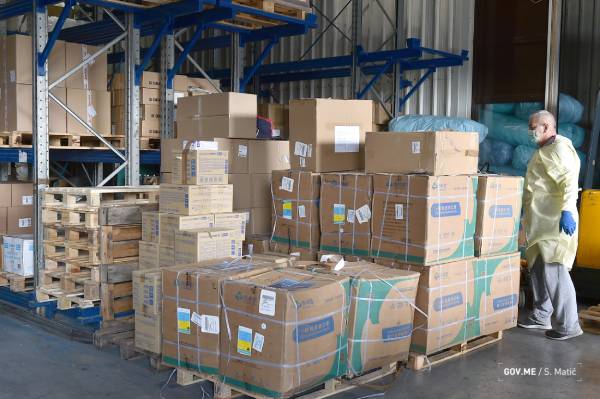
Donacije namjenski trošene u Nikšiću, Berane i Bar bez odgovora
Direktor Opšte bolnice Nikšić Marko Mitrović potvrdio je “Vijestima“ da je 18. avgusta prošle godine toj ustanovi, inače kovid centru, sa računa NKT uplaćeno 400.000 eura po zaključku bivše vlade.
Mitrović je odgovorio da je novac namijenjen za rekonstrukciju odjeljenja pedijatrije, ali i medicinske aparate. Pojasnio je da je za nabavku ultrazvučnog kolor dopler aparata i sedam pacijent monitora za praćenje vitalnih funkcija potrošeno 67.096,92 eura. To se vidi i iz ugovora dostupnih na sajtu Direktorata za politiku javnih nabavki, koje je bolnica potpisala sa kompanijama “Urion“ i “Farmalab“.
Mitrović je rekao da će preostali novac da bude namjenski utrošen nakon sprovođenja otvorenog postupka za radove na rekonstrukciji Odjeljenja pedijatrije, na osnovu urađenog Glavnog projekta.
Ministarka zdravlja Jelena Borovinić Bojović krajem aprila u Skupštini je kazala da je 1,2 miliona eura sa računa nekadašnjeg NKT tokom predizborne kampanje otišlo u navodnu rekonstrukciju, obnovu i dijagnostička sredstva za određene bolnice, ali da ne postoji niti jedna uplatnica na kojoj piše svrha uplate.
To je demantovao poslanik opozicione Demokratske partije socijalista (DPS) Jevto Eraković koji je bio član nekadašnjeg NKT. On je istakao da su tri kovid bolnice, u Beranama, Baru i Nikšiću, dobile po 400.000 eura za medicinsku opremu.
“Vijestima” iz beranske bolnice nisu odgovorili na više mejlova, dok je iz barske bolnice krajem juna saopšteno da pripremaju odgovor i čekaju saglasnost Ministarstva zdravlja.
Put do skenera od 170 kilometara
Opšta bolnica u Pljevljima nije bila kovid centar, ali je tokom drugog talasa pandemije zbrinjavala pacijente sa kovidom-19. Ta ustanova je od novembra prošle godine bez skenera.
Direktor Saša Grbović “Vijestima“ je rekao da je bolnica imala samo jedan skener, proizveden prije 16 godina.
Ustanova je ovaj polovan aparat dobila kao donaciju 2009. godine. Skener je u kvaru već osam mjeseci, a građani su pokrenuli akciju skupljanja novca za aparat.
Grbović je istakao da je ove godine raspisan tender za nabavku katodne cijevi koja košta 85.000 eura i da za se za ove aparate više ne proizvode rezervni djelovi.
Dok menadžment ustanove očekuje pozitivan odgovor Ministarstva zdravlja za nabavku novog skenera, stanovnike Pljevalja na snimanje šalju u podgorički Klinički centar, koji je od njihove opšte bolnice udaljen voše od 170 kilometara.
I stanovnici Herceg Novog već mjesecima moraju da putuju četrdesetak kilometara da bi im radiolozi snimili pluća ili neki drugi organ skenerom u Opštoj bolnici Kotor. Oni na raspolaganju nemaju državnu bolnicu, već im određene zdravstvene usluge, po ugovororu sa Fondom za zdravstveno osiguranje, pruža privatizovana ustanova - nekadašnja Vojna bolnica.
I tokom zimskih mjeseci, kada je stanovništvo Herceg Novog bilo pogođen koronavirusom, u ovoj opštini bilo je nemoguće uraditi pregled skenerom, kako hitnim, tako i pacijentima koji su preležali kovid-19. Građani, ali i ljekari, tada su se žalili na nedostatak kadra i opreme.
Medicinska direktorica Opšte bolnice Meljine Olivera Elez “Vijestima“ je potvrdila da je oprema koju ustanova posjeduje nedovoljna, a dijelom i ne zadovoljava savremene zahtjeve medicinske struke.
“Opšta bolnica Meljine godinama funkcioniše u otežanim uslovima. Po ugovoru koji bolnica ima sa Fondom, u obavezi je da pruža sve usluge građanima Herceg Novog iz oblasti interne medicine, hirurgije, genekologije sa akušerstvom, otorinolaringologije, kao i za sve građane iz oblasti hiperbarične terapije i rehabilitacije kardiovaskularnih bolesnika. U bolnici se, takođe, obavlja skrining kolorektalnog karcinoma za Boku. Pored ovoga, OB Meljine zbrinjava hitna stanja svih građana i turista koji se zateknu na teritoriji Opštine Herceg Novi a potrebna im je hitna medicinska pomoć. Sve ove usluge bolnica pruža u izuzetno otežanim uslovima, uz stalni nedostatak ljekarskog i srednjeg medicinskog kadra“, pojasnila je Elez.
Ona je odgovorila da je uz pomoć donacija firmi, građana Herceg Novog i njihovih partnera nabavljen dio opreme - jedno sanitetsko vozilo, aparat za gasne analize, a u skorije vrijeme očekuje se i spirometar i novi CTG aparat za porodilište.
Bolnica Meljine, kako kaže, nije bila predviđena za liječenje pacijenta oboljelih od kovida-19 upravo zbog ovih teškoća, ali je bila uklučena u borbu protiv epidemije, tako što su iz okolnih bolnica u Nikšiću, Kotoru, Baru i Cetinju premještani pacijenti koji nisu više bili infektivni, ali im je i dalje bio potreban bolnički tretman.
“Bez obzira na angažman našeg osoblja ova situacija je ponovo dokazala da je neophodno obezbjeđivanje savremene opreme a pogotovo dijagnostike bez koje nije moguće kvaliteno i blagovremeno zbrinjavanje pacijenata. U eri kada je CT pregled postao neohodna metoda u dijagnostici mnogih stanja bolnica Meljine nema skener aparat, a i čitava radiološka dijagnotika zahtjeva obnovu i digitalizaciju, pri čemu neophodnost pokretnog rendgen aparata nije potrebno naglašavati“, odgovorila je Elez.
Potrebni anesteziolozi, maske, PCR laboratorije...
U Sindikatu doktora medicine (SDM) smatraju da iskustvo iz prošla dva talasa korona virusa treba iskoristiti da se pripremimo za narednu krizu, ako se ponovi početkom jeseni.
“Ovo vrijeme upravo treba iskoristiti za osnaživanje slabih tačaka. Najneophodnije je obezbijeđivanje dovoljne količine lične zaštitne opreme, dakle, dovoljnog broja visokofiltracionih maski, zaštitnih mantila, skafandera i rukavica, kao i dovoljne količine dezinfekcionih sredstava koja su sertifikovana i pouzdana, kao i medijuma za PCR testiranje koji su od početka pandemije često bili deficitarni“, rekla je “Vijestima“ članica Glavnog odbora SDM Milena Petrović.
Ona smatra da državi najviše nedostaje visokokvalifikovani kadar - anesteziolozi intenzivisti, koji se ne mogu usavršiti preko noći.
“Iz tog razloga je neophodna adekvatna priprema za novi talas, kako bi sa kadrom sa kojim raspolažemo mogli pružiti kvalitetan odgovor“, rekla je ona.
Petrović je kazala da iz tog razloga vrijedi napraviti i sprovoditi akcioni plan, na nivou države koji bi bio usklađen i koordinisan sa Institutom za javno zdravlje.
“Vjerujem da se nije iskoristio potencijal digitalnih rješenja, koja se mogu primijeniti za praćenje kontakta i građana koji su u izolaciji, pri čemu bi se građani sami mogli prijavljivati, a na taj način bi epidemiolozi lakše mogli dobiti potrebne podatke, i spriječilo bi se zakrčenje zdravstvenog sistema. Preko digitalne platforme treba obezbijediti sve potrebne informacije za građane. U procesu praćenja kontakta može se angažovati i kadar koji nije visokokvalifikovan, studenti ili volonteri, ali koji je edukovan da na kvalitetan način obavlja ovaj posao. Postojalo je zakrčenje telefonskih linija, što se pokazalo kao slaba tačka prikliko odgovora na pandemiju, koja je i danas problem. Iz tog razloga potrebno je telefonske linije obezbijediti u većem broju“, poručila je ona.
Petrović je kazala da je često dolazilo do zastoja u radu što se tiče PCR testiranja, koji se u javnim zdravstvenim ustanovama obavlja samo u Podgorici i Kotoru.
“Laboratorija Tehnopolisa u Nikšiću jedan je od neiskorišćenih resursa u toku ove pandemije, koju treba opremiti kadrom. Dakle, što prije treba započeti sa edukacijom kadra koji bi radio na testiranju, kako bi spremni ušli u jesenji period“, naglasila je.
Mentalno zdravlje, kako tvrdi ona, trpjelo je i dalje trpi i zato je potreban veći broj linija koje se bave psihološkom podrškom, ali i koje su uvezane sa socijalnim službama, Crvenim krstom i nevladim organizacijama koje se bave psihosocijalnom, zaštitom od porodičnog nasilja i zaštitom prava i potreba ljudi koji spadaju u ranjive kategorije.
Srbija gradi kovid bolnice
Iako je najpogođenija zemlja koronavirusom u Evropi, sa više od 16.000 oboljelih na 100.000 stanovnika od početka pandemije, Crna Gora za 16 mjeseci nije izgradila niti jednu novu bolnicu za smještaj kovid pozitivnih pacijenata.
Susjedna Srbija, koja je na sedmom mjestu po ovom kriterijumu u Evropi, izgradila je u međuvremenu dvije kovid bolnice. Prvo je početkom decembra prošle godine otvorena ustanova u Batajnici, a samo izgradnja koštala je, prema tvrdnjama nadležnih, oko 27 miliona eura. Nova bolnica u Kruševcu, čija je izgradnja koštala oko 14,6 miliona eura, završena je za četiri mjeseca i prve pacijente primila je krajem prošle godine. Izgradnja nove kovid bolnice u Novom Sadu počela je prije tri mjeseca, a najavljeno je da će imati 624 kreveta i tri glavna objekta - dijagnostički centar, intenzivnu i poluintenzivnu njegu.
Bivša Vlada jedva dala pola novca za druge vakcine i materijal
Zdravstvena ustanova Apoteke Crne Gore “Montefarm“ tražila je početkom novembra prošle godine od odlazeće Vlade 1,64 miliona eura za nabavku novih količina vakcine protiv gripa i medicinske zaštitne opreme za period od četiri mjeseca. Na dopise im niko nije odgovorio skoro mjesec, pa su zamolili državne zdravstvene ustanove (domove zdravlja i bolnice) da dodatne doze vakcina i zaštitnu opremu protiv koronavirusa nabave sami.
Iz bivše Vlade i NKT koji je bio pred gašenjem nikada nisu odgovorili zašto nijesu obezbijedili 1,64 miliona eura, u trenutku kada su na računu za donacije milioni. “Montefarm“ je tražio novac za 10.000 doza vakcine protiv gripa, 5.000.000 komada nitrilnih nesterilnih rukavica, 400.000 pari hirurških rukavica, po 200.000 komada jednokratnih zaštitnih odijela i jednokratnih vodootpornih mantila.
Fond za zdravstveno osiguranje početkom decembra odlučio je da za ovu hitnu nabavku preusmjeri iz budžeta 700.000 eura namijenjenih za nabavku vakcine protiv humanog papiloma virusa (HPV), koja sprečava obolijevanje od karcinoma grlića materice.
HPV vakcinacija odložena je zbog kovida za ovu godinu i, prema tvrdnjama Ministarstva zdravlja, trebalo bi da počne na jesen.
Ana KOMATINA
Privreda traži kredite i subvencije da bi se povećao broj novih radnih mjesta.Iz Ministarstva ekonomskog razvoja očekuju da će mjera oslobađanja dijela plaćanja poreza i doprinosa smanjiti nezaposlenost
Od početka pandemije koronavirusa u Crnoj Gori broj nezaposlenih je povećan sa 35 hiljada, koliko je iznosio na kraju marta prošle godine, na 56 hiljada koliko ih ima na evidenciji Zavoda za zapošljavanje krajem maja ove godine. Istovremeno broj zaposlenih, prema Upravi za statistiku Monstat, je smanjen sa 187 na 151 hiljadu, odnosno izgubljeno je 20 odsto ili svako peto radno mjesto.
Iz Unije poslodavaca(UPCG) smatraju da je put za oporavak privrede dalje imunizacija građana, uspješna turistička sezona, ali i nastavak subvencija privredi kako bi se povećao broj radnih mjesta.
U cilju smanjenja nezaposlenosti Vlada i Ministarstvo ekonomskog razvoja (MER) su kroz drugi paket mjera predvidjeli subvencije za nova zapošljavanja kroz smanjenje dažbina, ali ta mjera još nije zaživjela jer se čekalo na usvajanje i stupanje na snagu izmjena zakona o porezu na dohodak i doprinosa na obavezno socijalno osiguranje što je završeno početkom juna.
Podsticaji za nova zapošljavanja
Iz MER-a očekuju da će nove podsticajne mjere, koje se primjenjuju od 10. juna dovesti do rasta zapošljavanja. Podsticaji za novozaposlene radnike važe od 1. januara ove godine, a omogućavaju oslobađanje od plaćanja dijela poreza na dohodak fizičkih lica i doprinosa za PIO na teret poslodavca i zaposlenog od 90 odsto za 2021. godinu, 60 odsto za 2022. i 30 odsto u 2023. godini.
„Nova zakonska rješenja propisuju obavezu poslodavca, koji je zainteresovan za oslobađenje od plaćanja dijela poreza i doprinosa, da podnese Upravi prihoda i carina zahtjev i dokaze o ispunjenosti uslova koji su u zakonima propisani. Imajući u vidu da je mjera Vlade za nova zapošljavanja aktivna 20-ak dana, a da Upravi prihoda i carina tek pristižu zahtjevi za oslobađanje od plaćanja dijela poreza na dohodak fizičkih lica i doprinosa za PIO, nije realno u ovom momentu govoriti konkretno o brojkama koje su rezultat novih zakonskih rješenja, a efekti od mjere se očekuju u narednom periodu”, objasnili su u MER-u.
Oni navode da su u kontiuniranoj komunikaciji sa privredom i da očekuju da će se za poreske olakšice prijaviti veliki broj poslodavaca.
„Nakon sprovedene procjene efekata od primjene novih zakonskih rješenja, imaćemo realniju sliku o rezultatima sprovedenih mjera u praksi, te u skladu sa tim ćemo reagovati ako bude potrebe za dodatnim promovisanjem. Ova mjera je snažan podsticaj zapošljavanju, a očekujemo da će se na osnovu ovih povoljnosti smanjiti nezaposlenost”, naveli su iz Ministarstva.
Prema rezultatima istraživanja UPCG gotovo 90 odsto preduzeća je u drugoj polovini prošle godine zabilježila pad prihoda, koji je prosječno na nivou uzorka iznosio 47 odsto. To pokazuje da su privrednici ostvarili tek polovinu prihoda koji je evidentiran u istom periodu 2019. godine.
Nastaviti antikrizne mjere
„Iako se epidemiološka situacija u međuvremenu značajno promijenila, moramo biti svjesni da je pandemija ostavila izuzetno teške posljedice po našu privredu i zato je veoma teško, a i nezahvalno, baviti se projekcijama daljih ekonomskih kretanja i predviđati moguću dinamiku oporavka privrede i vraćanja poslovanja u redovne tokove. Oštar pad privrednih aktivnosti, praćen potresima za cijelo društvo, proizveo je brojne negativne efekte koji nisu privremeni, već će se osjećati na duži rok”, rekli su za “Vijesti” iz UPCG.
Oni navode da ih ohrabruju podaci o turističkoj posjeti, ali da je za pun oporavak privrede, na nivou prije korone potreban duži period, pri čemu se za pojedine sektore - poput turizma, prema prognozama, to ne može desiti prije 2023. godine.
„Zato treba nastaviti sa anktikriznim mjerama Vlade za podršku privredi, dodatno intezivirati započete ekonomske reforme, snažnije raditi na izgradnji stabilnog i podsticajnog biznis ambijenta, te omogućiti da se opštine aktiviraju po pitanju ukidanja ili značajnog smanjenja troškova koji opterećuju poslovanje preduzeća i očuvanje radnih mjesta u njima. Sve to treba da prate odgovarajuće politike i mjere koje će doprinijeti zelenoj i digitalnoj tranziciji naše privrede, kao i snažnijem povezivanju turizma i poljoprivrede. Osnov daljeg djelovanja mora biti rad na uklanjanju biznis barijera, kao i udružen nastup svih segmenata društva u borbi protiv koronavirusa. Ovo posebno zbog činjenice da ekonomska kriza u Crnoj Gori još nije završena, niti su zdravstveni rizici pandemije u potpunosti eliminisani”, smatraju iz UPCG.
Oni kažu da sada stabilna epidemiološka situacija u zemlji kao i podaci o vakcinaciji 30 odsto punoljetnih građana, nosi izvjesnu dozu optimizma, kao i da liberalnije epidemiološke mjere pogoduju obavljanju privrednih djelatnosti i oporavku privrede.
Evropska komisija za ovu godinu predvidjela je rast crnogorske ekonomije za 7,1 odsto u odnosu na prošlu godinu, dok je Evropska banka za obnovu i razvoj u svom izvještaju krajem juna procijenila da će rast iznositi 8,5 odsto.
„Iako zdravstveni rizici još postoje ove prognoze ohrabruju, ali i govore da privredi treba obezbijediti još snažniju podršku za očuvanje likvidnosti i radnih mjesta, što znači da se od nadležnih očekuje da osiguraju mjere koje su privrednici prepoznali kao najneophodnije, poput subvencija na zarade zaposlenih i finansijske podrške, odnosno, mogućeg kreditiranja preko Investiciono-razvojnog fonda (IRF) ili komercijalnih banaka”, naveli su iz UPCG.
Vlada je dva puta od početka godine pomagala ranjive kategorije sa jednokratnom novčanom pomoći od 50 do 100 eura. Isplaćivana je novčana pomoći za korisnike materijalnog obezbjeđenja i lične invalidnine, kao i penzionere koji primaju iznos penzije do 222 eura, kao i za nezaposlene na evidenciji Zavoda za zapošljavanje. Ukupan broj korisnika podrške bio je 96.495, a podržani su sa 6.131.500 eura.
Polovina domaćinstava lošije živi
Prema podacima Unije slobodnih sindikata (USS) z ankete koju su sproveli krajem aprila ove godine na pitanje kako ocjenjuju ekonomsku situaciju u kojoj se nalazi njihovo domaćinstvu u odnosu na period prije pandemije, 47,3 odsto anketiranih je odgovorilo da je ostala ista, 31,3 odsto da se donekle pogoršala a 16,6 odsto da se značajno pogoršala. Da su im se ekonomske mogućnosti tokom panedmije značajno poboljšale saopštilo je 0,6 odsto anketiranih, a da su se donekle poboljšale još 4,3 odsto.
Od ukupno 1.010 ispitanika, koji su u toku ankete bili u radnom odnosu, 28,9 odsto je saopštilo da su im tokom pandemije smanjenje zarade. Da su imali niži obim posla izjasnilo se 31,2 odsto, a da se povećao 25,8 odsto anketiranih.
Da je njihov poslodavac imao prekide u radu navelo je 34,8 odsto, na rad od kuće prešlo je 19,3 odsto dok je neku drugu drugačiju organizaciju radnog vremena imalo 56,3 odsto anketiranih.
Statistika lijepo slika
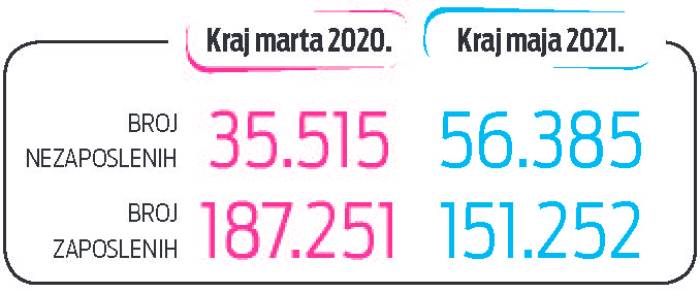
Zvanična crnogorska statistika zna da na prvi pogled bude suprostavljena samoj sebi, poput podatka da se u periodu od aprila prošle do kraja maja ove godine na evidenciju nezaposlenih prijavilo 11 hiljada građana koji su prethodno dobili otkaz ili im je raskinut ugovor, a da je u istom periodu broj zaposlenih smanjen tri puta više - 36 hiljada. Čudno zvuči i zvanični podatak da je u kriznoj 2020. godini, bilo više zapošljavanja nego u rekordnoj 2019.
Iz Zavoda za zapošljavanje, nezvanično pojašnjavaju, da je tačno da je u ovom periodu 11 hiljada novo prijavljenih nezaposlenih navelo da je prethodno dobilo otkaz ili im je istekao neki od ugovora o radu. Iako nije obavezno da se osoba kojoj je prestao radni odnos prijavi na biro za zapošljavanje, većina to uradi kako bi dobijala naknadu.
„Nekoliko puta je Vlada u ovom periodu više puta dijelila jednokratnu novčanu pomoć nezaposlenima na evidenciji, ili su smanjivani računi za električnu energiju. Kada bi se ta pomoć najavila imali smo ogroman rast prijava. To su vjerovatno osobe koje ne traže zaposlenje, rade negdje na crno ili ih izdržava neko drugi, ali su se tada prijavili zbog te pomoći. To značajno povećava ukupan broj nezaposlenih, jer istovremeno nismo sprovodili restriktivnu politiku brisanja sa evidencije”, naveli su iz Zavoda
Nevjerovatno zvuči i podatak, kojeg je Zavod za zapošljavanje dobio od Uprave prihoda i carina, da je tokom 2020. godine bilo prijavljeno 13.664 novih zapošljavanja, a da ih je u 2019. bilo 13.314. Takođe od početka ove godine do kraja maja bilo je 5.438 zapošljavanja, a u istom periodu 2019. godine 4.978.
Kako je moguće da je u periodu korone bilo više zapošljavanje nego u rekordnoj 2019, nezvanično objašnjava sagovornik iz “Vijesti” Zavoda, koji kaže da se veći broj poslodavaca, nego što je uobičajeno, zbog neizvjesnosti poslovanja opredjeljivao da radnike angažuje na po mjesec.
“Svaki novi ugovor za sljedeći mjesec formalno je značio novo zapošljavanje. Takođe, pad broja zaposlenih u ovom periodu za 36 hiljada, ne znači da je toliko bilo otkaza, već da neke grupe radnika nisu angažovane. Na primjer 2019. godine imali smo kvote za 20 hiljada stranih radnika, koji su bili u ukupnoj brojci zaposlenih, a tokom pandemije prošle godine nisu angažovani jer mnogi turistički objekti nijesu ni radili a za ostale je većinom bilo dovoljno domaće radne snage”, objašnjava sagovornik “Vijesti”.
I izbori održani u 2020. godinu su, prema za sada još nezvaničnim podacima, „značajno uticali” na rast zapošljavanja naročito u javnom sektoru.
Marija MIRJAČIĆ

 English
 Facebook
 Youtube
 X (Twitter)
 Instagram
2023, Centar za istraživačko novinarstvo CG - Sva prava zadržana